Magic mushroom
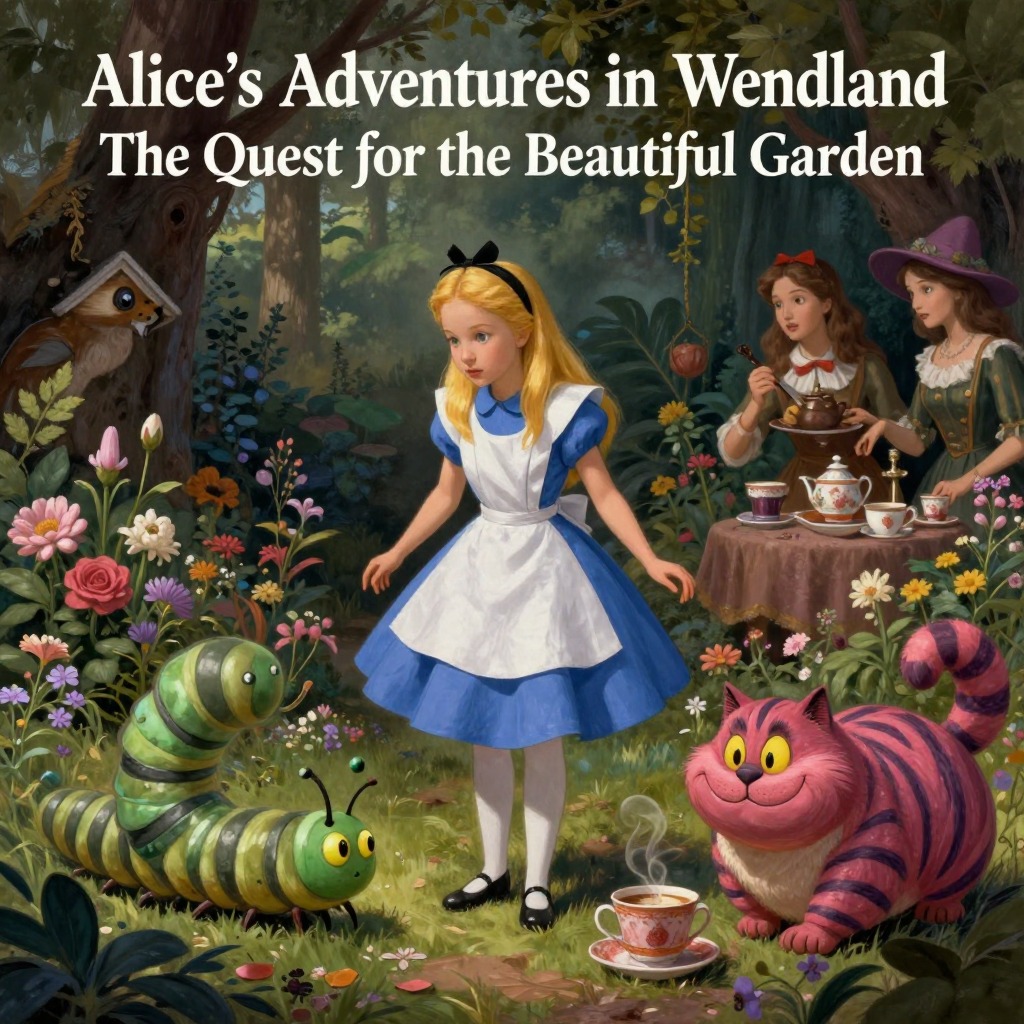
Alice's Adventures in WonderlandThe Magic mushroom is the central device through which Alice gains agency over her bewildering transformations in Wonderland, transforming her from a passive victim of random size changes into an active, if imperfect, manager of her own body. First encountered in a wood after her escape from the White Rabbit's house, the mushroom sits about the same height as Alice herself, and atop it sits a large blue Caterpillar, quietly smoking a long hookah. This meeting initiates Alice into the mushroom's secret power and sets the course for her subsequent adventures.
Identity and Discovery
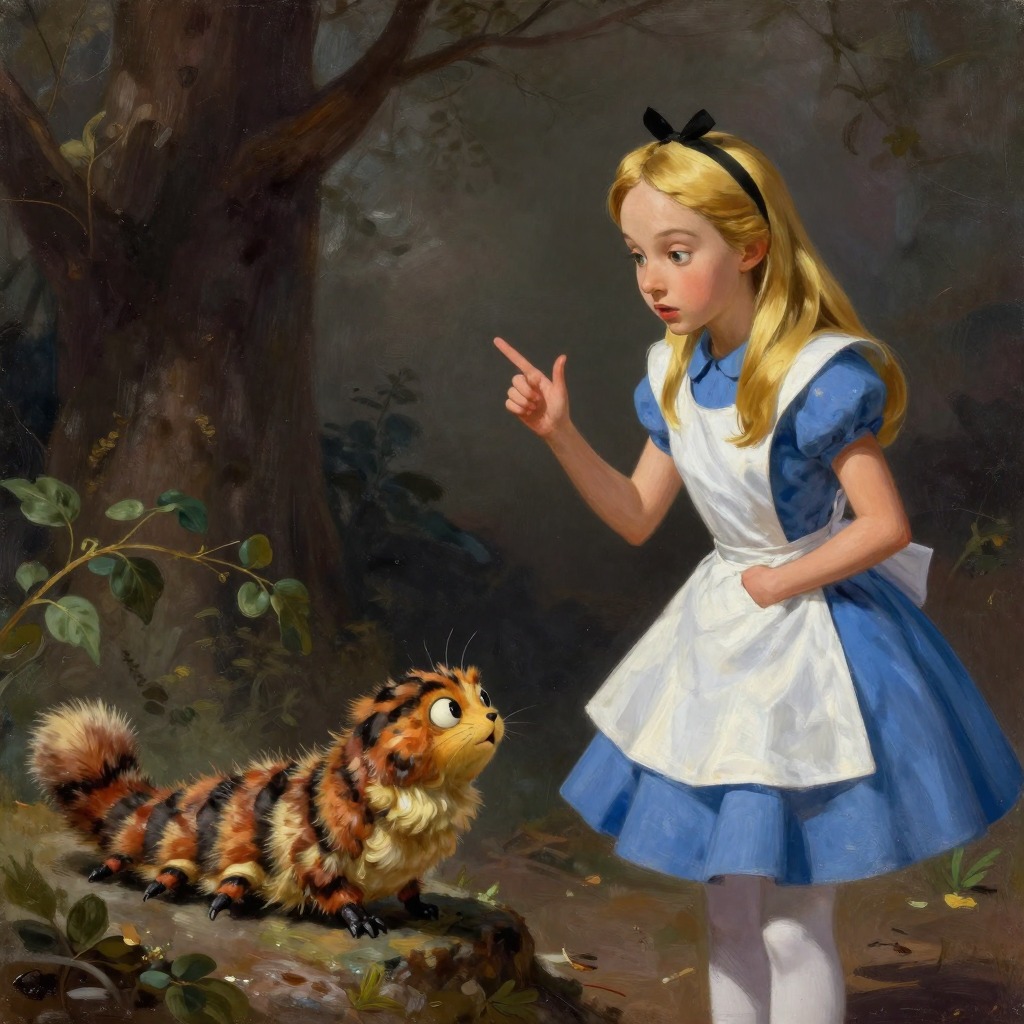
The mushroom appears in a wood where Alice has wandered after shrinking herself with a cake and fleeing a crowd of animals. She notices a large mushroom growing near her, about the same height as herself, and when she stretches up on tiptoe and peeps over its edge, her eyes meet those of a large blue Caterpillar sitting on the top with its arms folded, quietly smoking a long hookah. The Caterpillar takes no notice of her at first, but after a long, silent mutual inspection, it addresses her in a languid, sleepy voice. Their conversation is a test of identity and patience: the Caterpillar repeatedly asks "Who are you?" and Alice, unable to give a stable answer, confesses that she has been changed several times since that morning. The Caterpillar's curt, contradictory remarks frustrate her, but before it crawls away into the grass, it delivers the crucial information: "One side will make you grow taller, and the other side will make you grow shorter." Alice, left alone, must determine which side is which.
Operation and First Experiments
Alice finds the mushroom perfectly round, making it difficult to distinguish its two sides. She stretches her arms around it as far as they will go and breaks off a bit of the edge with each hand. Nibbling the right-hand bit first, she feels a violent blow underneath her chin: it has struck her foot, meaning she has shrunk dramatically. Frightened by the sudden change, she quickly eats some of the left-hand bit, but her chin is pressed so closely against her foot that she can barely open her mouth. She manages to swallow a morsel, and after a series of asterisks marking a passage of time, she finds her head free at last—but her shoulders are nowhere to be seen. Looking down, she sees an immense length of neck rising like a stalk out of a sea of green leaves far below. Her neck bends easily in any direction, like a serpent, and she is about to dive among the leaves—which are actually the tops of trees—when a large Pigeon flies into her face, beating her violently with its wings and mistaking her for a serpent. After a tense exchange, Alice remembers she still holds the pieces of mushroom. She nibbles carefully, first at one piece then the other, growing sometimes taller and sometimes shorter, until she succeeds in bringing herself down to her usual height.
Strategic Use and Mastery
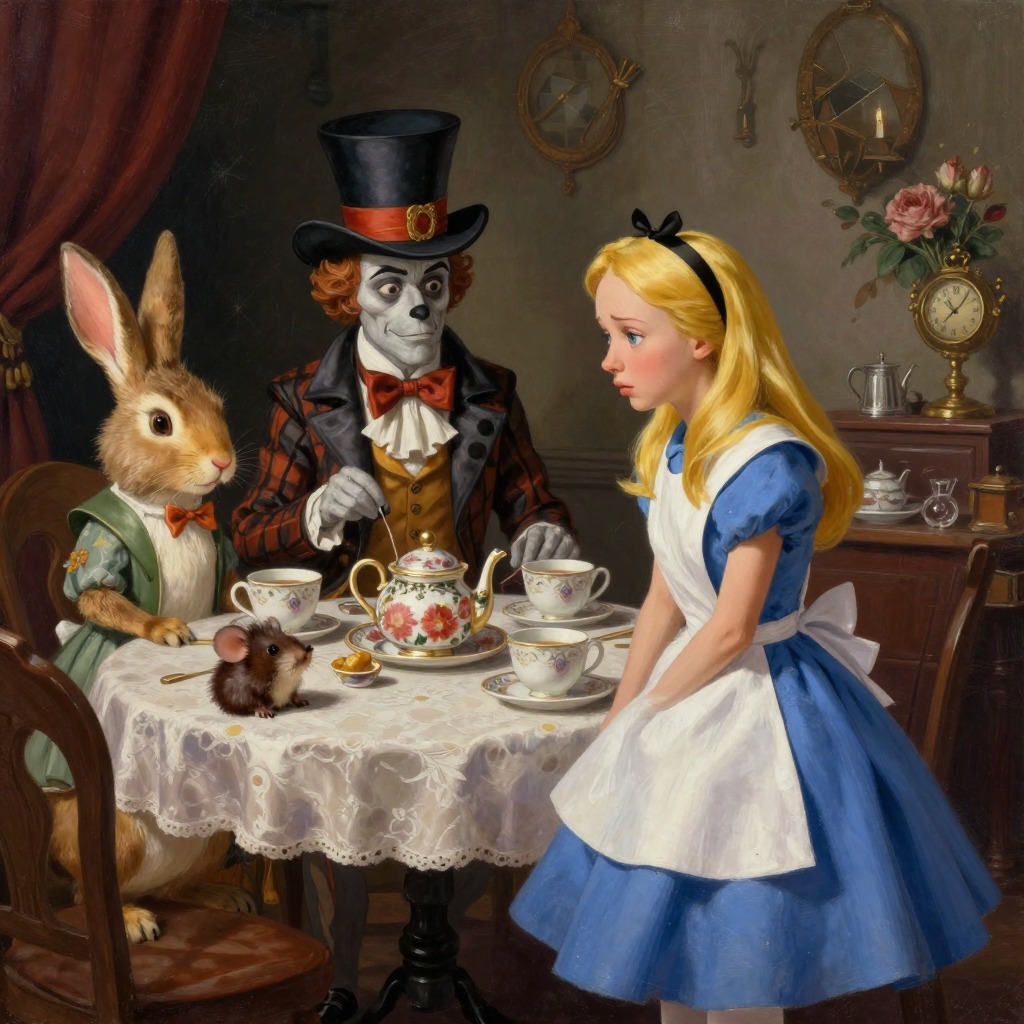
Having regained her normal size, Alice feels strange at first but soon grows accustomed to it. She realizes that half her plan is done: she is back to her right size, and the next step is to enter the beautiful garden. As she speaks, she comes upon an open place with a little house about four feet high. Deciding she must not approach the inhabitants at her current height, she nibbles the right-hand bit again, shrinking herself to nine inches high before venturing near the house. Later, when she reaches the March Hare's house—a large building with chimneys shaped like ears and a roof thatched with fur—she again uses the mushroom, nibbling more of the left-hand bit to raise herself to about two feet high before approaching. The mushroom remains in her pocket as a portable resource. After the chaotic Mad Tea-Party, when Alice finds herself once more in the long hall with the little glass table, she takes the golden key, unlocks the door to the garden, and then goes to work nibbling the mushroom until she is about a foot high. She walks down the little passage and finally enters the beautiful garden among the bright flower-beds and cool fountains.
Thematic Significance
The Magic mushroom embodies the central theme of unstable identity and the struggle for control in Wonderland. Unlike the DRINK ME bottle and the EAT ME cake, which impose involuntary changes, the mushroom offers Alice a choice—but a confusing one, since she must discover which side does what through trial and error. The mushroom's power is not absolute; it requires careful, repeated adjustment, and Alice's experiments often lead to alarming results before she achieves her desired size. The mushroom also serves as a bridge between the arbitrary, rule-bound world of Wonderland and Alice's own desire for order and predictability. By carrying a piece of it in her pocket, she carries a fragment of control over her own body, a rare commodity in a land where size, language, and logic are constantly shifting. The mushroom's dual nature—one side for growth, one for shrinkage—mirrors the binary choices that structure Alice's journey: up or down, in or out, sane or mad. In the end, the mushroom is the tool that allows her to enter the garden, the goal she has pursued since the beginning, and it remains with her as a symbol of the precarious agency she has won through persistence and ingenuity.