Parchment scroll
Alice's Adventures in WonderlandThe Parchment scroll is the formal instrument of accusation in the trial of the Knave of Hearts, a document that the White Rabbit carries into the Queen of Hearts' court and reads aloud to the assembled company. It is the physical embodiment of the legal proceedings that dominate the final two chapters of Alice's adventures, and its contents—a set of cryptic verses—become the focus of the King's interrogation and Alice's defiance. The scroll's function is not to convey clear evidence but to expose the absurdity of a judicial system where the Queen demands sentence before verdict and the King interprets nonsense as proof of guilt.
Appearance and Role in the Court
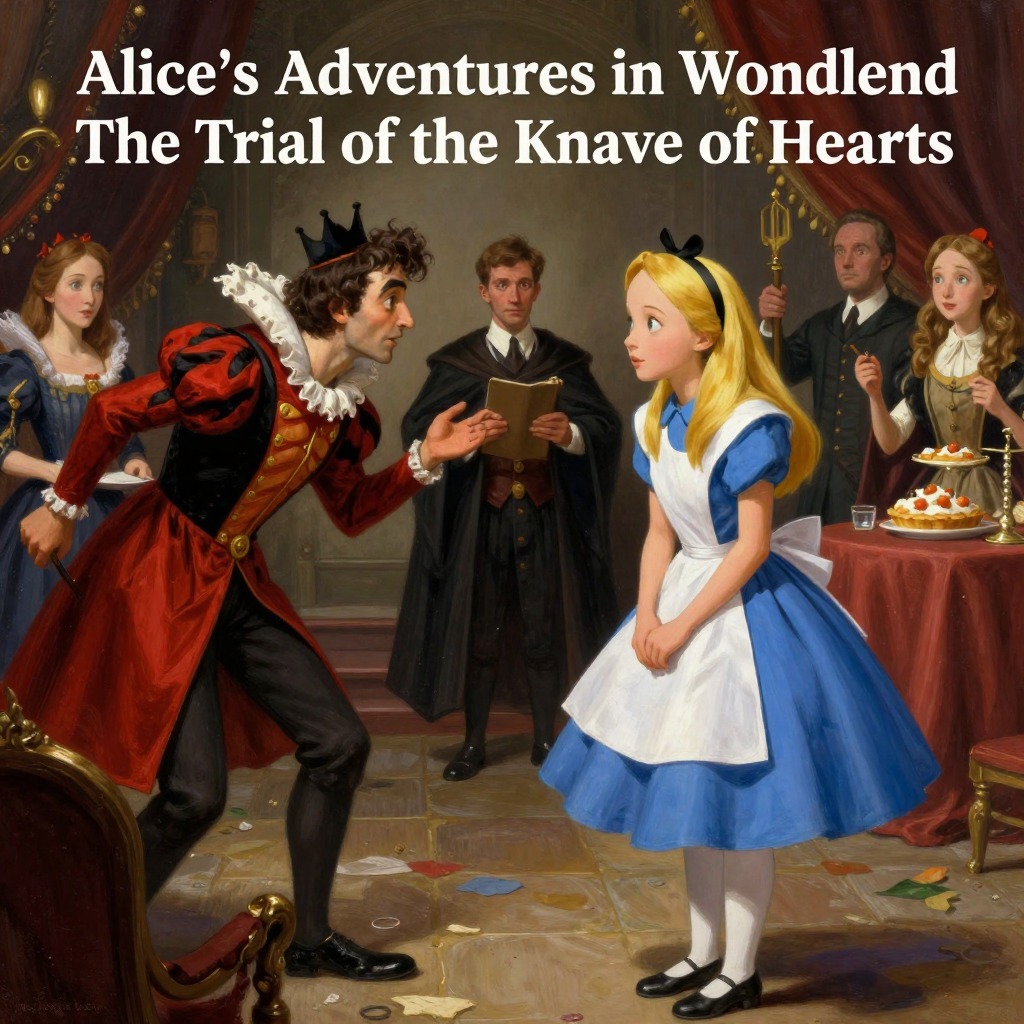
The Parchment scroll first appears in the courtroom scene, where the King and Queen of Hearts are seated on their throne, surrounded by a great crowd of birds, beasts, and the whole pack of cards. The Knave stands before them in chains, guarded by soldiers, and near the King is the White Rabbit, holding a trumpet in one hand and the scroll of parchment in the other. In the middle of the court stands a table with a large dish of tarts, the alleged stolen goods. The scroll is the formal accusation, and its reading is the first official act of the trial. The White Rabbit blows three blasts on the trumpet, then unrolls the parchment and reads the accusation in verse: "The Queen of Hearts, she made some tarts, / All on a summer day: / The Knave of Hearts, he stole those tarts, / And took them quite away!" This quatrain, simple and direct, is the entire basis of the prosecution's case.
The Verses and Their Interpretation
After the initial accusation, the White Rabbit produces a second document—a paper that has just been picked up—which he unfolds to reveal a set of verses. This paper, though not the original scroll, becomes the scroll's functional successor in the trial. The King immediately treats it as a letter written by the prisoner, but the White Rabbit notes that it is not directed to anyone and has nothing written on the outside. The verses themselves are a cryptic, circular narrative involving pronouns and ambiguous actions: "They told me you had been to her, / And mentioned me to him: / She gave me a good character, / But said I could not swim." The King, eager to find meaning, interprets the lines as a confession, pointing to the tarts on the table as proof. Alice, however, declares that there is not "an atom of meaning in it" and offers sixpence to anyone who can explain it. The jury writes down her statement but makes no attempt to decipher the verses.
The Scroll's Significance in the Trial's Collapse
The Parchment scroll and its associated verses are the catalyst for the trial's descent into chaos. The King's attempts to extract a coherent narrative from the verses only highlight the arbitrariness of the proceedings. He seizes on the line "said I could not swim" and asks the Knave if he can swim, receiving a sad shake of the head. He then interprets "I gave her one, they gave him two" as a reference to the tarts, ignoring Alice's objection that the next line says "they all returned from him to you." The Queen, impatient with the legal process, demands "Sentence first—verdict afterwards," a direct inversion of proper judicial order. Alice's loud refusal to accept this—"Stuff and nonsense!"—and her declaration that the court is "nothing but a pack of cards" trigger the final dissolution of the trial, as the entire pack rises into the air and flies down upon her. The scroll, which began as a solemn instrument of law, ends as a prop in a dream that dissolves upon waking.
The Scroll as a Symbol of Wonderland's Justice
The Parchment scroll is not merely a plot device but a symbol of the arbitrary and performative nature of justice in Wonderland. The accusation is a nursery rhyme, the evidence is a set of nonsensical verses, and the King's interpretation is driven by a desire to convict rather than to discover truth. The scroll's contents are never subjected to genuine scrutiny; instead, they are manipulated to fit the Queen's desire for executions. Alice's challenge to the meaning of the verses—and her ultimate rejection of the court's authority—marks her final assertion of rational order against the chaos of Wonderland. The scroll, like the trial itself, is a hollow form, a document that carries the weight of authority but no substance, and its failure to produce a coherent verdict mirrors the failure of Wonderland's entire system of rules and punishments.