We're all mad here
Alice's Adventures in WonderlandThe phrase "We're all mad here" is one of the most famous and philosophically dense lines in Lewis Carroll's Alice's Adventures in Wonderland. Uttered by the Cheshire Cat during his first conversation with Alice, it serves as both a diagnosis of Wonderland's fundamental nature and a justification for its inhabitants' illogical behavior. The statement does not merely describe a state of chaos but establishes a governing principle: in Wonderland, madness is the norm, and the only way to be sane is to be mad. This paradox becomes the lens through which Alice's subsequent encounters—with the Queen of Hearts' arbitrary executions, the Mad Tea-Party's nonsensical logic, and the trial's absurd legal proceedings—must be understood. The expression encapsulates the story's challenge to conventional reason, suggesting that the world Alice has entered operates on a different, self-consistent logic that defies the rules of the world she left behind.
Origin and Context of the Statement
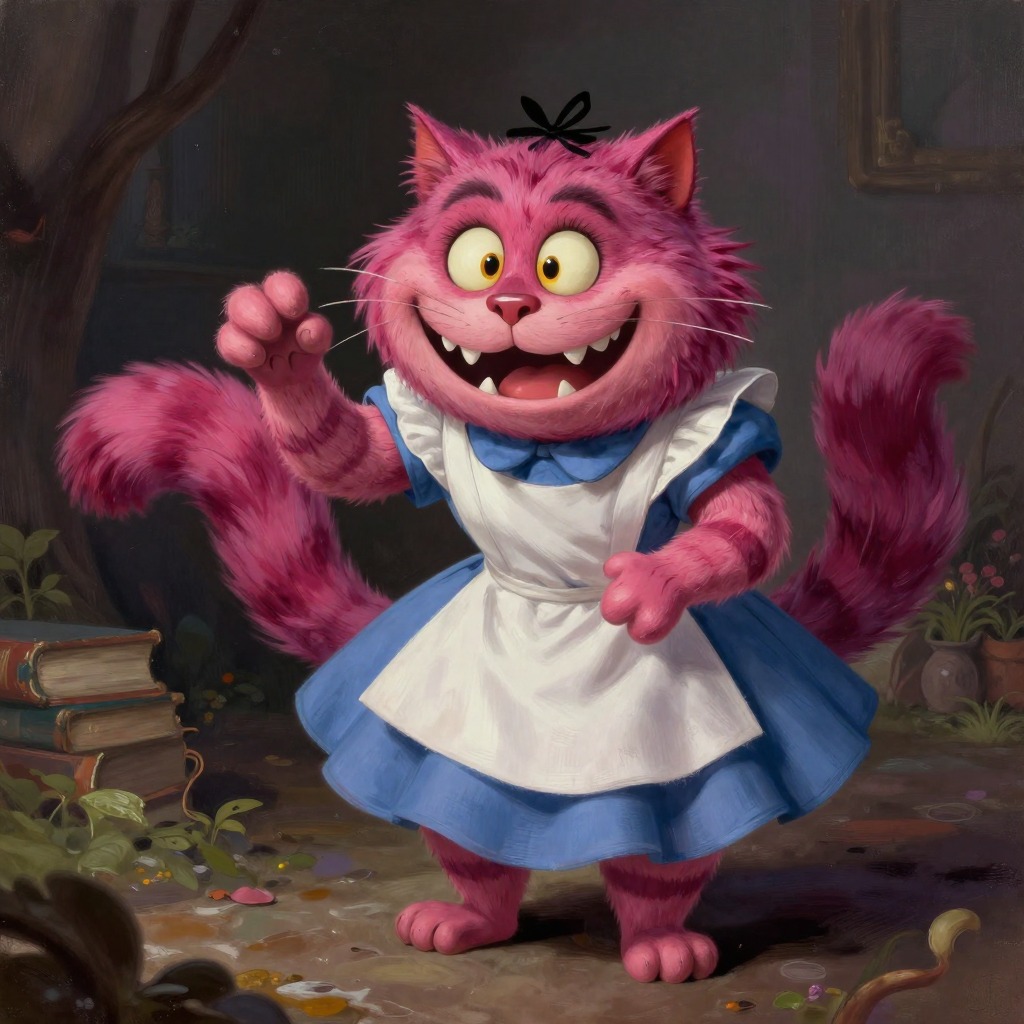
The Cheshire Cat introduces the idea of universal madness when Alice asks for directions. After telling her that a Hatter and a March Hare live nearby, the Cat warns that both are mad. When Alice protests that she does not want to go among mad people, the Cat replies, "Oh, you can't help that... we're all mad here. I'm mad. You're mad." When Alice asks how the Cat knows she is mad, the Cat answers, "You must be... or you wouldn't have come here." This exchange establishes that entering Wonderland itself is proof of madness, making the condition not a flaw but a prerequisite for membership in this world. The Cat then offers a logical proof of its own madness: a dog growls when angry and wags its tail when pleased, whereas the Cat growls when pleased and wags its tail when angry—therefore, it is mad. This syllogism, though absurd, follows a formal structure, demonstrating that Wonderland's madness has its own internal coherence.
The Queen of Hearts and the Logic of Arbitrary Power
The Queen of Hearts embodies the most violent and capricious application of Wonderland's mad logic. Her signature command, "Off with his head!" or "Off with her head!" is uttered repeatedly throughout the croquet game and the trial, often for trivial or imagined offenses. When the Queen first encounters Alice and the three gardeners, she screams for Alice's beheading simply for not knowing who the gardeners are. Alice's bold reply of "Nonsense!" silences the Queen momentarily, but the threat remains constant. During the croquet game, the Queen stamps about shouting executions "about once in a minute," and by the end of half an hour, all players except the King, the Queen, and Alice are in custody and under sentence of execution. The Queen's commands are performative speech acts that create reality through utterance, yet they are also hollow: the Gryphon later reveals that "they never executes nobody, you know," suggesting that the threat of execution is itself a mad ritual rather than a genuine practice. This contradiction—between the absolute power of the Queen's words and their lack of actual effect—mirrors the Cheshire Cat's definition of madness as a system that inverts normal expectations.
The Mad Tea-Party and the Inversion of Time
The Mad Tea-Party, hosted by the Hatter, the March Hare, and the Dormouse, is the most concentrated demonstration of Wonderland's mad social logic. The party is stuck in perpetual tea-time because the Hatter quarreled with Time himself at a concert given by the Queen of Hearts. When the Hatter sang "Twinkle, twinkle, little bat," the Queen shouted, "He's murdering the time! Off with his head!" Since then, Time has refused to do anything the Hatter asks, and it is "always six o'clock now." This explanation transforms a mundane social faux pas into a cosmic punishment, trapping the trio in an endless, circular meal where they must keep moving around the table to find clean cups. The party's logic is a parody of cause and effect: a musical performance leads to a quarrel with a personified abstraction, which results in an eternal tea-time. The riddles and wordplay that dominate the conversation—such as the Hatter's unanswerable riddle "Why is a raven like a writing-desk?" and the debate over whether "I see what I eat" is the same as "I eat what I see"—further illustrate a world where language itself has become unmoored from stable meaning. Alice's departure in disgust, declaring it "the stupidest tea-party I ever was at in all my life," underscores her inability to accept this mad social contract.
The Trial and the Collapse of Legal Reason
The trial of the Knave of Hearts, who is accused of stealing the Queen's tarts, represents the culmination of Wonderland's mad logic applied to institutional authority. The proceedings are a travesty of justice: the King, who serves as judge, wears his crown over his wig and invents rules on the spot, such as "Rule Forty-two. All persons more than a mile high to leave the court," which he then claims is "the oldest rule in the book." The evidence consists of a set of nonsensical verses that the King interprets as proof of guilt, while Alice points out that they have no meaning at all. The Queen insists on "Sentence first—verdict afterwards," a direct inversion of legal procedure. When Alice finally defies the Queen's command for silence, the Queen shouts "Off with her head!" but nobody moves. Alice, having grown to her full size, declares, "You're nothing but a pack of cards!" This moment of defiance is the ultimate rejection of Wonderland's mad authority: by naming the cards as mere objects, Alice breaks the spell of their power. The entire pack then rises into the air and flies down upon her, triggering her awakening from the dream. The trial thus demonstrates that Wonderland's madness, when pushed to its extreme, collapses under the weight of its own absurdity.
Thematic Significance: Madness as a Challenge to Reason
The expression "We're all mad here" functions as the story's governing premise, challenging the Victorian faith in rationality, order, and fixed identity. Throughout her adventures, Alice encounters characters who operate on logics that are internally consistent but externally absurd: the Caterpillar's contradictory commands, the Duchess's insistence that everything has a moral, and the Mock Turtle's educational system where lessons "lessen from day to day." Each encounter forces Alice to question her own sanity and identity, as when she wonders if she has been changed into Mabel or when she cannot remember her lessons correctly. The Cheshire Cat's statement that Alice must be mad to have entered Wonderland suggests that the boundary between sanity and madness is not absolute but depends on one's frame of reference. By the end of the story, Alice's assertion that the Queen and her court are "nothing but a pack of cards" represents a reassertion of her own rational perspective, but the dream framework leaves open the possibility that Wonderland's madness was, in fact, a valid alternative reality. The phrase thus encapsulates the book's enduring fascination with the limits of reason and the liberating potential of absurdity.