Why is a raven like a writing-desk?
Alice's Adventures in WonderlandThe riddle "Why is a raven like a writing-desk?" is the most famous unanswered question in Wonderland, posed by the Hatter at the Mad Tea-Party and later echoed in the trial, embodying the story's core logic of absurdity, the failure of language to communicate, and the inversion of meaning itself. It is a question that has no answer, yet it generates a cascade of logical play, puns, and social disruption, marking the point where Wonderland's nonsense becomes a deliberate, self-conscious performance.
Origin and Context at the Mad Tea-Party
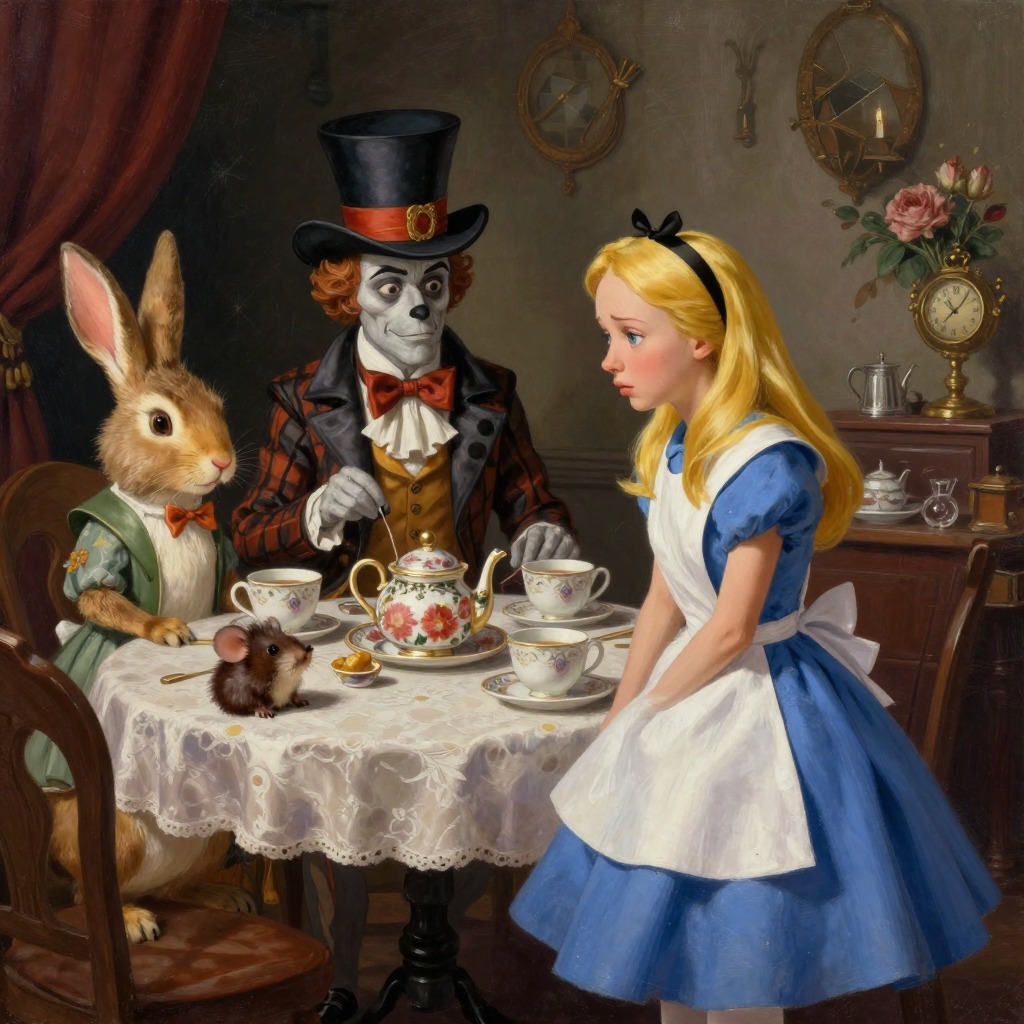
The riddle is first introduced by the Hatter during the chaotic tea-party under a tree, where the March Hare, the Hatter, and the Dormouse are crowded at one end of a large table. After Alice remarks that personal remarks are rude, the Hatter opens his eyes very wide and asks, "Why is a raven like a writing-desk?" Alice, glad for some fun, believes she can guess the answer. The March Hare immediately challenges her, insisting that she should "say what you mean," which leads to a rapid-fire exchange of logical paradoxes: the Hatter argues that "I see what I eat" is not the same as "I eat what I see," the March Hare offers "I like what I get" versus "I get what I like," and the Dormouse, talking in his sleep, adds "I breathe when I sleep" versus "I sleep when I breathe." The Hatter then declares that with the Dormouse it is the same thing, and the conversation drops into silence. Alice thinks over all she can remember about ravens and writing-desks, which is not much. The riddle is never answered; the Hatter later admits he has not the slightest idea of the answer, and the March Hare says the same. Alice sighs wearily, accusing them of wasting time asking riddles that have no answers.
The Riddle as a Catalyst for Absurdist Logic
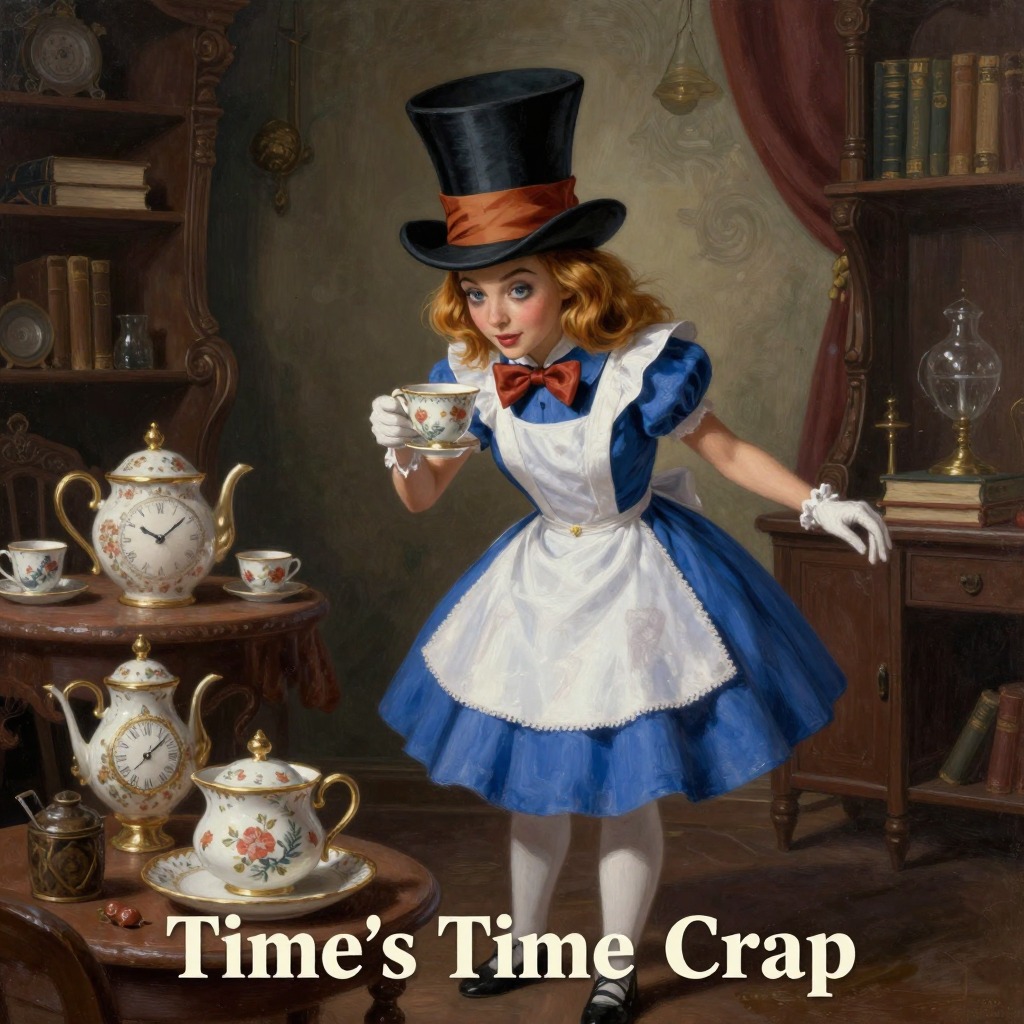
The riddle functions as a perfect example of the absurdist logic that governs Wonderland. It is not a genuine puzzle but a linguistic trap that exposes the arbitrary nature of language and meaning. The Hatter's follow-up remarks about Time—that he quarrelled with Time last March, that Time won't stand beating, and that it is always six o'clock now—are all extensions of the same principle: words and concepts are not fixed but can be twisted to produce any outcome. The riddle's lack of an answer is not a failure but a feature; it demonstrates that in Wonderland, questions can exist purely for their own sake, without resolution. This mirrors the broader structure of the story, where Alice's attempts to find order, rules, and meaning are continually frustrated by creatures who treat language as a game rather than a tool for communication.
Echoes in the Trial of the Knave of Hearts
The riddle's spirit resurfaces during the trial of the Knave of Hearts, when the King of Hearts attempts to interpret a set of nonsensical verses as evidence. The King mutters over the lines, trying to force them into a coherent narrative about the stolen tarts, but Alice interrupts to point out that the verses say "they all returned from him to you," which contradicts the King's interpretation. The King then declares that the words don't fit the Queen, and when there is a dead silence, he adds, "It's a pun!" in an offended tone, and everybody laughs. This moment is a direct echo of the riddle: a piece of language that resists stable meaning is treated as a joke, and the authority figure (the King) is exposed as unable to control interpretation. The riddle's unanswered status thus becomes a model for the entire trial, where evidence is meaningless, rules are invented on the spot, and the verdict is demanded before any reasoning can occur.
Thematic Significance: The Failure of Language and the Triumph of Nonsense
The riddle "Why is a raven like a writing-desk?" is the emblem of Wonderland's linguistic philosophy. It is a question that invites interpretation but refuses closure, forcing the listener to confront the limits of rational thought. The Hatter, the March Hare, and the Dormouse all participate in a performance of nonsense that is not chaotic but highly structured—each paradox builds on the previous one, and the riddle is the centerpiece. Alice's reaction—weariness, frustration, and a desire to leave—mirrors the reader's own experience of trying to make sense of a world that operates on different rules. The riddle's persistence in the story (it is never answered, even in the trial) suggests that Wonderland's power lies not in providing answers but in generating endless questions. It is a literary device that enacts the very absurdity it describes, making the form of the riddle identical to its content.
The Riddle's Legacy and the Queen's Fury
The riddle's unanswered nature is reinforced by the Queen of Hearts's characteristic response to any challenge: "Off with her head!" This command, repeated throughout the croquet game and the trial, is another form of linguistic absurdity—a sentence that cannot be executed because it is issued too frequently and without regard for reality. The Queen's fury at Alice's defiance, and Alice's final declaration that the Queen and her court are "nothing but a pack of cards," are the ultimate refutations of the riddle's logic: when language loses its connection to truth, authority collapses. The riddle thus stands as a key to understanding the entire narrative: it is a question that cannot be answered, and that is precisely the point.