the pool of tears
Alice's Adventures in WonderlandThe pool of tears is the first landscape Alice herself generates in Wonderland, a saltwater body born from her own weeping after she grows to nine feet high and finds herself too large to enter the garden. It is the setting for her initial encounters with several of Wonderland's creatures and for the Caucus-race, the first communal activity she participates in. The pool crystallizes the story's central paradox: Alice's emotional and physical transformations create the very obstacles she must then overcome, and the creatures she meets there treat her self-made predicament with the same matter-of-fact absurdity they apply to everything else.
Formation and Nature
The pool of tears comes into existence in the long hall after Alice, having grown to more than nine feet tall, realizes she cannot fit through the little door into the garden. She sits down and begins to cry, and despite scolding herself—"You ought to be ashamed of yourself, a great girl like you," she says—she continues until she has shed "gallons of tears." The result is a large pool about four inches deep that reaches halfway down the hall. When Alice later shrinks to about two feet high and then shrinks further, her foot slips and she finds herself up to her chin in salt water. At first she thinks she has fallen into the sea, but she soon realizes she is in the pool of tears she wept when she was nine feet high. The pool thus literalizes the emotional volatility that defines Alice's early experience in Wonderland: her tears, produced by frustration and helplessness, become a physical space she must swim through.
Inhabitants and Encounters
The pool is crowded with creatures that have fallen into it, including a Duck, a Dodo, a Lory, an Eaglet, and "several other curious creatures." Alice's first significant interaction in the pool is with the Mouse, whom she initially mistakes for a walrus or hippopotamus. She attempts to speak to it in Latin—"O Mouse"—and then in French—"Où est ma chatte?"—which frightens the Mouse because it hates cats. Alice's subsequent attempts to describe her cat Dinah's skill at catching mice offend the Mouse further, and it swims away. The Mouse only returns when Alice promises not to talk about cats or dogs, and it proposes that they all get to the shore, where it will tell its history. The pool thus serves as the stage for Alice's first lesson in Wonderland's social rules: her ordinary conversational topics—pets, domestic life—are deeply offensive here, and she must learn a new etiquette.
The Caucus-race and Aftermath
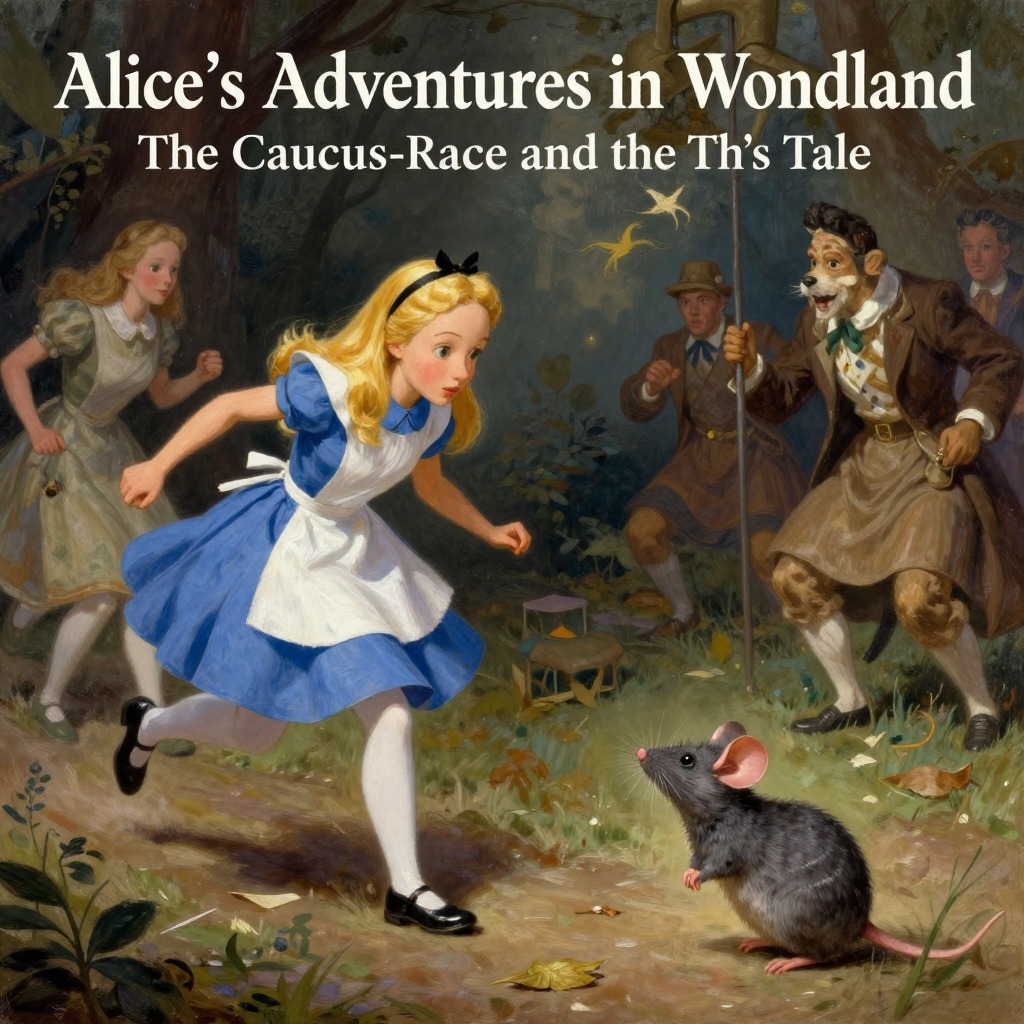
Once the party reaches the shore, the Dodo proposes a Caucus-race to dry everyone off. The race has no fixed start or finish: the participants begin running when they like and leave off when they like, and after about half an hour the Dodo declares the race over. When asked who has won, the Dodo announces, "Everybody has won, and all must have prizes." Alice distributes comfits from her pocket as prizes, and the Dodo solemnly presents her with a thimble she had also been carrying. The Caucus-race is the first organized activity Alice encounters in Wonderland, and its arbitrary rules—no clear winner, everyone gets a prize—establish the pattern of nonsensical yet rigidly observed procedures that will recur throughout her adventures. After the race, the creatures beg the Mouse to tell its story, but when Alice misinterprets its "long and sad tale" as a literal tail, the Mouse becomes offended and leaves. Alice's mention of Dinah's hunting prowess then frightens away the remaining birds and animals, and she is left alone again, crying from loneliness.
Thematic Significance
The pool of tears embodies the story's exploration of identity, scale, and consequence. Alice's tears are a direct result of her inability to control her size, and the pool they create becomes a space where she must confront the social and emotional consequences of her own actions. The creatures she meets there—the Mouse, the Duck, the Dodo—are not hostile but are governed by a logic entirely different from her own, and her attempts to communicate using the frameworks she knows (Latin grammar, French lessons, domestic anecdotes) fail repeatedly. The pool also introduces the motif of self-generated environments: Alice's emotional state literally reshapes the world around her, a pattern that continues with the pepper-filled kitchen of the Duchess and the chaotic croquet ground of the Queen of Hearts. When Alice later wakes from her dream, her sister imagines the pool of tears as part of the lingering dream-world, with the "frightened Mouse" splashing through it, suggesting that the pool remains a potent symbol of the emotional intensity and confusion of Alice's journey.