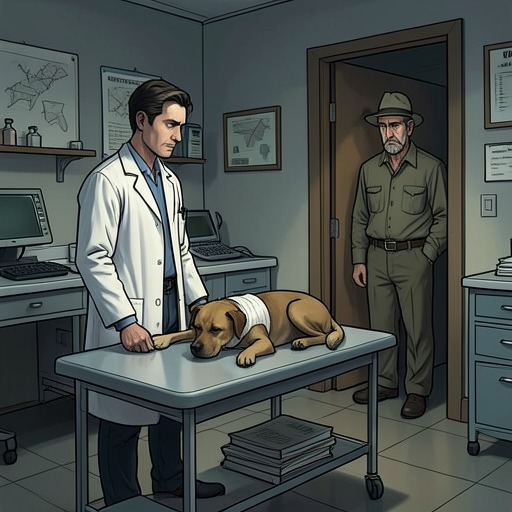
“Dinna meddle wi’ things ye ken nuthin’ aboot!”
All Creatures Great and Small“Dinna meddle wi’ things ye ken nuthin’ aboot!” is a vernacular admonition that turns a dangerous encounter into a lesson about the limits of knowledge. Spoken to James Herriot by the man whose intervention makes the horse release him, it is both a rebuke and a compact statement of practical authority: the speaker has understood what the situation requires, while Herriot has been caught in circumstances beyond his command.
Meaning and Form
The sentence is built as a direct prohibition. “Dinna” and “ye” give it a colloquial dialect voice, while “meddle” makes the fault not simply ignorance but acting where one lacks understanding. Its bluntness suits the immediate scene: it offers no abstract explanation, only a sharp boundary between knowing how to respond and interfering without the necessary knowledge.
The Immediate Scene
The phrase follows the intervention of a little man after a horse has trapped Herriot. The man applies pressure to the animal’s belly; the horse releases Herriot, who falls to his knees and takes time to recover his breath. From a distance, Herriot can still hear the man shouting the warning. The sequence lends the rebuke its force: it comes from someone whose practical action has just changed the outcome, not from a detached lecturer.
Practical Knowledge and Humility
The expression’s authority rests on the contrast between limited understanding and effective response. In this scene, the man’s knowledge is demonstrated through what he does, and the warning that follows makes the encounter a correction as well as a rescue. Elsewhere, James Herriot acknowledges uncertainty when comforting Miss Stubbs about whether her animals will accompany her after death, while grounding his reassurance in their capacity for love and loyalty. That later moment is not a repetition of the expression, but it offers a counterpoint: knowing the limits of what can be claimed need not prevent humane action. Together, the scenes distinguish careless interference from an honest recognition of uncertainty.