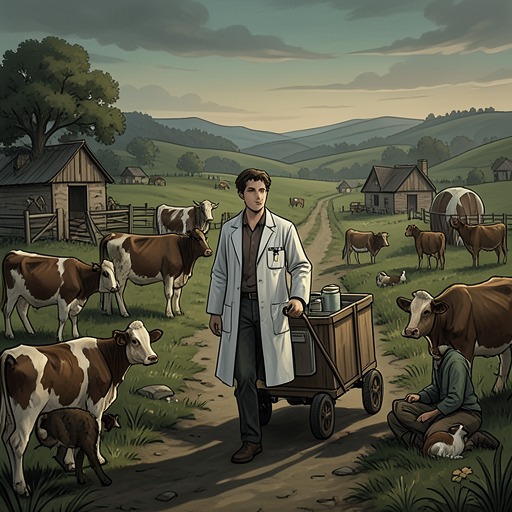
“You will never grow rich, but you will have a life of endless interest and variety”
All Creatures Great and Small“You will never grow rich, but you will have a life of endless interest and variety” is a piece of career advice whose force comes from experience: after a night of veterinary work, James Herriot recalls an old school visitor’s prediction and recognizes its truth in the variety of the cases before him. The phrase links the hardships and uncertainties of practice to its sustaining rewards, and its final emphasis returns in his delighted conclusion: “Variety. That was it—variety.”
The Advice and Its Recollection
The saying comes from an old gentleman who addressed Herriot’s school class about careers. His warning was not that veterinary work would be dull or easy, but that it would not make a practitioner rich; in exchange, it promised “a life of endless interest and variety.” The recollection occurs after Herriot has attended a sow giving birth through the night. Once the piglets are suckling and the gilt has settled, he drives through mud, stops to open a gate, and stands in the cold night air looking across dark fields. The ordinary pause between calls gives the old advice room to return to him.
Herriot laughs as he gets back into his car. His response turns the saying from a prediction into a recognition: the work has already supplied the variety it promised. The repeated word at the end is not an abstract motto but the conclusion of a night whose clinical demands, discomforts, and small signs of relief have just passed before him.
Variety in the Examination Room
Other cases make clear what such variety entails. At Lord Hulton’s estate, Herriot is confronted with a bay hunter staggering around its box, drenched in sweat, with foam at its mouth. Mr. Soames has relied on black draughts for what began as bellyache, but Herriot warns that severe, continuous pain may indicate a twisted bowel rather than ordinary colic. A rectal examination reveals a displaced small intestine and an abnormal, tense mass. The diagnosis emerges through examination under pressure, not from a routine application of the treatment already tried.
A different kind of uncertainty appears when Mr. Dean’s old dog lies with a grossly distended abdomen. The dog has stopped eating and no longer rests his head on his master’s knee at mealtimes. His tail thumps briefly when Mr. Dean speaks, then the dog’s blank, inward expression returns. As Herriot carefully rolls him over, the physical cause of the trouble becomes apparent. The passage sets clinical observation alongside the familiar details of the dog’s attachment to his owner, showing how a case can be both diagnostic problem and altered relationship.
Slow Progress and Difficult Births
The case of Strawberry, Dick Rudd’s cow, offers no quick resolution. Although she is eating and her temperature and lungs are normal, Herriot hears a faint snoring sound and notices that she gulps when swallowing. He suspects an abscess behind the throat, an inaccessible site where a large swelling could seriously impede breathing. He injects Prontosil and instructs Dick to apply hot water and salve behind the angle of the jaw at least three times daily. Over the next ten days the abscess continues to develop: Strawberry eats less, grows thinner, and gives less milk. Herriot feels largely helpless because he expects relief only when it ruptures, while the treatments he can give are of limited use.
In another examination, Herriot finds a calf’s feet and head beyond a narrow, ridged opening and recognizes a uterine torsion. The calf is alive, but there is no easy passage for it. The contrast between these cases—the slow, frustrating progress of Strawberry’s abscess and the immediate mechanical obstruction of a twisted uterus—gives the promise of “endless interest and variety” its practical meaning. The phrase does not imply that every case ends neatly; it names the changing demands and limits of the work.
The Phrase as a Career Principle
The saying holds together a tension that the cases repeatedly expose: veterinary work calls for knowledge and decisive examination, yet diagnosis and treatment unfold amid uncertainty, time pressure, and outcomes that cannot simply be commanded. Herriot’s remembered lesson gains credibility through the specific work around it, from a hunter’s suspected intestinal torsion to a cow whose throat abscess takes days to develop.
Its closing echo, “Variety. That was it—variety,” is therefore both humorous and affirmative. After the night’s birth and his return to the road, Herriot recognizes the career not as a promise of wealth or ease but as an unending succession of distinct problems, each demanding attention in its own way.