“worm in the tail”
All Creatures Great and Small“Worm in the tail” is a folk explanation for a cow’s refusal or inability to rise, and a rationale for cutting off the tip of its tail. In James Herriot’s account, the supposed worm is not a veterinary diagnosis: the practice’s apparent successes arise when pain from the injured stump forces a cow to scramble upright. The phrase exposes a recurring conflict between inherited farm remedies, persuasive but misleading results, and clinical judgment.
The Belief and Its Rural Authority
Herriot encounters the belief both as a familiar piece of farm lore and through Jeff Mallock, a knacker and fell-monger whose post-mortem work gave him an influential place in the local farming community. Farmers sometimes took animals Mallock had cut up as a way to discover what had been wrong with them; his confident explanations could overrule Herriot’s diagnosis in their eyes. One farmer reported that a cow treated for magnesium deficiency had not improved, then repeated Mallock’s conclusion that it had “Worm i’ the tail” and would have recovered if its tail had been cut off. Herriot found the claim difficult to answer: arguing that the disease did not exist did little against Mallock’s local authority.
Mallock’s diagnosis belonged to a wider private system of folk pathology. Despite his professional pride and more than twenty years of cutting up diseased animals, he had constructed an eccentric catalogue of diseases and remedies rather than a reliable clinical account. Farmers’ readiness to ask him to identify a cause of death reinforced his standing, and made the “worm in the tail” more than an isolated phrase: it was part of a body of supposedly practical knowledge that could challenge veterinary expertise.
The Handshaw Cow
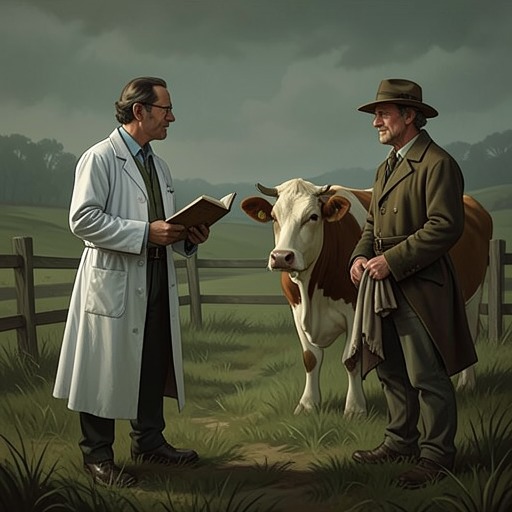
The belief returns when Mr. Handshaw calls about a cow that has remained down for forty-eight hours. She is eating well but will not rise, and Handshaw invokes his father’s advice: cows in that condition had a worm in the tail, and cutting off the tail’s end would do the trick. The inherited remedy is presented as a practical answer to an urgent problem: the cow must somehow be got back on her feet.
Herriot explains why the tale can seem confirmed by experience. Once the tail has been cut, the painful stump touches the ground; that pain may make a “sulky” cow scramble up. The observed outcome can therefore appear to validate both the diagnosis and the treatment, although it does not establish that a worm was present. The remedy’s apparent success is produced by the injury itself, not by removing the cause of the cow’s condition.
Veterinary Rebuttal and the Cost of the Remedy
Herriot tells Handshaw that there is no such thing as a worm in the tail and objects that cutting off a cow’s tail is cruel. He notes that the R.S.P.C.A. had recently taken someone to court over such a procedure. The exchange sets practical pressure against veterinary and animal-welfare judgment: Handshaw wants an intervention that might raise the cow, while Herriot must refuse a harmful treatment founded on a false explanation.
His refusal does not make the clinical problem easy. He thinks the cow has recovered from milk fever because she is eating and appears content, and suspects posterior paralysis; with no confidence in the stimulant injection he chooses, he nevertheless feels he cannot do nothing. That uncertainty sharpens the contrast with the folk remedy’s certainty. Herriot has to acknowledge the limits of his treatment without accepting an invented diagnosis or using pain and mutilation as a shortcut.
Meaning and Recurrence
The expression recurs because it offers a memorable cause and a decisive remedy for the unsettling sight of a cow that will not get up. Its persistence rests partly on a deceptive chain of cause and effect: amputation may be followed by the animal rising, but the pain that prompts movement is mistaken for proof that the tail contained a worm. The story thus treats the phrase not simply as rustic error but as a warning about how an outcome can seem to confirm a belief when the real mechanism is misunderstood.
Through both Mallock’s confident pronouncement and Handshaw’s inherited advice, “worm in the tail” marks a point of friction between local experience and professional knowledge. Herriot’s account also insists that the consequences are borne by the animal: a mistaken explanation can authorize a cruel procedure, even when the practice appears to work.