Angus Grier
All Creatures Great and SmallAngus Grier is a veterinarian whose imperious manner makes professional life around him feel like a test of endurance, yet his encounters with James Herriot reveal a more complicated figure than his permanent scowl suggests. His authority rests on real clinical experience, but he exercises it through provocation, complaint, and a bluntly personal style that leaves little room for comfort.
Identity and First Encounter
Grier practises in Brawton, a fashionable town where, according to Siegfried Farnon, he attracts students and gives them a hard time. He is described as a cantankerous Aberdonian, and James’s first impression fixes on his fleshy, mottled cheeks, swimming eyes, prominent nose webbed with purple veins, and permanently insulted expression. The impression is almost comic, but Grier’s manner quickly makes clear that he can turn a clinical encounter into a judgment of the people around him.
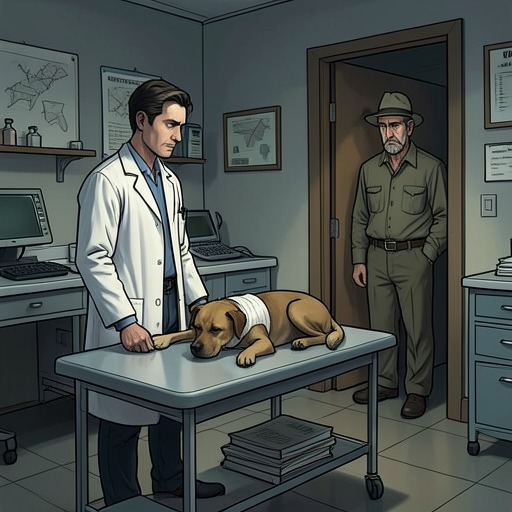
James first goes to Grier with a terrier suffering from bladder stones. Siegfried sends the dog for an immediate operation, preferring to let the veterinarian who had already treated the case perform it rather than offend his touchy colleague. Grier takes the dog from James with little more than a nod and grunt, then introduces Clinton, a final-year student, by mocking his appearance. During the operation, he continues to needle the student. The surgery itself proceeds uneventfully; Grier finishes the final stitch, tells James to wait until the dog has recovered from the anaesthetic, and invites him along on a visit.
In the car, Grier does not so much converse as deliver a long account of injuries he believes clients and fellow practitioners have done him. The story that most entertains James concerns a retired admiral who rejected Grier’s warning that a horse had a bad heart and obtained a second opinion declaring it sound. Grier recounts that the horse later collapsed at a gallop, killing itself and leaving the admiral with a compound fracture of the leg and a crushed pelvis. The episode arrives as one of Grier’s grievance stories, not as an independently investigated account; its place in the narrative chiefly shows how readily he turns professional disagreement into a personal wrong, and how vividly he savours vindication.
The Calving Suit and an Uneasy Partnership
Grier’s abrasive manner did not exclude an unexpected taste for mischief. On a farm visit, James Herriot initially resisted joining him because his coat and Wellingtons were back in the car and he thought the job would leave him dirty. Grier’s irritation gave way to an offer of a calving outfit from a large wooden box in the boot. He described it as a little heavy but suitable for keeping clean, and told James to come in and pass him a pessary when needed. The invitation made the task sound routine; the outfit made it a spectacle.
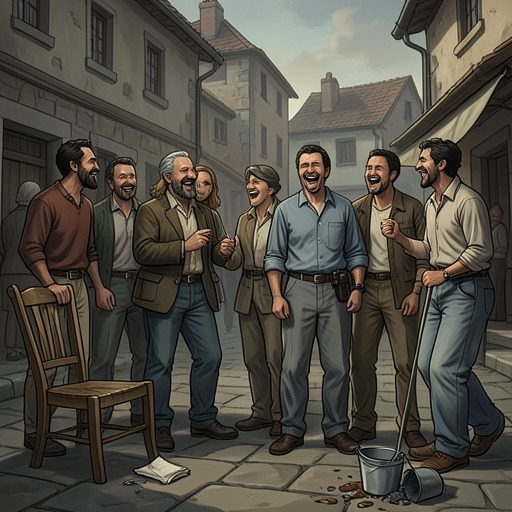
The rubber suit’s elastic sleeves constricted James’s arms, and the farm men watched with growing disbelief as he stood by the wall while Grier treated the cow. When Grier began undoing the studs and zips, the men understood that the performance was over and turned from anticipation to amusement. James, swollen-armed and struggling to recover his dignity, found their attention fixed on him rather than on Grier. The scene ends with a private reversal: back at the surgery, James saw Grier handling the suit in the storeroom, his body shaking and a muffled wail escaping him. The permanently offended veterinarian was laughing. His amusement was not offered as an apology, but it disclosed a capacity for comedy beneath the forbidding exterior—and that he knew exactly how ridiculous the episode had looked.
The relationship became more difficult when Grier needed someone to run his practice. While castrating a colt, he had been thrown beneath the animal and cracked a couple of ribs; his assistant had recently left. Grier asked Siegfried Farnon to send James to Brawton for a week or two. James objected that Grier disliked him, but Siegfried explained that Grier disliked everybody and had no one else to send. The arrangement turned a brief, uneasy acquaintance into a period of close daily dependence.
At eight in the morning, Grier received James from his bed in a pink quilted bed jacket and immediately complained that he was late. He criticized the cut of James’s breeches, which James had paid thirty shillings for and privately thought gave him a smart appearance. The criticism stung all the more because James suspected that Grier was receiving his work without paying for it. Grier also noticed that James had barely touched his porridge and treated his lack of appetite as another fault. His scrutiny encompassed not only the work but the clothes, meals, habits, and bearing of the person doing it.
Yet the bedroom routine also served as a clinical examination room. Grier handed James a list of visits and asked what he would do about a cow with a prolapse of the cervix. James proposed an epidural, replacing the prolapse, and retaining it with sutures through the vulva. Grier’s questioning put the temporary assistant under pressure to show what he knew, even as his own injury kept him in bed and dependent on James to make the calls. Their exchange joined instruction to intimidation: Grier delegated responsibility, but made the delegation feel like a test.
The practical strain intensified when Grier had to return to bed, groaning from his ribs and relying on whisky for relief. His wife hovered around him as James reported in, and the whispering between them stopped when he entered, only to resume when he left. One late-evening call came from Mrs. Mallard, whose dog seemed to have a bone in its throat. Grier sat silently considering the report, then sent James to the case with the diagnosis that it would probably be pharyngitis rather than a bone. The episode shows the authority he continued to exercise from bed: even when unable to go himself, he directed James’s response and supplied a confident interpretation of the symptoms.
Within two days Grier was out of bed and apparently recovered, while a replacement assistant was about to take up the post. James could leave. He departed at 6:30 in the morning, aiming to reach Darrowby by breakfast and escape another serving of the porridge that had become part of his unhappy routine. As his car crossed the Plain of York and climbed toward the Pennines, the familiar landscape marked a release from the constricted world of Grier’s house and practice. The relief of departure does not erase the work James had carried out there; it closes an apprenticeship conducted less through reassurance than through exposure to Grier’s demands, judgments, and occasional, disconcerting humor.
Clinical Authority Under Scrutiny
Less than a week after the discussion of the cow with a prolapsed cervix, Grier received a card from the farmer saying he was dissatisfied with James’s work. Grier treated the complaint as requiring immediate attention: at breakfast he announced that they would return to the farm that morning because he disliked complaints. His face, already marked by habitual offense, tightened with such distress that James thought he might weep into his porridge. The reaction complicates the image of a man who seemed to relish criticism of others. However brusquely he questioned his assistant, Grier took a client’s dissatisfaction seriously enough to investigate it himself.
At the farm, the farmer led them into the byre and asked James to assess the result. The scene turns the earlier bedside questioning into a practical test: James’s judgment is now exposed not only to Grier’s scrutiny but to the person whose animal he treated. Grier does not answer for him or dismiss the complaint; he brings James back to confront the case in person. The episode shows professional authority as something that must be exercised under observation and remain answerable to outcomes, even when the veterinarian supervising the work is irritable and difficult to please.
Authority, Accountability, and Narrative Role
Grier’s authority is never presented as simple reassurance. In the operating room, on the farm rounds, and in the return visit prompted by a client’s complaint, he places James Herriot where professional judgment must be demonstrated and its consequences faced. His manner makes that pressure personal: he comments on James’s clothes and appetite as readily as his treatment decisions. Yet the complaint brings Grier himself back to the farm rather than allowing him to dismiss the client’s dissatisfaction from his sickbed. The resulting portrait holds together two unlike qualities: a veterinarian capable of directing a practice and taking a case seriously, and a colleague whose criticism makes ordinary work feel like an ordeal. His laughter at James in the rubber suit briefly breaks the pattern, but does not erase it; it makes the sternness more human without making it gentler.