August Bag
All Creatures Great and SmallAugust Bag is the rural name used for summer mastitis, a painful, often incurable udder infection whose consequences reach beyond the affected cow. The account of Terry Watson’s sick cow shows how its characteristic signs, limited treatment prospects, and risk of permanent loss turn a veterinary diagnosis into an economic blow for a young farm worker’s family.
Meaning and Seasonal Pattern
Farmers called summer mastitis August Bag because cases were especially numerous in the later summer months. The name was colloquial rather than a guarantee of when the disease would appear: Terry Watson’s cow developed it in mid-July, earlier than the usual season. The narrator explains that later in summer the practice would see hundreds of cases, establishing the condition as a recurring feature of rural veterinary work rather than an isolated curiosity.
The disease carried a bleak reputation. The narrator describes it as just about incurable, with the usual result that the cow lost one quarter of her udder—the section that supplies milk through a teat—and, in some cases, her life. The expected damage therefore had two forms: immediate illness and the lasting loss of productive capacity. Even when a cow survived, losing a quarter could materially reduce her value.
Signs and Diagnosis in Terry Watson’s Cow
Terry Watson called the veterinarian at about seven in the evening, after the day’s visits seemed finished. His cow had limped in from the field at milking time, swinging her right hind leg out to avoid the painful udder. In the stall she trembled and stared anxiously. When the veterinarian drew at the affected teat, dark, foul-smelling serum—not milk—spurted into the tin can. The stink, together with the hot, swollen quarter and the cow’s quick lift of her leg when it was touched, made the summer type unmistakable.
The examination also registered the seriousness of her condition: the thermometer read 106 degrees. Yet the case challenged the assumptions Terry had brought to it. He thought the disease usually struck dry cows, while his animal was still giving two gallons a day. He had not applied Stockholm tar, which farmers dabbed on the teats of dry cows to keep away flies believed to carry the infection. The veterinarian corrected the assumption that only dry cows were susceptible, noting that cows beginning to dry off were particularly vulnerable but that all cows could get it. The cow’s current milk production did not protect her from the disease.
Treatment and Uncertain Prognosis
The veterinarian offered treatment without promising recovery. He injected Coryne pyogenes toxoid and instructed Terry to strip the teat as often as possible, explaining that cases receiving the most frequent stripping did best. For that evening, the aim was every half-hour if Terry could manage it: removing the material as soon as it formed might help, while bathing the udder in warm water and massaging it were additional measures he could perform himself. These instructions made care an ongoing task, not a single intervention completed during the visit.
The treatment’s limits are explicit. The veterinarian knew the outlook was poor, and the account notes that even modern antibiotics had little effect on summer mastitis. He tried to reassure Terry that he did not think the cow would die and that, even if she lost the affected quarter, the other three might make up some of the loss. But this was qualified hope, not a cure. The narrator acknowledges feeling helpless when little could be done about something that mattered greatly, and admits that the possibility of the animal dying was difficult to contemplate.
Economic and Narrative Significance
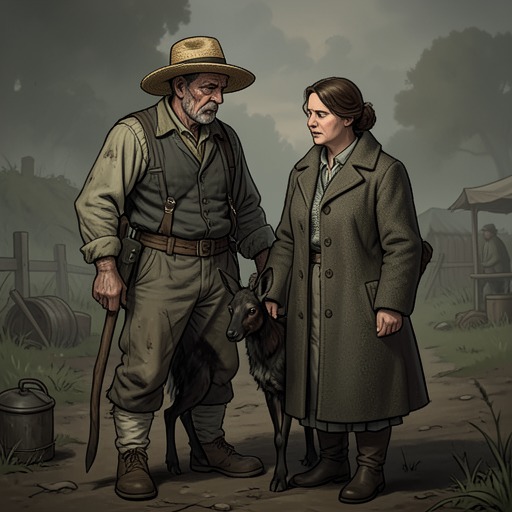
Terry’s circumstances give the prognosis its full weight. In his early twenties, with a wife and small baby, he worked for others all day and then tended his own small stock: two cows, a few pigs, and hens. His wages were thirty shillings a week, so the animals made a substantial difference to the household. A cow left with three productive quarters would lose much of her market value; the possible loss was therefore not an abstract veterinary consequence but a direct threat to a narrow family livelihood.
The scene also sets professional knowledge beside local practice without making the latter seem foolish. Terry knows that dry cows are commonly associated with the disease and understands the use of tar against flies, but the veterinarian’s examination and broader experience revise his understanding of who can be affected. At the same time, veterinary expertise cannot remove the central uncertainty: the diagnosis is clear, the care plan specific, and the likely damage still difficult to prevent. August Bag thus names both a recurring seasonal disease and a predicament in which careful treatment offers limited control over illness and its economic aftermath.