Cattle
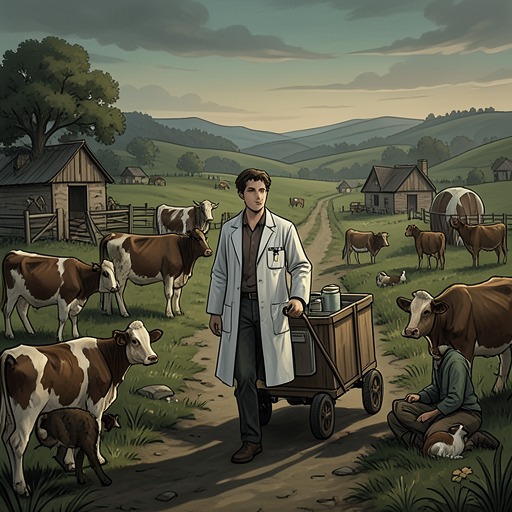
All Creatures Great and SmallCattle are the defining patients of rural veterinary practice in James Herriot’s account, bringing together the daily demands of diagnosis, calving, herd management, and farm life. Their scale and strength make treatment physically exacting; their illnesses can be routine or unexpectedly grave; and their care depends on a combination of veterinary knowledge, farmer cooperation, and close attention to the circumstances of each animal.
The working patient in country practice
Cattle occupy the ordinary and extraordinary hours of the practice. After six months, James Herriot could look back on treating cows alongside horses, pigs, dogs, and cats at all hours of the week. Calving cows and assisting sows had left him exhausted, while the varied cases had taught him how little a young veterinarian could assume he already knew. Cattle work was not a specialized sideline but part of the demanding routine through which practical competence was acquired.
A first examination could determine the shape of an entire call. Herriot describes the moment of putting a hand into a cow as a decisive assessment: within seconds, the veterinarian might know whether the visit would be brief or require hours of difficult labor. One early calving case placed him working in a cold, cramped farm setting, by the light of an oil lamp held by the farmer. The conditions make clear that veterinary judgment had to operate not in a controlled clinic but amid weather, limited light, and the immediate needs of an animal in labor.
The physical demands extended beyond delivery. During routine testing at a byre, a thin, rangy cow kicked Herriot when he had barely begun examining her udder. The incident punctures any idea that repetitive work is automatically safe: even familiar procedures required alertness around an animal whose movements could change the situation instantly.
Diagnosis, treatment, and uncertainty
Cattle cases range from recognizable disorders to problems that resist easy interpretation. Milk fever, a calcium deficiency that can follow calving and progress from collapse to coma, appears in more than one episode. In one, the cow had slipped down a muddy bank into a beck and lay unconscious with her hindquarters submerged; her wet calf remained beside her in the rain. The case turns a familiar postpartum condition into an urgent problem shaped by the animal’s surroundings as well as her illness.
Another milk-fever call involved Mr. Handshaw’s cow, found motionless on her side. To work with her, Herriot stripped off his jacket, soaped his arms, and asked two people to hold the cow’s hip bones and rock her gently from side to side. The episode, identified with the sheep-skin treatment, shows how recovery could depend on coordinated physical effort and a practical method rather than medication alone. Cattle care was a collaboration: the veterinarian examined and directed, while people present had to help carry out the procedure.
Other cases make the range of diagnosis visible. Terry Watson, a young farm worker who kept two cows, called in the evening about one with summer mastitis. Herriot notes that the condition was usually difficult to cure and could cost a cow a quarter of her udder, or even her life; farmers also commonly called it August Bag, though Watson’s call came in mid-July. The individual cow’s eventual outcome is not given in this account, but the general prognosis establishes the stakes behind a seemingly familiar complaint.
At Mr. Sidlow’s farm, Herriot recognized Johne’s disease in a cow after hearing how months of home remedies had failed to resolve recurring diarrhoea. The remedies had progressed from ground eggshells in gruel to blue vitriol and dandelion tea, while the veterinarian’s diagnosis came from the condition apparent on examination. The contrast is not simply between professional and folk knowledge: it shows how a farmer’s sustained observation and treatment history could supply context, even when it did not identify the disease.
The practice also faced cases where uncertainty itself shaped treatment. Universal Cattle Medicine was advertised for a long list of complaints, from coughs and chills to milk fever and bloat. Its confident promise of relief exceeded its actual usefulness, but the bottle offered a familiar recourse when the veterinarians had few specific remedies and were unsure what was wrong. A day-book entry recording a visit, advice, and one bottle was, Herriot observes, a sign that the diagnosis had not been settled. The medicine thus represents both the limits of available treatment and the reassurance that a tangible intervention could provide.
Calving and the work of delivery
Calving is a recurring test of practical skill, and the first signs do not always disclose the difficulty ahead. In one case, a large white cow strained while only a pair of feet appeared briefly. Their position seemed manageable and the mother looked roomy, yet the expected progress did not follow. The episode emphasizes the veterinarian’s reliance on small physical clues, while also showing that a promising initial assessment cannot guarantee an uncomplicated delivery.
Candy’s case gives that uncertainty a clear cause and resolution. Helen Alderson’s father had prepared a loose box with steaming buckets of water, a towel over the half door, and two experienced cowmen, Stan and Bert, standing by. Candy lay comfortably in deep straw and was not straining, though her inward, preoccupied appearance suggested something was wrong. Examination revealed uterine torsion: the calf could be felt, but the passage was narrowed, and there would be no easy delivery.
Herriot worked to correct the torsion until the uterus opened and his arm was free in the available space. Candy then began to strain decisively, and a second effort brought the calf into his arms, wet and moving. The successful birth depends on a sequence of observation, diagnosis, correction, and the cow’s own renewed labor. It also shows how preparation by the farm household and veterinary intervention meet at the crucial moment without making the outcome seem automatic.
Herds, handling, and agricultural practice
Cattle were not only individual patients; whole herds could present a different order of veterinary work. Mr. Copfield’s eighty-five Galloway cattle were known as exceptionally tough and scarcely handled. They lived on the fells, calved and reared their calves outside, and were described as practically wild. For testing, the animals had been brought into the buildings, where about twenty-five filled a passage, twenty occupied an old stable, and two further groups of twenty milled in loose boxes. The crowded arrangement makes the scale of the task concrete: a visit involving one diagnosis was very different from work requiring the management of an entire herd.
Herriot’s duties as a Local Veterinary Inspector brought him into routine examinations and tuberculin testing under the Ministry of Agriculture and Fisheries. The work could be tedious: on one day he was making a ninth visit to Mr. Kay’s field and had begun to feel that the schedule would not proceed at his preferred pace. Such assignments reveal a less dramatic but essential side of cattle medicine, in which repeated testing and the timing of farm work mattered as much as sudden treatment calls.
The Allen herd shows how testing depended on skilled handling as well as veterinary measurement. The cattle were scattered over high fells, and Mr. Allen’s sons, Jack and Robbie, spent the morning chasing and catching them. Jack even ran down a galloping heifer on open moorland and held it for Herriot to inject. On a sunny hillside, the young animals were penned while the brothers went among them and their father courteously dusted the top of a wall. Herriot then recorded a precise test observation for animal number thirty-eight: seven millimetres, circumscribed. The detail joins strenuous farm labor to standardized veterinary procedure, without implying an outcome beyond the recorded measurement.
Significance in the veterinary narrative
Cattle make visible the variety and uncertainty of Herriot’s work. A cow may require a brief examination, prolonged assistance in labor, an urgent response to illness after calving, or a carefully organized herd inspection. The practical demands change with the animal, the diagnosis, the weather, and the farm’s facilities; the veterinarian cannot rely on one setting or one method.
These episodes also place expertise in a shared rural world. Farmers and workers provide histories, prepare spaces, handle animals, and help carry out treatment, while veterinary training contributes examination and diagnosis. Neither side is shown as sufficient in every circumstance: Mr. Sidlow’s remedies do not solve his cow’s disease, but his account of them records months of attention; the Allen brothers’ strength makes testing possible, while Herriot supplies the measurement. Across these contrasts, cattle are not merely units of production or instruments for illustrating professional skill. Their births, illnesses, behavior, and vulnerability determine the work’s pace and consequences, making their care the ground on which rural veterinary knowledge is continually tested.