Dales resilience and hospitality
All Creatures Great and SmallDales resilience and hospitality is the local ethic the narrator gradually recognizes in the people he serves: a capacity to endure difficult work and weather, coupled with an unceremonious generosity toward visitors. Its fullest expression appears in Dick Rudd and his family, but the principle emerges across the Yorkshire Dales—in farms where a late-arriving veterinarian is welcomed rather than reproached, and in households whose invitations make hospitality part of ordinary workday life. The book sets this human steadiness against a landscape of striking beauty, while making clear that rural life is sustained by labor, not scenery alone.
Landscape, work, and endurance
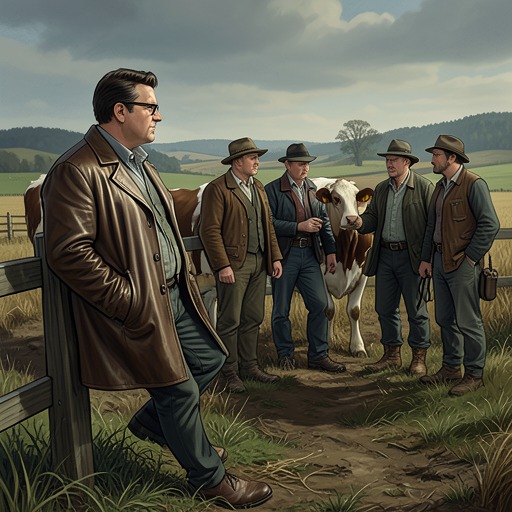
The narrator first approaches the Yorkshire Dales as a young veterinary surgeon with little reason to expect an easy future. On the climb toward the Pennines, his preconception of Yorkshire as dull gives way to a landscape of grassy hills, wide valleys, twisting rivers, grey-stone farmhouses, cultivated fields and miles of dry-stone walls. That beauty is real, but it does not make the work gentle. The landscape is also a place of steep roads and exposed farms, where a visit may depend on getting through bad weather and where the distance between neighbors is measured in arduous travel as much as miles.
The work follows an agricultural calendar whose demands return every year. In spring, livestock emerge from the long winter weakened: cows have spent months confined in byres, calves have little resistance to illness, and the veterinary workload is already full of respiratory disease and other troubles when lambing arrives. For roughly two months sheep can dominate the practice, bringing pregnancy toxaemia, prolapses, hurried deliveries, calcium deficiencies, gangrenous mastitis and diseases of young lambs. Then the rush recedes, and the sheep become part of the hills again. The cycle makes endurance practical rather than heroic: it is the ability to meet a concentrated wave of work amid the other calls that cannot wait.
The gentler days do not erase that labor. In May and early June, the narrator drives out through early sunshine and lingering mist, while wild flowers scent the pastures and the wistaria at Skeldale House pushes mauve blooms toward the open windows. Yet these same months bring the uncomfortable work of castrating horses, still common on farms despite the arrival of tractors. The pastoral scene and the demands of production coexist. The book’s picture of Dales life is therefore neither simply idyllic nor bleak: pleasure in the landscape is part of a life whose weather, animals and work impose continual obligations.
Courtesy as a local practice
The narrator experiences hospitality as a pattern of actions rather than a formal show. The Bellerbys, whom he regards as belonging to a world moving at its own unhurried pace, ask him to drive them to Darrowby church for a performance of Handel’s Messiah. Their request grows out of a practical difficulty: preparing the pony and trap would take time, and the journey would be slow. On arrival, he finds the family sitting down to Sunday dinner at a quarter to twelve, with the performance due to begin at two. Mr. Bellerby immediately invites him to eat. The narrator declines because his own meal will be ready when he returns and he does not want Mrs. Hall’s food wasted. The exchange conveys both the warmth of the invitation and the ordinary domestic arrangements around which it is made.
A similar courtesy greets him at the Hugills’ farm. The four brothers and their families manage a herd of nearly two hundred cattle, yet when the narrator arrives more than an hour late to test them, the family leaves its tasks to welcome him with smiling faces. He expects no complaint: the Hugills, he observes, have carried the Dales tradition of courtesy to an exceptional degree, treating a stranger as an honored guest. Their welcome does not suspend the work; it meets him at the farmyard while the work is waiting.
The Bramleys offer a different measure of the local world. Their isolated farm has no road, and the family has little desire to seek the outside world; access runs over fields in summer or by a deeply rutted track. The narrator values a letter from them partly because he treasures encounters with people who retain older local ways and expressions. Their remoteness is not itself proof of a universal custom, but it helps establish the variety of lives contained within the Dales: courtesy and attachment to familiar ways exist alongside the practical isolation imposed by the terrain.
Dick Rudd and the meaning of generosity
Dick Rudd makes the connection between endurance and hospitality most intimate. The narrator first meets him at Skeldale House on a black, rainy morning. Rudd has arrived by bicycle from Birch Tree Farm to summon help for a heifer in labor. He is soaked, yet refuses the offer to leave his bicycle and travel by car, reasoning that he would otherwise have to return for it. He rides on through the rain, while the narrator recognizes the full cost of the journey: no car or telephone, a night attending the heifer, eight miles of cycling and a hard day still ahead. The episode does not present hardship as a badge worn for admiration; it makes visible the work a small farmer must undertake simply to keep things going.
The narrator delivers a live calf and later shares tea in the farmhouse kitchen. There he meets the seven Rudd children, whose ages range from about ten to their twenties. Dick and his wife had five daughters before two sons were born; Dick’s hope of building a dairy herd is tied to a future that may belong to those sons as much as to himself. With little money behind him, he knows that improving the stock will take time. His ambition is measured across generations: he imagines that one day people may admire the Birch Tree Farm cows, even if that day comes after his own lifetime.
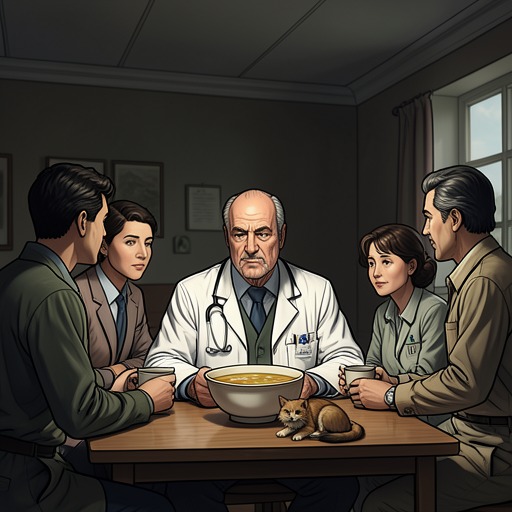
Hospitality at Birch Tree Farm becomes a repeated ritual. After veterinary visits, the family stops work and gathers to watch the narrator drink a cup of tea. On Sundays all nine Rudds sit around him, responding to his remarks with nods and smiles. Their attention gratifies him, but also makes him feel humble; the relationship is not simply a professional being deferred to by clients. Dick trusts veterinary advice and welcomes him as a friend, while the narrator comes to respect the family’s contentment and the effort behind it.
The family’s generosity also travels with the narrator when he leaves. A couple of homemade scones or three eggs appear on the seat of his car, gifts that seem especially significant because the Rudds have so little to spare. Dick’s humor is another form of warmth: when asked to hold a cow’s nose, he solemnly promises to endeavor to do so; faced with lifting plywood from a calf’s corner, he likens it to raising a portcullis. His jokes are modest and deliberate, and his smile transforms his pinched features. Integrity, humor and generosity sit beside the hard philosophy and stamina the narrator associates with the Dalesman, giving the ethic a particular human face rather than reducing it to stoicism.
Hospitality as friendship and recognition
The Rudd family’s regard changes the narrator’s sense of his place in the community. After just over a year he is becoming accepted as a veterinarian, but remains conscious of the gulf between the hill people and a city-trained newcomer. Dick’s friendship matters because it crosses that difference without pretending it does not exist. The family’s eager attention makes the narrator feel valued, while their circumstances remind him that his own occasional bursts of activity cannot compare with the daily burden of a small farm. Their respect and his admiration develop together.
That bond reaches a public milestone when Dick and his wife invite the narrator to their silver wedding anniversary. Dick first makes the occasion sound like a substantial celebration: there will be a hot dinner and entertainers, and a room has been booked at the King’s Head in Carsley. The invitation is more than another cup of tea after a call. It places the veterinarian among the family’s guests for a major occasion, confirming that the relationship built through treatment, conversation and repeated visits has become a friendship.
Across these encounters, hospitality is not an escape from rural pressures but one way people make life within them. The invitation to dinner, the tea watched over by a whole family, and the small gifts left in a car seat all arise within households shaped by work and limited means. The narrator’s account of the Dales therefore joins two qualities often separated in romantic portraits of rural life: resilience is not merely the ability to bear hardship, and hospitality is not merely a picturesque custom. Each gives the other meaning. The work is real, the welcome is freely offered, and the friendship that grows between a city-trained veterinarian and the farmers he serves becomes the clearest measure of belonging.