Darrowby
All Creatures Great and SmallDarrowby is the central town of the narrative’s rural world, joining a demanding veterinary practice to the farms, hills, and everyday institutions around it. Its significance lies in being more than a backdrop: it is where James Herriot returns to work, builds relationships, and comes to understand the Dales as a place in which he can make a life.
Setting and approaches
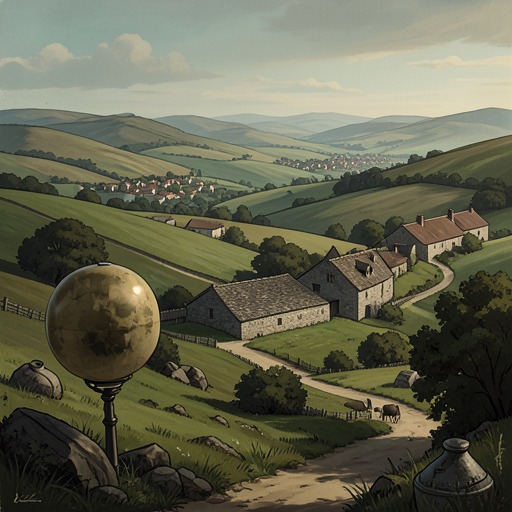
Darrowby is presented as a market town within the landscape of the Yorkshire Dales, with the surrounding hills close enough to shape how the town feels and how its inhabitants travel. On one return, James Herriot drives west across the Plain of York and watches the Pennines rise beyond the hedges and trees. As the road climbs, hedges give way to limestone walls; Darrowby appears beneath Herne Fell, with the green folds of the Dales beyond. The change in terrain gives the journey a distinct emotional force: the open hills signal a return to familiar country after time away.
The town itself is encountered through small, concrete landmarks rather than a broad description of its layout. Herriot rattles over the cobbled market place and turns down a quiet street towards Skeldale House. Elsewhere, the local cinema, the Darrowby Plaza, is tucked between an ironmonger’s and a chemist’s, its entrance scarcely wider than an ordinary shopfront. These details establish a compact town where work, errands, and leisure occupy the same streets, and where a familiar destination can be easy to overlook.
Skeldale House and the veterinary practice
Skeldale House makes Darrowby the base of a veterinary service extending out across the surrounding countryside. The old brick house has ivy growing untidily over it, and its brass professional plaque hangs slightly askew on the railings. James Herriot’s return there after working away begins with a welcome from all five of the family dogs, who crowd the passage, and from Mrs. Hall, carrying the coffee-pot from the dining room. Her offer of home-cured food makes the practice house a workplace and a domestic refuge at once.
The house is also a crowded, sometimes improvised household. Beds and blankets are in short supply, so when unexpected visitors arrive, Tristan Farnon may be sent to stay with his mother in Brawton. On one such occasion, a note from Siegfried Farnon tells Tristan to go home; the instruction interrupts his plans for a village dance. The shortage links the rhythms of professional life to the private arrangements of the people living at Skeldale House.
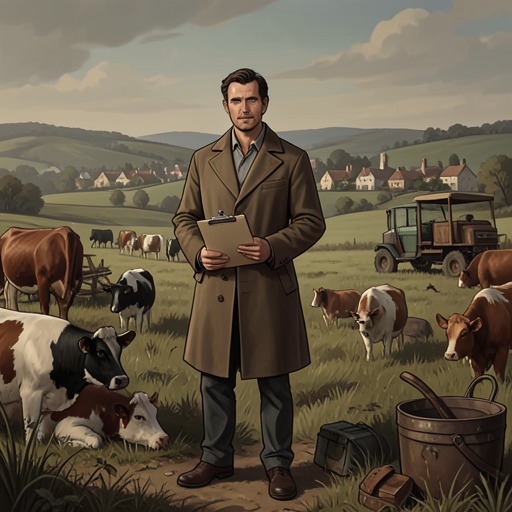
The practice’s identity is visible in its people as well as its premises. Herriot returns to find Siegfried Farnon and Tristan Farnon together at breakfast, amid the familiar pattern of one brother scolding the other. After more than a year away from his original plans, Herriot recognizes that the work itself has become compelling: treating cows, pigs, sheep, and horses has given him a sense of participating in British agriculture. The daily drive from Darrowby to farms across the high country makes the town the fixed point of a working life spent largely on the road.
A working centre for a scattered countryside
Darrowby’s practice serves a rural district in which farms may be far from the town and beyond the normal boundaries of the clinic’s area. The Sidlow farm, for example, lies nearer Brawton than Darrowby, down on the Plain of York. Its distance and history complicate the idea of a tidy local catchment: the family has previously used veterinary firms elsewhere, yet eventually becomes attached to the Darrowby practice. Calls from the farm, often made late after days of home treatment, bring the countryside’s medical demands back to the town and its practitioners.
The work reaching the practice ranges from urgent farm cases to routine visits, and the surrounding landscape can make even a short call feel remote. One evening Herriot and Tristan Farnon finish treating a cow with an infected eye at a village high in the Dale. Dusk has fallen by the time they leave: the street is empty, the last red light remains in the sky, and the dark fells enclose the settlement. The scene shows how a day based in Darrowby can carry the veterinarians out into isolated communities and return them only after the work is done.
Weather is another part of the working geography. In winter, a biting north wind drives snow past the windows so fiercely that it obscures the street. Herriot waits for his morning list with his scarf raised over his ears, his overcoat buttoned tightly, and holes in his woollen gloves. The scene makes the season an immediate constraint on travel and work rather than decorative scenery. In contrast, the first suggestion of spring is registered on a Darrowby street: although the cold remains, the hills seem to send a promise of sunshine, warm grass, and softer days.
Streets, gathering places, and local life
Darrowby’s social life is distributed among modest public places. The village dance, with its three-piece band and refreshments served by older women, is part of the local calendar. Tristan Farnon looks forward to attending with Herriot, and their last veterinary visit of the evening becomes entangled with those plans. When they return to Skeldale House, however, Siegfried Farnon’s note ordering Tristan to Brawton disrupts the evening. The dance matters not simply as entertainment but as a measure of how the brothers’ arrangements can redirect ordinary social plans.
Other meeting places offer different forms of company. Herriot watches Tristan Farnon waiting near the hospital for nurses to finish their shift, using a dark corner by the gas company’s office to stay out of sight if Siegfried Farnon should pass. The hospital entrance and its long corridor are therefore part of the town’s nighttime social geography as well as a place of care. At the opposite end of the town’s public life, The Drovers provides a place where Tristan can talk over an uncomfortable farm assignment with Herriot. Over a succession of drinks, his mood lifts enough for him to recount what happened.
The Darrowby Plaza is another of these close-set institutions. Its small, easily missed frontage lies among the shops, and its darkness one evening unsettles Herriot, who has arranged to meet Helen Alderson there. He has chosen the local cinema partly to avoid relying on his unreliable car. His recollection of an earlier, humiliating attempt to take a girl to the cinema in Glasgow makes this modest outing carry a longer personal history; in Darrowby, however, the meeting offers the possibility of beginning again. The town’s ordinary venues thus become settings for changes in Herriot’s private life as well as pauses between professional calls.
Return, belonging, and change
Darrowby gains its strongest meaning through Herriot’s changing response to it. When he first arrives, he regards the veterinary job as a stepping-stone towards another ambition. That understanding shifts quickly. He comes to value the freshness of the air at Skeldale House, the varied life of the old house with Siegfried Farnon and Tristan Farnon, and the unexpected interest of treating farm animals. The surrounding Dales, which he had not imagined could become home, help him see himself as part of a larger agricultural community.
A return to Darrowby after an absence makes that attachment visible in physical details: the familiar bulk of Herne Fell, the quiet street, the ivy-clad practice house, the dogs surging to greet him, and Mrs. Hall’s pleased welcome. The journey ends not at an abstract destination but among the people and routines that have come to matter. The town also becomes the place where Herriot’s professional status changes. When he sees a new, straight-mounted plaque bearing his name beside Siegfried Farnon’s, he understands that he has become a partner and has acquired a real place in the world. Darrowby is therefore both the centre from which his work radiates and the home that gives that work its personal significance.