Dennaby Close
All Creatures Great and SmallDennaby Close is both a substantial working farm and a centuries-old manor in the Yorkshire Dales, but its significance rests on a contrast: the estate records John Skipton’s extraordinary success, while the retired horses in its pastures reveal the care that success has not displaced. The property’s house, fields, and farm buildings speak of endurance and agricultural judgment; its river-side refuge for two old horses shows what that hard-earned prosperity means in practice.
The Estate and Its Owner
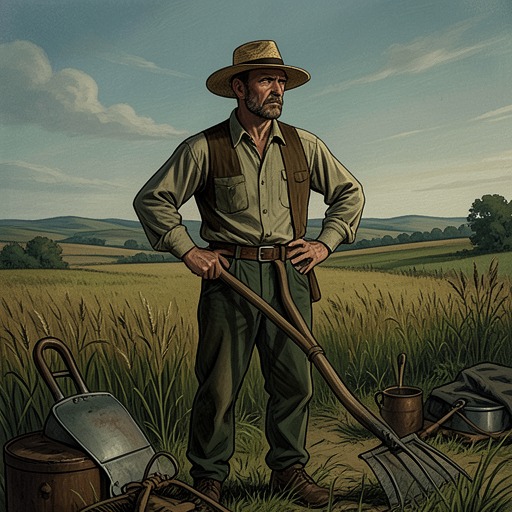
Dennaby Close is presented as proof of what John Skipton has made of his life. He began as an uneducated farm labourer and became a wealthy landowner, building his position through a lifetime of punishing work and unusually shrewd agricultural decisions. The estate itself is only one of his farms: he also owns two large arable properties lower down the Dale, each about four hundred acres. In difficult years when other farmers were going bankrupt, his farms made money. His habit of taking the contrary course when everyone else followed one road became a local saying, and his success made him a district legend.
That achievement has its cost. Skipton has spent so long driving himself that he seems unable to stop, even though he could now afford comforts. People say that his poorest workers live better than he does. The disparity is visible when James Herriot visits: the prosperous landowner approaches in a tattered coat without buttons, held together at the waist by binder twine. His clothes and bare ankles sit uneasily beside the scale of the property, making the estate’s wealth look less like personal luxury than the accumulated result of work that has consumed its owner.
The Manor and Its Grounds
The house at Dennaby Close has stood for more than three hundred years against the harsh climate. Its tall leaded windows, massive chimneys, and old moss-covered roof tiles give it a stately presence; people travel to see it and photograph its façade. A neglected garden and broad entrance steps lead to a wide stone arch above a great studded door. The house suggests a past of formal grandeur, and Herriot imagines the figures that might have appeared in its windows or walked beneath its high boundary wall. Instead, the immediate reality is Skipton, briskly coming out to meet him.
The first business of Herriot’s visit is ordinary: Skipton wants to pay a small bill. Inside, the scale of the manor’s rooms does not translate into lavish furnishing. The graceful, spacious room contains only a table, wooden chairs, and a collapsed sofa. Skipton retrieves papers from behind the clock, sets out an envelope and cheque book, and concentrates carefully on signing the payment. These details make the house more than a picturesque landmark. Its impressive exterior coexists with spare rooms and an owner who does not arrange his life around the comforts his wealth could buy.
The River Pasture and the Retired Horses
Once the bill is settled, Skipton immediately leads Herriot down to the river, where the horses are kept. Herriot has brought a heavy wooden box of veterinary instruments, and the journey continues through walled pastures as Skipton strides ahead, carrying a bale of hay on a pitchfork. The animals are standing fetlock-deep in the pebbly shallows, close to a small beach and green turf. They have been rubbing their chins along one another’s backs. A high cliff shelters the far bank from the wind, and oak and beech trees surround the spot. Nearby, a low, thick-walled barn offers shelter in winter. The horses are free to come and go between it and the pasture.
The arrangement is not temporary. The horses have been retired there for about twelve years, and Skipton explains that they have earned their rest. He remembers them as two slaves when he was a slave himself, briefly exposing the shared history beneath his otherwise matter-of-fact account. Their present surroundings offer a marked reversal: animals once bound to work now spend their days in a protected landscape, with a barn for winter and cool water in hot weather.
Daily Care and the Meaning of the Place
A farm worker tells Herriot that Skipton visits the horses every day, whatever the weather. He brings something for them each time, whether a bag of corn or straw for their bedding. The animals have done no work for twelve years, and their owner could have sold them to horse-meat dealers for good money. Instead, he continues to give them care and security. The contrast is particularly sharp because Skipton has denied himself the ease he has provided for them: the man who seems unable to stop working has made a peaceful retirement possible for the animals who worked alongside him.
Herriot’s reflection on this choice changes how the estate is understood. Dennaby Close is certainly a monument to Skipton’s endurance and skill, but the horses disclose a less visible measure of its owner. His many animals might seem to make individual attachment unlikely; the daily journey to the river, maintained for years and through rain, snow, and wind, contradicts that assumption. The estate’s material prosperity and its quiet act of stewardship belong together, yet they are not the same kind of achievement. The manor can be photographed, and the fields testify to agricultural success; the horses’ comfort is sustained by repeated, uncelebrated care.
The Wider Rural Setting
Dennaby Close belongs to a working rural world in which land, weather, and animal health shape the rhythms of veterinary life. In the wider Yorkshire Dales, the country rises toward the Pennines through green hills and broad valleys, with farmhouses among cultivated fields and dry-stone walls tracing the uplands. The year brings sharp changes in both landscape and work: spring lambing arrives in a concentrated rush while other livestock also need attention after winter, and the high country can be transformed by snow that blocks roads and forces vets to continue on foot. These are features of the book’s wider setting, not a description of a particular season at Dennaby Close. They help place the farm within a landscape where landholding means continual work and animal care is inseparable from local conditions. Against that background, Skipton’s provision for two retired horses is striking precisely because it persists beyond their usefulness as workers. Dennaby Close holds both the demands of production and the possibility of rest within the same estate.