Dick Rudd
All Creatures Great and SmallDick Rudd is a small farmer at Birch Tree Farm, remembered for the resilience and generosity with which he meets rural hardship. His friendship with James Herriot grows through calving calls, repeated visits, cups of tea, and the family’s open welcome. In his determination to improve a modest herd, especially through the prized cow Strawberry, Dick also gives a human measure to the hopes and risks behind farm work.
Identity and First Encounter
James Herriot first meets Dick on a winter morning at six o’clock, when the farmer appears at the door of Skeldale House in an old army greatcoat and balaclava. Rain lashes the pavement; Dick has come by bicycle to ask for help with a heifer that cannot calve. He refuses the offer of a lift, reasoning that he would otherwise have to return for his bicycle, and pedals on through the rain. The four-mile journey to the farm, followed by the return trip, means eight miles of cycling in foul weather before a night with the heifer and a hard day’s work.
The scene makes Dick’s circumstances concrete: he has no car or telephone, and getting veterinary attention depends on his own effort. James Herriot goes directly to Birch Tree Farm and helps bring a live heifer calf into the world. Later, over hot tea in the farmhouse kitchen, he meets Dick’s seven children. In the dim light of the doorway and the byre, Dick had seemed a man in his thirties; in the kitchen, the grey in his wiry hair and the fine lines around his eyes disclose that he is older than James had supposed.
Family, Hospitality, and Character
Dick and his wife have five daughters and two sons. In their early married life, the arrival of five girls in succession had caused them increasing disappointment because, like many farmers, they hoped for sons. Dick once confides that they nearly gave up, but they persevered, and eventually two boys arrived. The family’s future is bound up with the farm: Dick has something to work for, and he hopes that his sons will one day help carry forward what he is building.
The children are strikingly large and robust beside their frail, small parents. James Herriot wonders how Dick and his wife, living on the milk cheque from a few shaggy cows, have managed to feed and raise such a family. A meal at the farmhouse provides one answer to their resourcefulness. Instead of the Yorkshire pudding or suet dumplings James expects on a hill farm, his first course is a large bowl of rice pudding made with plenty of milk. It is filling enough to change his appetite for what follows, and it shows the practical ingenuity behind the household’s hospitality.
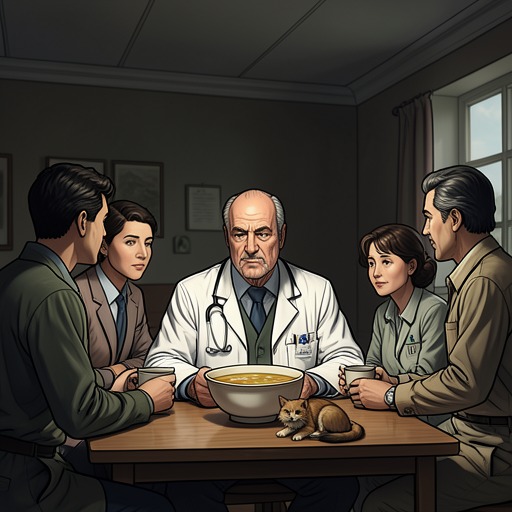
Dick believes in veterinary advice and calls James Herriot frequently, but each visit also brings a ritual of welcome. The family stops work to sit and watch him drink tea. On Sundays all nine Rudds gather around him in what James describes as an admiring circle, receiving his remarks with nods and smiles. The attention flatters the young vet, yet it also makes him feel humble. Their welcome is not confined to the kitchen: after visits, he regularly finds home-made scones or a few eggs on the seat of his car, gifts whose cost and generosity matter in a household with so little to spare.
Dick’s humor emerges in his solemnly formal answers to ordinary requests. Asked to hold a cow’s nose, he says he will endeavour to do so; when a square of plywood must be lifted to free a calf, he announces that he will raise the portcullis. The jokes are small, but their effect is not. They reveal a cheerful manner sustained amid difficult work, and help explain why James Herriot sees in Dick both the tough philosophy and unthinking hospitality he associates with the Dales, as well as an individual integrity and humor of his own.
Building a Better Herd
Dick’s ambition is to improve his stock until Birch Tree Farm has a dairy herd worthy of his ideals. He knows that, without money behind him, progress will be slow and that the goal may not be realized in his lifetime. He nevertheless works toward a future in which people will come to admire the farm’s cows, perhaps when his sons are grown.
James Herriot witnesses the first visible sign of that project when Dick stops him on the road one morning and leads him into the byre. The existing herd is a varied collection assembled over years: older cows discarded by more prosperous farmers for their udders or because they are three-titted, alongside rough-haired animals Dick has raised himself. Among them stands a cow whose quality is immediately apparent, a Dairy Shorthorn with a broad pelvis, fine shoulders, a level udder, and a dark-roan coat. Dick calls her Strawberry, though she has a grand pedigree name.
For Dick, Strawberry is more than an impressive animal. He expects her to produce heavily, values her high butterfat, and believes a calf from her will be worth something. In the primitive byre, she represents the foundation of the herd he has long wanted. James Herriot sees the same promise: Strawberry turns Dick’s distant ambition into something present and tangible, standing in sharp contrast with the worn, mixed company around her.
Strawberry’s Illness and Their Friendship
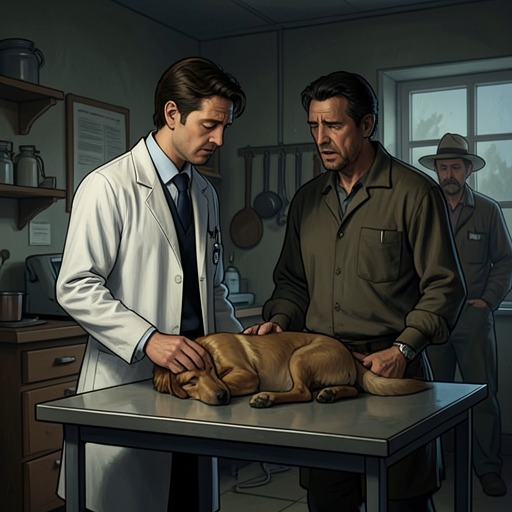
About a month after seeing Strawberry in the byre, James Herriot receives a call from Dick. The cow has been doing well and giving plenty of milk, but something is wrong. She does not look seriously ill and is still eating, yet she gulps slightly when swallowing. Her temperature is normal and her lungs are clear; at her head, the vet hears a faint snoring sound. He suspects an abscess behind the throat, a dangerous possibility because it lies in an inaccessible place and could interfere with breathing if it grows.
James Herriot checks on Strawberry over the next ten days. The abscess steadily develops while the cow eats less, loses weight, and gives less milk. The injections he tries offer little prospect of solving the problem; in his judgment, relief depends on the abscess rupturing. The delay leaves him feeling helpless. When Siegfried Farnon is away at an equine conference and James is stretched by other work, Dick comes to tell him that Strawberry has deteriorated sharply over three days.
At Birch Tree Farm, the sight of the cow stops James Herriot in his tracks. The show animal has lost flesh until she looks almost skeletal. Her rasping breath carries through the byre; her cheeks puff as she exhales, and her eyes remain fixed in terror on the wall. A painful cough brings saliva from her mouth. The contrast with the healthy, valuable cow Dick had proudly shown him makes the illness a direct blow to the promise the animal had represented. The account establishes the severity of Strawberry’s condition and the strain it places on both farmer and vet, without making her subsequent outcome part of Dick’s characterization here.
Their connection extends beyond treatment and the farm. Dick invites James Herriot and his wife to the Rudds’ silver wedding anniversary, explaining that the family has booked a room at the King’s Head in Carsley and intends to celebrate properly. The invitation follows the accumulated visits, the farmhouse tea, and the small gifts left in the car: it marks James not merely as a veterinarian whom Dick trusts, but as a friend the family wants among its guests.
Significance
Dick’s story places pastoral beauty beside the labor and vulnerability that sustain it. The surrounding hills and changing seasons can seem idyllic, but a farmer’s life is also shaped by poor resources, long hours, weather, and the uncertain health of livestock. Dick’s rain-soaked bicycle journey and his dependence on a small, motley herd make that material reality visible; his hospitality and humor show that hardship does not exhaust his character.
Strawberry concentrates the tension between aspiration and risk. She is at once a productive animal, a valuable prospect, and the beginning of the herd Dick hopes to leave to the next generation. Her illness threatens more than milk or market value: it imperils a carefully held future. Through Dick, James Herriot encounters a farmer whose dignity rests not on wealth but on persistence, trust, and the generosity with which he shares what little he has.