Handshaw’s cow’s pelvic fracture and continued recumbency
All Creatures Great and SmallHandshaw’s cow’s pelvic fracture and continued recumbency are the stubborn aftermath of an illness that initially seemed to yield to treatment. James Herriot brings the cow through Milk fever, but her failure to rise transforms recovery into a crisis of diagnosis, prognosis, and trust. As the cow remains alert and eating on the ground, repeated injections and collective efforts fail to settle the question that matters most to her owner: whether she can stand again.
Diagnosis and the first recovery
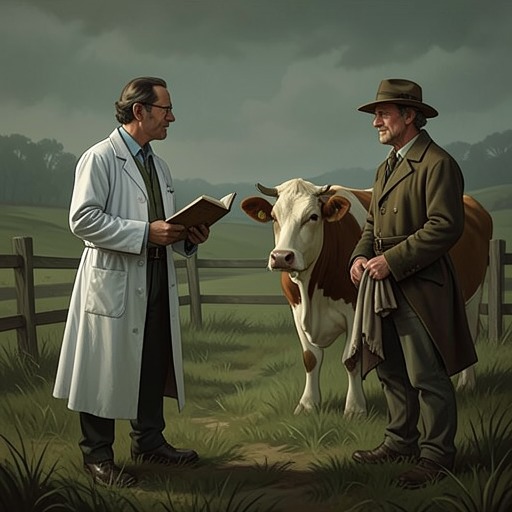
Herriot is a year into veterinary practice when Siegfried Farnon sends him to treat a case of Milk fever. The condition is described as a sudden calcium deficiency in high-yielding animals just after calving, causing collapse and progressive coma. The cow is found motionless on her side, so still that Herriot has to check carefully that she is alive. By 1938, calcium therapy has made it possible to reverse many such crises rapidly. Herriot carries the two-bottle treatment and gives one injection into a vein and the other under the skin; after he and Handshaw roll the cow onto her chest, she begins looking about and shaking her head.
Because other calls are waiting, Herriot does not stay to see whether she gets to her feet. He expects the improvement to continue and asks Handshaw to call if she is still down by dinner. At midday, she has not risen, so he returns and gives her another bottle of calcium. Her persistent recumbency, rather than the initial collapse, becomes the case’s defining problem. Handshaw interprets the diagnosis of a broken pelvis as a prediction that she will never stand again, but does not believe Herriot’s assessment; he points to the cow chewing her cud and invokes his deceased father’s ability to get cows up.
Treatment loses its apparent certainty
At first Herriot is not greatly alarmed when the cow remains down the following day. Handshaw is more disappointed, and the difference between them sharpens as the familiar remedy seems to have failed. Herriot administers further calcium, but the procedure has lost its persuasive force for the farmer. When Handshaw calls again before breakfast to report no change, the cow has been down for forty-eight hours. She is eating heartily, yet makes no effort to rise.
The contrast complicates the meaning of recovery. Herriot considers the original Milk fever overcome because the cow eats well and appears content, but her inability to stand points to another problem. He suspects posterior paralysis and decides that more calcium will not help. He tries a stimulant injection despite having little confidence in it, describing the choice as the last available resource rather than a treatment he expects to work. The cow’s condition exposes a gap between correcting the acute illness and restoring the animal’s ability to stand: apparent improvement does not resolve the consequences of prolonged recumbency.
Herriot explains that a cow may seem to have recovered from the first ailment and still be unable to rise. For a fully recumbent dairy cow, that distinction has severe practical consequences: she has no future if she remains down. His concern is therefore not simply whether the cow looks comfortable or continues eating, but whether she can regain mobility. Handshaw’s hope, by contrast, rests partly on what he can observe in the moment and on his faith in his father’s judgment.
Inherited remedies and the failed lift
Handshaw proposes that a cow which stays down has a worm in its tail, and that cutting off the tail’s end will make it rise. Herriot rejects the explanation and the procedure. He knows that the remedy can appear to work because the painful stump touches the ground and prompts a cow to scramble up; that apparent success does not make the practice sound. He also warns that the R.S.P.C.A. had recently brought a man to court over such an operation. The disagreement is both practical and ethical: the farmer wants an action that might force the cow to stand, while Herriot refuses an intervention he regards as cruel and based on a false diagnosis.
Handshaw then suggests shouting into the cow’s ears, another method attributed to his father. Herriot, with little room left to preserve professional dignity, grabs the cow by the ear and bellows into it. She pauses chewing, looks at him, then lowers her eyes and resumes cud-chewing. The attempt changes nothing. Herriot says they will wait another day and, if she remains down, try to lift her with help from the neighbours.
The next day brings no improvement. Handshaw’s neighbours gather in a buoyant mood, full of advice about someone else’s animal. They slide sacks under the cow and, amid laughter and teasing, make a concerted effort to raise her. The cow hangs placidly with her legs dangling instead of taking weight or standing. The collective lift therefore makes the physical impasse unmistakable: strength and good will can raise her body, but cannot make her rise under her own power. The group lowers her again, and the neighbours look to Herriot for what to try next. Handshaw offers one more of his father’s suggestions—that a strange dog would get a cow up—but the evidence here records the proposal, not its outcome.
Clinical limits and the meaning of remaining down
The case places veterinary knowledge beside rural experience without making their conflict merely a contest between expertise and ignorance. Handshaw’s remedies are inherited and, in the tail-cutting story, may seem confirmed by a visible result; Herriot understands why that result can mislead, and refuses to reproduce it at the cow’s expense. Yet his own treatment is not assured. He repeats calcium when the cow remains down, recognizes when further doses are pointless, and turns to a stimulant he does not trust because doing nothing also feels unacceptable.
The historical limits are explicit. Herriot identifies the year as 1938 and contrasts his restricted options with equipment and treatments available thirty years later: the Bagshaw hoist, which clamps to the pelvis and raises the cow naturally, phosphorus injections, and an electric goad capable of prompting some animals to leap up. Their later availability underscores what the present case lacks. At the point reached here, the cow is still recumbent, the neighbours’ lift has failed, and another folk remedy has only been proposed. The unresolved state is the episode’s central fact: successful treatment of Milk fever has not yet answered whether this cow can stand.