Herriot’s Austin car
All Creatures Great and SmallHerriot’s Austin car is both a fragile tool of James Herriot’s veterinary work and the centre of a running joke about care, blame, and mechanical unreliability. Its engine consumes oil, its body bears the marks of age, and its handling demands attention; yet its most memorable episode comes when Siegfried Farnon’s strict instructions to James are contradicted by Siegfried’s own reckless drive.
An old car in daily service
The Austin is allotted to James Herriot for his rounds. It is described as tiny and of an almost forgotten vintage, and getting it started forms part of the daily routine. Old Boardman has the voluntary task of towing it when it will not start. On one morning, however, the engine catches after six turns of the starting handle, allowing James to set off without help. The small detail captures the car’s uncertain status: indispensable to the work, but not reliably ready for it.
The Austin’s condition is not merely an inconvenience in the background. James depends on it to reach the visits where the practice’s cases and pressures await him. Its routine appearance at the beginning of a working day therefore connects the vehicle to the practical demands of rural veterinary work: the car must carry the vet out to his patients, while its age and mechanical needs remain an ongoing complication.
Reboring and rules for careful use
The problem becomes harder to ignore as the Austin’s oil consumption rises. It had been using two pints a day, a rate Siegfried had not considered excessive; when the amount reaches half a gallon daily, he decides that something must be done. A farmer’s observation that the young vet could be spotted by a blue cloud of smoke visible from miles away adds a public, comic measure of the fault. The car’s condition is no longer private evidence known only to its driver: it announces itself across the countryside.
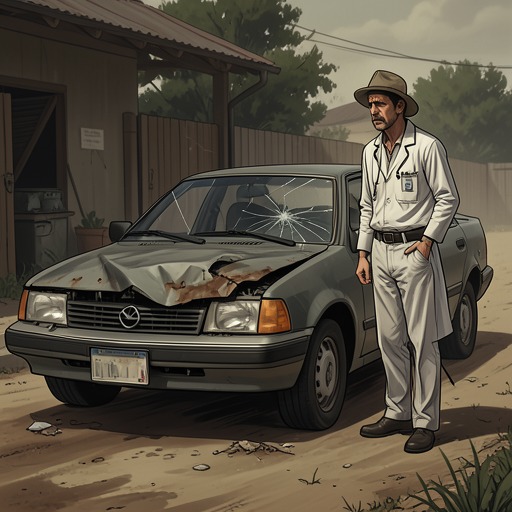
After the garage has rebored the engine, Siegfried fusses over the Austin. He presents the work as an expensive renewal and insists that James now has, in effect, a new car. His demonstration under the bonnet complicates that confident description. The engine is black and oily, with pieces of flex and rubber tubing hanging among its components; the bonnet opens with rust and dirt falling from it, and the windscreen is cracked. The contrast between Siegfried’s language of a newly restored machine and the car’s visible condition gives his instructions a touch of absurdity even before the later drive.
Siegfried nevertheless lays down precise limits. James is to nurse the engine for the next two or three thousand miles, keep to thirty miles an hour, and avoid driving it hard. Siegfried’s warning makes the Austin an object requiring care, but also establishes the standard by which the later episode will be judged. James takes the instruction seriously: he crawls around his visits at almost walking pace for the rest of the day.
Siegfried’s night drive
That evening Siegfried asks James to bring the Austin around so he can drive two farm lads home. They have missed the last bus after playing dominoes with him at the Black Bull. James gets into the back as Siegfried lowers himself unsteadily into the driving seat. The trip begins on the main road, then turns onto a narrow track twisting across a dark hillside in the North Moors.
The pace soon overturns the morning’s instructions. Siegfried keeps his foot down as the engine rises to a strained roar, and the car hurtles along the rough track. James calls out a reminder that the engine has just been rebored. Siegfried acknowledges it, but carries on: the Austin leaves the road and bounces over grass at sixty miles an hour before finding its way back. The farm lads’ grins disappear; they sit rigid and silent. The scene makes the car’s vulnerability concrete through the passengers’ response and the repeated loss of the road beneath its wheels.
The return journey is no gentler. Going downhill, Siegfried drives faster, and the Austin leaps and bumps over the uneven surface. It makes several brief departures onto the surrounding moors before the group gets home. The account does not report a breakdown or injury, but the journey puts the car through precisely the sort of hard use Siegfried had forbidden. James’s earlier, painstakingly slow driving stands in sharp contrast to Siegfried’s conduct at the wheel.
Blame and comic reversal
A month later, Siegfried again takes James to task over the Austin. He describes it as recently rebored and in excellent condition, then complains that it is drinking oil and calls James a terror with cars. The charge returns the narrative to the same mechanical problem that prompted the repair, but now the reprimand carries an irony established by the night drive: Siegfried himself had ignored the speed limit he set and driven the car across the rough hillside at high speed.
The Austin’s role in the episode is therefore more than that of a worn vehicle. Its recurring oil consumption, difficult starting, and weathered parts make it a practical presence in James’s work, while its rebore briefly gives Siegfried a reason to impose rules. The drive exposes how readily those rules can be suspended by the person who made them. The closing accusation leaves the car’s eventual mechanical fate unstated, but preserves the comic imbalance: after Siegfried’s own reckless journey, James is once again held responsible for the Austin’s condition.