Isaac Cranford
All Creatures Great and SmallIsaac Cranford is a prosperous but famously ungenerous farmer whose dealings with the veterinary practice expose a recurring tension between his certainty and professional diagnosis. When a cow dies, he attributes the death to lightning; examination instead identifies a heart condition. A later package mix-up prompts him to accuse the practice of insulting him and endangering his boar, carrying the conflict from disagreement over evidence into a threatened break in their relationship.
Identity and Reputation
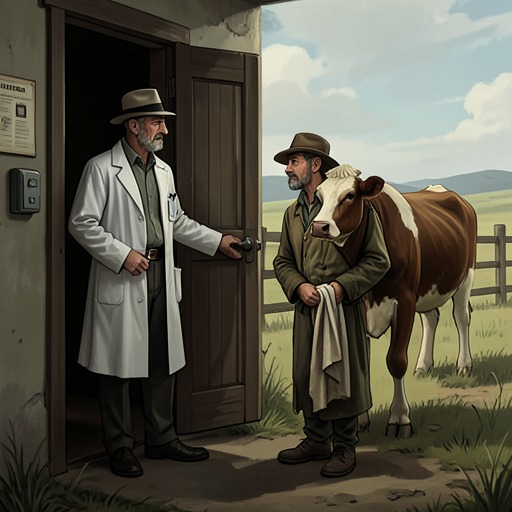
Cranford farms some of the best land in the lower Dale. His shorthorns regularly win prizes at agricultural shows, marking him as a successful breeder as well as a landowner. Yet this standing does not make him socially popular: the account presents him as austere, a sharp bargainer, and determined to win at any cost. Neighbours characterize his thrift as extreme, and he is described as having no friends. His public identity therefore rests on a contrast: he can produce prize-winning stock, but his reputation among those around him is defined by hard bargaining and isolation.
That reputation shapes how his encounter with the veterinary surgeons is read. The narrator acknowledges Cranford’s forceful character but does not reduce the dispute to a simple clash between a bad-tempered farmer and competent professionals. Cranford has an immediate practical concern: he has lost a cow and wants its death explained. His manner makes the exchange difficult, but the central conflict turns on what the evidence from the animal can establish, and on whether he will accept that evidence when it contradicts his account.
The Cow and the Competing Explanations
The meeting at Jeff Mallock’s knacker yard began with a telephone call from Cranford the previous afternoon. He reported that a cow had been struck by lightning and was dead in a field. The narrator questioned whether lightning was plausible because no storm had occurred where he was. Cranford answered that the weather had been different in his own locality. The exchange establishes that he was not merely repeating a diagnosis supplied by someone else: he had a specific explanation, grounded in what he believed had happened on his farm.
The following day, Cranford was present with the narrator and Mallock while they examined the cow. Mallock owned the yard and had opened the carcass for the inspection. At the narrator’s direction, Mallock cut into the heart. The examination disclosed a cauliflower-like growth on the valves, obstructing the heart’s chambers. The narrator identified the condition as verrucous endocarditis, uncommon in cattle, and explained that it had stopped the flow of blood. He told Cranford that heart failure, not lightning, had killed the cow.
Cranford rejected the conclusion. He doubted that the growths could kill an animal as large as a cow, while the narrator maintained that they were large enough to block circulation and that the diagnosis was certain. The exchange leaves the disagreement clearly defined: Cranford’s proposed cause is displaced by a specific finding and an explanation of its effect, but the evidence does not show him accepting the veterinary conclusion. His response instead keeps his confidence in dispute with the account based on examination.
The Sample-Package Dispute
Cranford’s name returned to the practice three days later, when Siegfried Farnon opened the morning mail and found a letter written on blue notepaper. Siegfried described the letter as intensely hostile. According to his account, Cranford declared that he would have no further dealings with the practice and was considering legal action. The complaint concerned a package that Cranford said had reached him as a tin of cow dung, accompanied by instructions to rub it on his boar’s back three times a day. He regarded the delivery as a gross insult and said it put the boar’s health at risk.
The surrounding circumstances make the accusation part of a practical packing failure rather than an intended insult. The practice had run out of small glass sample jars. Siegfried told Tristan to use a tin, press its lid down, wrap it in brown paper, and send it to the laboratory. The account places this instruction shortly before Siegfried receives Cranford’s complaint; the broader episode identifies the parcels as having been sent to the wrong destinations. The juxtaposition explains how a routine shortage and dispatch error could acquire, for Cranford, the meaning of a deliberate affront. It does not establish that he knew about the shortage or accepted an explanation for the mix-up.
Conflict and Narrative Function
The two disputes give Cranford a consistent but not identical kind of opposition to the veterinary practice. In the first, he resists a diagnosis that contradicts his belief about the cow’s death. In the second, he interprets a mistaken package as an insult and a danger to another animal, then threatens to end the professional relationship and consider legal action. One conflict concerns the cause of death; the other concerns the conduct and reliability of the people who treat his animals. Together they show how a clinical disagreement can be compounded by the ordinary vulnerabilities of rural practice, where diagnosis, samples, correspondence, and trust all matter.
Cranford’s characterization also depends on the distance between reputation and observable action. His neighbours’ judgments establish a broad local image of meanness, while the scenes with the veterinarians supply concrete grounds for his contentious reputation: he bargains hard, contests the explanation of his cow’s death, and responds forcefully to the misdirected tin. At the same time, the account reports his concerns about his boar as accusations rather than confirming that the animal was harmed. His role is therefore not simply that of a difficult client; he is the person through whom the narrative brings professional certainty into contact with a farmer’s own convictions and with the consequences of an error in the practice’s routine work.