James Herriot
All Creatures Great and SmallJames Herriot is a newly qualified veterinarian whose movement from insecure job-seeker to experienced rural practitioner is shaped by the unpredictable work of the Dales. His cases expose the distance between textbook knowledge and practical judgment, while the rhythms of Skeldale House, farm life, and his relationship with Helen give him both professional purpose and a home in the region.
Identity and entry into practice
When a letter arrived from Darrowby inviting him to meet Siegfried Farnon, Herriot had little reason to expect a veterinary career. Friends who had qualified alongside him were unemployed or working in shops and shipyards, and he had begun to relinquish hope of finding work in his profession. The proposed arrangement was conditional: after tea, the two men would decide whether they suited one another, and Herriot might stay as an assistant. He regarded the invitation as a lifeline, a first opening into the working life that he had feared was unavailable to him.
That beginning establishes the precariousness of his position. He enters Skeldale House with professional training but without the confidence or experience that rural practice demands. The work does not arrive as a sequence of controlled demonstrations. It comes at all hours and among people who may already have their own ideas about what is wrong and what should be done. Herriot’s education therefore continues in the field, under pressure to make decisions whose consequences belong to living animals and their owners.
Learning through cases
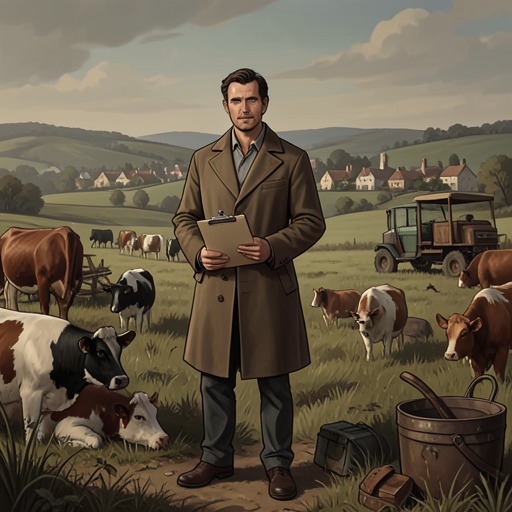
Herriot’s first examinations make clear how quickly an apparently routine call can become a test of judgment. At a difficult calving, he recognizes that the decision to stay for prolonged work or leave soon depends on what his examination reveals. The case also teaches him something about local authority: a farmer’s relative, treated by the family as a sage, offers advice that the Dinsdales hear with deference. Herriot has already noticed that farmers often consider one another’s opinions more valuable than a veterinarian’s, particularly when the animal belongs to someone else. The young practitioner must establish his judgment in a setting where professional status does not automatically command trust.
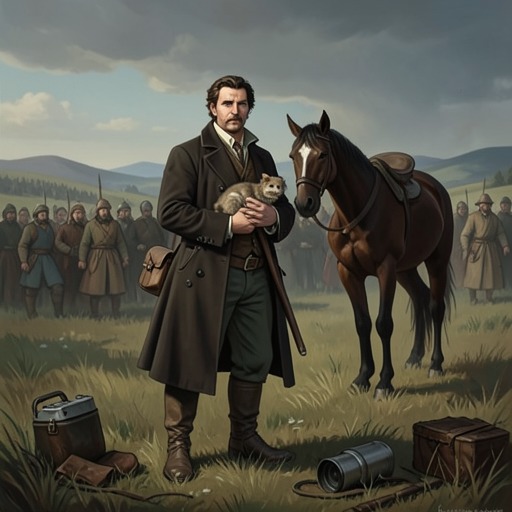
A case involving a bay horse with severe colic further tests his ability to distinguish a serious condition from an ordinary one. The horse’s distressed state leads Herriot to reject the prospect that a simple remedy will be enough. He examines the animal and identifies displacement of the small intestine and an abnormal, tense mass. The significance of the scene lies not in a sudden display of certainty but in the way a physical examination turns a troubling appearance into a more specific clinical assessment. His knowledge has to operate through careful observation and touch, not merely through remembered instruction.
Other calls reinforce the same lesson in different forms. A dog’s markedly swollen abdomen and visible signs of pain prompt unease as Herriot assesses the case. When a dog is brought in with a possible abscess behind the throat, he explains that the condition could be limited but might also threaten breathing if it enlarged; his previous experience has included cases that subsided or resolved without intervention. He is neither able to dismiss risk nor to claim certainty in advance. His practice depends on recognizing what is dangerous, what remains uncertain, and what the available evidence permits him to say.
At a difficult cow delivery, Herriot’s examination identifies a uterine torsion and overturns any hope of an easy resolution. In another demanding examination, he takes an animal’s temperature, listens to its heart and lungs, checks its eyes, and tests its limbs and joints. These episodes show a practitioner assembling knowledge through repeated, hands-on assessments. They also retain the awkwardness of the work: professional seriousness does not remove the physical demands or indignities of examining animals in the circumstances in which they are found.
Professional discipline and authority
Siegfried Farnon gives Herriot a concise rule for the profession: a veterinarian must attend a client’s call, whatever the weather or hour, because an owner cannot reliably decide how urgent an animal’s condition is and an animal may die. The instruction corrects Herriot’s temptation to judge a call from an owner’s description alone. It makes attendance itself an ethical and practical obligation: only by going can the veterinarian learn whether the case has worsened or been misrepresented by incomplete knowledge.
Herriot’s developing authority is also tested by people whose knowledge comes from years of handling animals rather than formal education. Jeff Mallock, who cannot read or write, takes considerable professional pride in his work as a fell-monger. Farmers sometimes ask him to explain what had been wrong with animals Herriot had treated, and Jeff is inclined to use that position to assert his own expertise. The farming community often agrees with him. The resulting friction shows that veterinary authority must be negotiated among practitioners, farmers, and people whose practical experience gives them standing in the community. Herriot’s role is not simply to possess formal training, but to make its value understood amid competing claims to knowledge.
His official duties broaden that role. As a Local Veterinary Inspector for the Ministry of Agriculture and Fisheries, Herriot carries a certificate identifying him for the work and undertakes routine clinical examinations and tuberculin testing. A visit that requires him to walk up Mr. Kay’s field for the ninth time becomes an emblem of the gap between his own sense of time and that of the Dales farmers. The work is repetitive and administrative as well as clinical; practice means returning, recording, and testing, not only responding to dramatic illness.
Skeldale House and the Dales
After only two weeks away, Herriot feels afresh that work in the high country has something he misses elsewhere. On a narrow, unfenced road connecting Sildale and Cosdale, he climbs in bottom gear, pulls onto the roadside turf, and gets out. The pause becomes part of his recognition that the region matters to him beyond its demands as a workplace. The high roads and open country provide a setting to which his sense of belonging can attach, even as his daily work keeps him moving between farms.
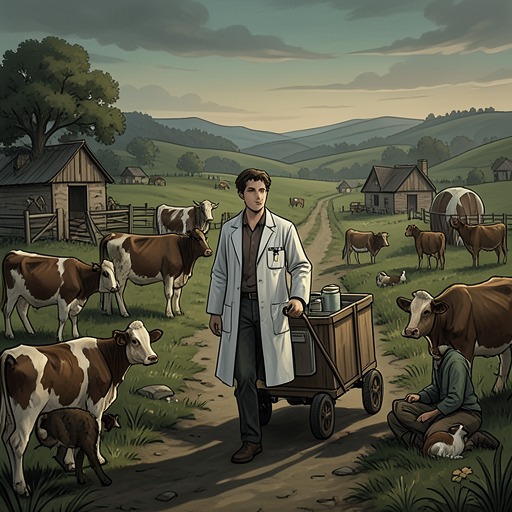
That attachment also grows from the contrasts of life at Skeldale House. Herriot associates its old garden with the sweetness of the morning air and its old house with the daily liveliness of working alongside Siegfried, whom he describes as gifted but mercurial, and Siegfried’s reluctant student brother, Tristan. The cases themselves surprise him with a fascination he had not anticipated. Treating cows, pigs, sheep, and horses gives him a sense of being a small part of the larger system of British agriculture. His satisfaction comes not from mastery over that system but from finding a meaningful place within it.
The workload makes clear how much practical experience has accumulated. Looking back after six months, Herriot counts work with cows, horses, pigs, dogs, and cats across every day of the week and every part of the day. He has calved cows and farrowed sows, sustained the physical consequences of farm work, and encountered a wide range of animal diseases. Yet experience has not produced complacency. A persistent sense that he knows almost nothing remains alongside the record of what he has learned. The contrast is central to his professional development: increased competence brings a sharper awareness of how much remains beyond his command.
Relationships and changing ambitions
Herriot’s relationships at work and beyond it gradually change the shape of his life. Mrs. Pumphrey’s Pekingese, Tricki, sends him gifts and invites him to a party at home, addressing him as Uncle Herriot. Siegfried reads the invitation aloud and treats the dog’s hospitality as evidence of exceptional generosity. The exchange shows Herriot’s place extending beyond the strictly clinical: his work can create affectionate ties between a veterinarian, an animal, and its owner.
His courtship of Helen begins more hesitantly. At the Darrowby Music Society, Herriot spends Tuesday evenings looking at the back of Helen’s head, finding no better way to get to know her. When he finally arranges to pick her up, he feels uneasy outside her home. On other occasions he has entered a farm as the needed veterinary surgeon, someone expected to know what to do; this time he is there to take the farmer’s daughter out, and he worries that her father may resent it. The shift from professional visitor to prospective suitor unsettles the confidence his work usually supplies.
Siegfried urges him not to let work and study consume his entire life. He points out that Herriot works long hours and studies his cases whenever he is not working, then encourages him to get out and meet people. Later, Siegfried directly asks whether he is courting Helen. Herriot initially thinks his friend’s opinions ridiculous, but the intervention prompts him to raise marriage with Helen. She says she would like to marry him, and they set their sights on an early date. Herriot’s own retrospective account credits Siegfried’s chance remarks with helping to bring about this decision; the advice alters the course of his personal life rather than merely supplying comic commentary on it.
Marriage, recognition, and narrative role
Herriot remembers little of the wedding itself. He describes it as a quiet affair and recalls chiefly Siegfried, his best man, booming Amen at intervals during the ceremony. The memory suits the relationship between the two men: Siegfried’s presence is both personal and unmistakably theatrical, even at a formal turning point in Herriot’s life. Herriot’s own emphasis remains on the odd, particular detail rather than on a grand account of the occasion.
A new veterinary plaque marks a change in his standing at Skeldale House. Beneath Siegfried’s slightly askew brass plate, Herriot’s own plaque appears, bearing his name and professional title. Unlike the older plate, it is fixed straight and level. The small visual contrast gives public form to Herriot’s growing professional identity: he is no longer only the assistant who arrived hoping to be accepted, but a veterinarian whose name is displayed alongside Siegfried’s.
The character’s development is conveyed through a first-person narrative that repeatedly looks back on earlier uncertainty from the vantage of later experience. Herriot’s reflections place demanding examinations, routine inspection work, rural customs, friendship, and courtship within one continuous account of becoming. His progress is not a simple conversion from ignorance to expertise: six months of hard work can coexist with the feeling that he knows little, and professional confidence in a case does not erase uncertainty about the next one. By the time his own plaque hangs at Skeldale House and he has married Helen, the young man who had nearly given up hope of veterinary work has acquired a profession, a community, and a family future.