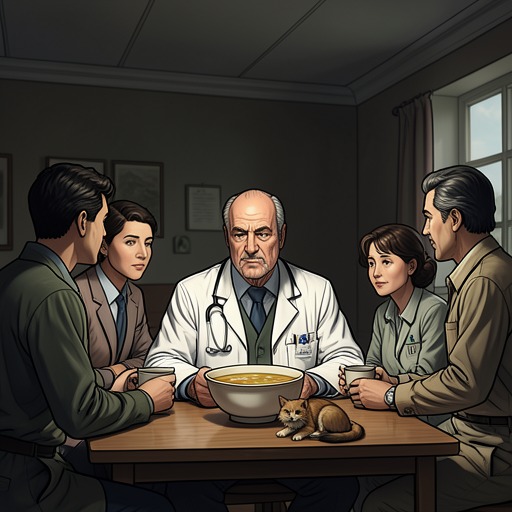
James Herriot and Dick Rudd
All Creatures Great and SmallThe relationship between James Herriot and Dick Rudd grows out of veterinary calls at Birch Tree Farm into a friendship grounded in trust, hospitality, and shared concern for the animals. Dick looks to Herriot for advice and welcomes him as a friend; Herriot, in turn, admires the effort behind Dick’s farming life and feels the weight of Dick’s confidence when Strawberry falls seriously ill.
First Meeting and the Work of Farming
Herriot first meets Dick on a winter morning at the door of Skeldale House, at six o’clock. Dick is muffled in an old army greatcoat and balaclava, standing beside his bicycle while rain pours over the pavement. The circumstances of the call reveal the demands of his ordinary life: he has spent the night with a heifer, has no car or telephone, and faces an eight-mile ride home before another hard day’s work. Herriot’s recollection of Dick cycling away in the rain makes the small farmer’s labor a measure against which the veterinarian’s own occasional exertions seem slight.
This first impression helps explain the respect at the heart of their friendship. Herriot does not present Dick’s work as an abstract hardship; he remembers the particular journey, the night spent caring for an animal, and the work still waiting at the farm. The memory also gives their later veterinary encounters a human context: Herriot is treating animals for a farmer whose daily life already involves sustained, practical care.
Birch Tree Farm and a Family’s Welcome
Dick believes in seeking veterinary advice, so Herriot becomes a frequent visitor to Birch Tree Farm. The calls are followed by a consistent gesture of hospitality: Dick asks him into the house for tea, and the family stops its work to sit with him while he drinks. On weekdays, the eldest daughter is away at work and the boys are at school; on Sundays, all nine Rudds gather around. They listen closely and greet Herriot’s remarks with nods and smiles.
The attention pleases Herriot, but it also makes him feel humble. He sees that Dick’s family shares the farmer’s outlook, and their laughter and welcome make him feel that they regard him as a friend. The exchange is not simply a professional audience for his advice. It is a repeated act of inclusion: the household pauses, makes room for him, and treats his presence as part of the visit.
That welcome extends beyond the tea table. Whenever Herriot leaves the farm, he finds something on the seat of his car, such as homemade scones or three eggs. Mrs. Rudd gives these gifts despite the apparent limits on what the household can spare. The small provisions make the family’s regard tangible, and their recurrence turns hospitality into an ongoing part of Herriot’s relationship with the Rudds.
Dick’s Ambition and Strawberry’s Arrival
Dick’s hopes for Birch Tree Farm are focused on improving his stock until he has a dairy herd that meets his own standards. He knows that, without money behind him, the work will be slow; he accepts that its fullest result may come only when his sons are grown. The ambition nevertheless has a clear object: he imagines people one day coming to admire the cows at Birch Tree.
Herriot witnesses the beginning of that project when Dick stops him on the road one morning and leads him into the byre. Dick’s suppressed excitement signals that something important has happened. There he shows Herriot a cow whose quality is immediately apparent to the veterinarian. A month later, Dick phones about Strawberry, saying she had been doing well and producing plenty of milk, but something seems wrong that morning. Her place in the herd gives the call significance beyond an ordinary examination: she is both a valued animal and part of the improvement Dick has worked toward.
Herriot suspects a problem in Strawberry’s throat and explains that an abscess behind the throat can be difficult to reach and, if it grows, can interfere with breathing. He speaks lightly, but his experience leaves him uneasy. The episode exposes the limits of reassurance: Dick has brought him a problem he trusts him to assess, yet the diagnosis carries uncertainty and the possibility of a grave outcome.
Strawberry’s Illness and Mutual Trust
When Herriot returns to the byre, Strawberry has deteriorated severely. The once-prized cow has lost much of her condition, breathes with difficulty, and appears frightened. The change from the productive animal Dick had described is stark. Herriot recognizes how serious the situation has become, while Dick faces the possible loss of a cow connected to his hopes for the farm.
Herriot cannot offer a confident recovery. At one point Dick acknowledges that Strawberry may not survive until the following day, but he also tells Herriot that he has done everything anyone could do. Later, after another assessment, Herriot says he has nothing more to try at that moment. Although he fears the case is hopeless, he does not want Strawberry to suffer unnecessarily and judges that she is distressed but not actually in pain. He asks Dick not to call Jeff Mallock yet and proposes waiting another day, with Strawberry to be sent in if her condition remains unchanged.
The decision is marked by Herriot’s sense of failure and Dick’s steadiness. As Herriot leaves the yard, Dick tells him not to worry, recognizes that such things happen, and thanks him for his efforts. Dick’s response does not erase the uncertainty or establish Strawberry’s eventual fate; it changes the immediate burden of the scene by refusing to turn a difficult outcome into blame. His confidence in Herriot persists even when the veterinarian cannot promise success.
Friendship Beyond the Call
Dick’s invitation to Herriot and his wife to attend the Rudds’ silver wedding anniversary shows how far the connection has moved beyond the terms of a veterinary visit. The celebration is to be a modest gathering, but Dick expressly wants Herriot there as a guest. The invitation belongs to the same pattern as the tea, the family’s attentive welcome, and the food left in the car: the Rudds treat the veterinarian not only as a professional whose advice they value, but as someone they want included in their family life.
The friendship is reciprocal without being presented as identical in circumstance. Dick relies on Herriot’s veterinary judgment and shares the gradual ambition he has for his herd; Herriot recognizes Dick’s labor, is moved by the family’s generosity, and feels responsible when Strawberry’s condition defeats his expectations. Their relationship is therefore shown through practical acts rather than declarations: a difficult journey, a farm visit, tea with nine family members, gifts for the road, confidence placed in veterinary advice, and consolation when that advice cannot secure an easy outcome.