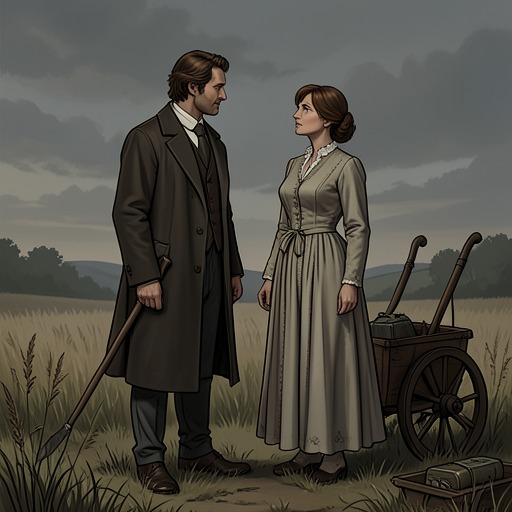
James Herriot and Helen Alderson
All Creatures Great and SmallJames Herriot and Helen Alderson’s relationship develops through a sharp contrast between romantic expectation and practical companionship. James’s first attempt to take Helen out becomes a chain of mishaps and strained silences, leaving him convinced she has rejected him; when they meet again over her injured sheepdog, Dan, the conversation flows with the ease their first date lacked. These episodes establish an important pattern: James is most at ease with Helen not when trying to stage an impressive evening, but when helping with an animal she loves.
The first date: anticipation and self-consciousness
James’s first planned evening with Helen begins with Tristan’s elaborate vision of what a successful date should be. Tristan urges him to take her to The Reniston, describing its luxurious reputation, Saturday dinner dance, and expensive meal as a chance to impress her. The proposed dinner-jacket is part of the same performance. James is so absorbed by the imagined closeness of Helen at the dance that the warning about the cost barely registers. Tristan then helps him dress, carefully adjusting the outfit and assuring him that he looks distinguished. His practical encouragement gives shape to James’s hopes, but also raises the stakes: the evening becomes an occasion on which James feels he must prove himself.
That pressure follows James to Helen’s family home. He has previously arrived at farms as a veterinary surgeon, a person summoned because he knows what to do and can offer help. This time he is there to take Mr. Alderson’s daughter out, and the change in his role unsettles him; he worries that Helen’s father may resent the visit. While he waits, the silence in the kitchen lengthens around the ticking clock, the children’s barely concealed amusement, and Mr. Alderson’s continued reading. The contrast between James’s familiar professional authority and his uncertainty as a suitor makes the visit feel like a test for which his veterinary experience has not prepared him.
When Helen finally appears in a blue dress and camel-hair coat, James is struck by her. The surrounding kitchen is plain, but his attention fixes on her quiet smile and appearance. His response is not matched by immediate conversational ease. In the car he relies on remarks about the weather until they reach a flooded dip in the road. The engine stops, the water comes into the car, and James apologizes for getting Helen’s feet wet; she has tucked them onto the seat and suggests that they push. The predicament punctures the polished evening Tristan imagined before it has properly begun. Helen responds practically, while James is left to manage both the car and his embarrassment.
A costly evening and an assumed rejection
At The Reniston, the dinner does not restore the confidence James hoped to gain. He struggles to decipher the French menu, tries to hide his dirty nails, and works hard to keep conversation moving. Around them, other diners talk and laugh while silences stretch between him and Helen. James interprets those pauses through his own fear: he imagines she accepted the invitation only out of politeness and is enduring a boring evening. The account establishes that this is his conclusion, not a confirmed statement of Helen’s feelings.
The journey back through the Dales continues the same pattern of strained remarks and silence. Helen thanks him for a lovely evening, but James notices a tremor in her voice and an anxious, withdrawn expression in the moonlight. He says goodnight and drives away without resolving what she thought of the date. Later, Tristan identifies the outing as the reason James has been unusually edgy. James says that he has neither seen nor heard from Helen since and treats that absence as proof that the relationship is over. His response shows how quickly uncertainty hardens into rejection in his mind; the evidence gives no indication that Helen has actually told him this.
An encounter at the dance
At a later dance, James is in a humiliating condition: his suit is plastered with clay, Connie is dishevelled and in tears, and he feels physically sick. Helen arrives with a man whose spotless overcoat and appearance James registers as a stark contrast to his own state. For a few moments his vision swims, and he hears Helen before he can properly focus on her. She asks whether they are enjoying the dance, then looks from James to Connie and back again. Her smile remains kind, but her eyes are strained. James cannot speak and only nods; although he briefly imagines embracing her, he discards the impulse. Helen says they must be off and leaves with her companion.
The encounter does not settle the meaning of the first date or disclose Helen’s relationship with the man who accompanies her. Instead, it shows James encountering her again at a moment when he feels most exposed. His attention is caught by her familiar kindness and beauty even amid the noise and confusion, while his silence leaves him unable to turn recognition into conversation. The scene keeps the relationship unresolved rather than supplying a simple explanation for the distance between them.
Dan brings them together again
The next clear opening comes when Helen asks whether James can see her dog. Her voice stops him in the passage; through the waiting-room door he first sees only a hand resting on the head of a sheepdog and the edge of a tweed skirt. When he enters, Helen greets him with the same steady, friendly smile he remembers from their first meeting. Their reunion begins not with an explanation of the date, but with Dan’s trouble. Helen describes him as the family sheepdog and says the family is so fond of him that he is more like one of them.
After Dan’s treatment, Helen and James share tea. The visit recalls an earlier tea with a girl at Skeldale House, but this time James feels on his own ground. He notices Helen’s dark hair and blue eyes at close range, yet what most distinguishes the encounter from the first date is how readily they talk. He considers that his ease may come from the setting, or from the presence of a sick animal; either way, conversation flows as naturally as it had when they first met on a hill. The empty teapot and finished biscuits mark the visit’s unhurried length before Helen leaves and James returns to his rounds.
That evening, Helen telephones with news that Dan is up and walking, though still a little wobbly, and sound on the injured leg. James responds with relief and confidence that the dog’s recovery will continue. The call extends their connection beyond the clinic visit: their conversation now has a shared concern and a hopeful outcome. In these episodes, the relationship remains at an early and uncertain stage, without a declared commitment or a clear account of Helen’s feelings. Its movement is nevertheless distinct: a failed performance gives way to a reunion in which professional care, affection for Dan, and easy conversation let James and Helen meet on more comfortable terms.