Jeff Mallock
All Creatures Great and SmallJeff Mallock is the owner of Darrowby’s knacker yard, a practical resource for James Herriot and a persistent rival authority on animal disease. Mallock’s work gives him close knowledge of dead and diseased livestock; his certainty about what that knowledge proves, however, turns the yard into a place where veterinary judgment can be tested, disputed, and sometimes undermined.
The fell-monger and his yard
Mallock is introduced alongside Isaac Cranford and Herriot as the three men gathered in the yard, where they peer into the carcass of a cow Mallock has just opened. The setting is more than a grisly backdrop. Its drab red-brick buildings stand apart from the road, with a short chimney sending up black smoke; inside, carcasses and butchered remains make the place a working landscape of animal death. The account establishes the yard as one of the local institutions through which illness and death acquire an afterlife: bodies become material to inspect, interpret, and use.
Mallock is not simply a figure who receives carcasses. He owns the premises and performs the work, arriving in the country at any hour in a ramshackle lorry to winch up a dead animal and bring it back for processing. He sells fresh meat to a dog-food dealer from Brawton, boils other material into meat meal for pig and poultry rations, and sends bones, hides, and other remains to different uses. The breadth of this work explains why the yard has a useful place in rural veterinary practice, while its relentless conversion of dead animals into products gives Mallock’s occupation a practical authority distinct from the veterinarian’s.
A working relationship with veterinary medicine
Herriot’s contacts with Mallock are frequent because the yard can serve as a crude post-mortem room. When an animal dies after treatment, Herriot can examine it there and check his diagnosis against what is found in the carcass; when a case has baffled him, Mallock’s knife may expose what had remained hidden. The relationship is therefore professionally useful, even though it is not simply collaborative: the same facility that helps a veterinarian investigate a death can also become the stage for a competing explanation of it.
A competing authority on disease
Mallock’s professional role extends from opening carcasses to claiming the right to explain them. He cannot read or write, but takes considerable pride in his work and rejects the label of knacker man in favour of fell-monger. After more than twenty years cutting up diseased animals, he believes his experience has taught him more than any veterinarian knows. The farmers’ willingness to agree gives that belief force beyond the yard: when they bring him animals Herriot has treated and ask what was wrong, Mallock can overrule the veterinarian in the eyes of the very clients whose confidence matters.
His diagnoses form a self-contained pathology, built from folk remedies and assertions rather than the veterinary knowledge he might have gained from his work. Among the conditions he names are “Stagnation of t’lungs,” “Black Rot,” “Gastric Ulsters” and “Golf Stones.” He also attributes a cow’s illness to a “worm i’ the tail,” insisting that cutting off the tail would have made the animal get up. The claim could follow Herriot back to the surgery: farmers would repeat Mallock’s verdict as proof that the veterinarian had misunderstood the case, and arguing that no such disease existed did little to dislodge Mallock’s certainty.
The Cranford dispute
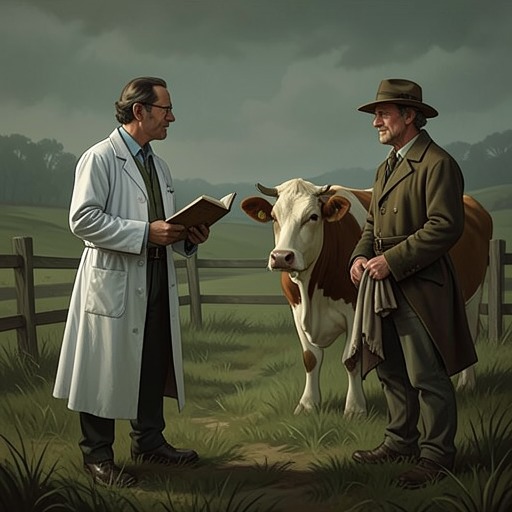
The limits of Mallock’s authority become especially clear in the examination of Isaac Cranford’s cow. At the yard the following morning, Mallock’s account of his earlier visit supplied a miniature performance of diagnosis: he had leapt from his lorry, inspected the carcass, and pronounced “Stagnation o’ t’lungs,” claiming he could recognize it from the animal’s eyes and the way its hair lay along its back. Cranford had answered that the cow had been struck by lightning. The dispute followed them to the opened carcass, where James Herriot could find no bruising and the internal organs appeared clean and normal.
When Herriot refused to provide a death certificate, Mallock stated his own explanation with equal confidence: milk from the milk vein had returned into the body, reached the heart, and formed the clots they were examining. Cranford rejected Mallock’s account as well as Herriot’s, insisting that lightning had killed his cow; he left angry and told Herriot he would never again walk onto his farm. Mallock’s claim did not resolve the evidence, but it sharpened the practical consequences of competing expertise: Herriot’s professional judgment could not settle the farmer’s complaint, and Mallock’s certainty offered no common ground between them.
Narrative Role and Significance
Mallock embodies a distinction between knowing how to handle an animal’s body and being able to establish what its illness meant. The knacker’s yard gives him repeated, material access to the evidence left by disease, and Herriot himself depends on that access when a diagnosis needs checking. Yet Mallock turns practical experience into a sweeping claim of authority, while his invented disease names and confident explanations show how observation can be made to serve a theory rather than test it. The narrative does not dismiss his work: it makes the yard indispensable even as it exposes the limits of his diagnoses.
That tension gives Mallock a consequential place in the rural community. His pronouncements travel beyond the yard because farmers accept them, so veterinary authority is measured not only by examination or professional responsibility but also by who can persuade a client. In the Cranford case, neither Mallock’s certainty nor Herriot’s refusal to certify the death settles the farmer’s conviction; the result is not agreement but a broken professional relationship. Mallock is thus a recurring counterforce to Herriot’s practice, revealing how difficult it can be to distinguish useful experience from unsupported certainty when both claim the authority of knowing animals.