John Skipton
All Creatures Great and SmallJohn Skipton is a wealthy Yorkshire farmer whose rise from uneducated labourer to landowner is matched by a quieter, more revealing devotion to two retired horses. His success rests on endurance and an ability to go against prevailing agricultural opinion; his character comes into fullest view in the daily care he gives animals that can no longer work for him. Through him, practical skill and hard-won prosperity coexist with an affection that resists the assumption that a man with many animals cannot love any one of them.
Identity and Background
Skipton’s estate at Dennaby Close is described as evidence of what he has achieved: a fine old house, extensive farm buildings and a sweep of grassland along the fell. He began as an uneducated farm labourer and became a wealthy landowner. The transformation was neither easy nor comfortable. He spent a lifetime in grinding toil, with little room for family life or personal ease, and his agricultural judgement helped make him a local legend.
His maxim, “When all t’world goes one road, I go t’other,” captures the independence behind that reputation. While other farmers went bankrupt in hard times, the Skipton farms made money. Dennaby Close was only one of his holdings; lower down the Dale he also owned two large arable farms, each about four hundred acres. His achievement is therefore substantial, but the account complicates any uncomplicated image of success: people said his poorest workers lived better than he did. Skipton had gained the means for comfort without learning how to stop working long enough to enjoy it.
At Dennaby Close
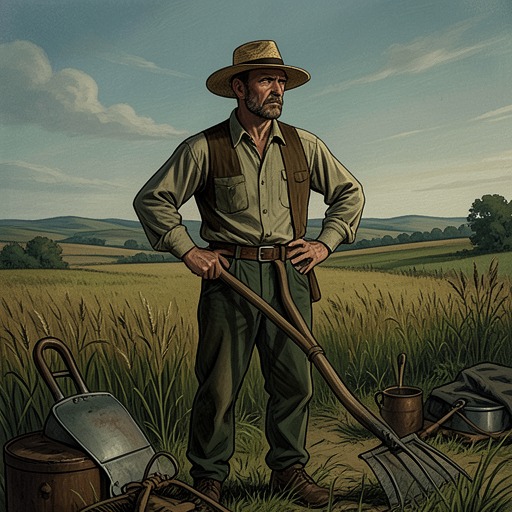
The first impression of Skipton’s estate is almost historical. Visitors came to see the manor’s tall leaded windows, massive chimneys and moss-grown tiles, or to walk through its neglected garden and climb the steps to the broad stone arch and studded door. Against this stately setting, Skipton himself appears in a tattered, buttonless coat held around his waist with binder twine. The contrast does not make him a picturesque relic: it makes visible the distance between the wealth he has built and the comforts he has denied himself.
When he invites James Herriot inside to settle a bill, he calls it “a little bill,” in keeping with the local habit of understatement. The graceful, spacious room is sparsely furnished, with a table, a few wooden chairs and a collapsed sofa. Skipton retrieves papers from behind the clock, sets down an envelope and cheque book, and signs with careful concentration, his cloth cap low over his face. The details suggest a man attentive to accounts and accustomed to a plain life, even within a house that testifies to long-standing prosperity.
The Retired Horses
Skipton’s care is clearest at the riverside refuge where two horses stand in the shallow water, rubbing their chins along one another’s backs. They have a sheltered spot to keep cool in hot weather and a thick-walled barn for winter; they can come and go as they please. The arrangement is not a brief retirement. When Herriot asks when they last worked, Skipton estimates that it was about twelve years earlier. They have spent all that time there, retired, because they have earned it.
For a moment, Skipton explains their history in terms that join their lives to his own: “They were two slaves when I was a slave.” The remark reveals more than the animals’ former labour. He recognizes a shared past of service and hardship, and the quiet retirement he gives them is a form of consideration that he has not extended to himself. Herriot later learns that Skipton visits them every day, whatever the weather, bringing a bag of corn or straw for their bedding. He could have sold the horses to horse-flesh merchants, and they have done no work for twelve years, but he continues to provide for them.
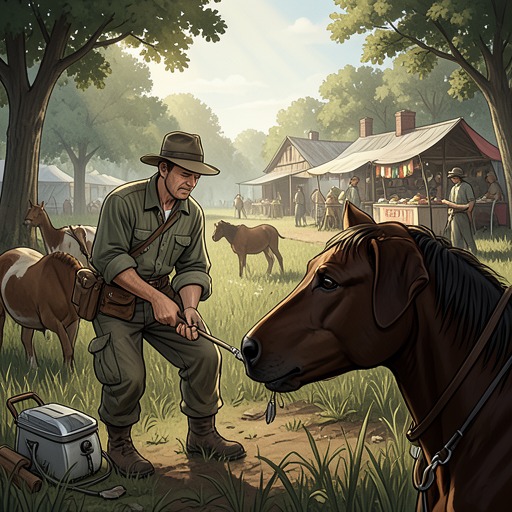
During Herriot’s visit, the vet examines an old horse’s mouth and finds wolf teeth that need attention. The horse stands patiently as Herriot uses a gag and removes the bony projections; even when the work is done, the animal barely reacts. Skipton picks up the removed pieces from the grass, studies them with interest and thanks Herriot, convinced the horse will feel better. His concern is practical as well as tender: he wants the old horse comfortable, and he is pleased to have secured help that may relieve it.
Character and Significance
Skipton’s care unsettles a conclusion Herriot and Siegfried Farnon had nearly reached: that someone with many animals could not be expected to feel affection for individuals among them. Skipton’s farms contain hundreds of animals, yet his daily journeys down the hillside to tend these two horses make that generalization untenable. The book gives the answer plainly: “It could only be love.” The word is earned through repeated acts rather than sentiment alone—the feed and bedding carried through all weathers, the years of retirement, and the attention he gives the horses’ comfort.
His story also holds together two kinds of hardship. The broader rural world is shaped by demanding work, changing farm practice and severe weather; the Dales can appear beautiful, but their beauty does not erase labour or economic pressure. Skipton embodies that tension in an especially personal way. He has mastered the business of farming and accumulated wealth, yet the habits that helped him endure have left him unable to take ease for himself. For the horses, however, he has made a peaceful place beside the water. Their retirement becomes a measure of his capacity for kindness—and of the difference between what he believes he has earned and what he believes they have.