Miss Harbottle
All Creatures Great and SmallMiss Harbottle arrives at Siegfried Farnon’s practice as an experienced company secretary and quickly becomes more than its administrator: she is the person who insists its scattered records, unpriced visits, and disappearing petty cash must answer to an orderly system. Her persistent demands turn the office into a comic but consequential struggle over responsibility, where Siegfried’s authority as employer meets her command of the records he neglects.
Appointment and First Impression
The appointment follows the practice’s latest billing muddle, associated with Tristan’s earlier spell in charge of the bills. Siegfried announces that he has chosen an expert: Miss Harbottle, in her fifties, recently retired after thirty years with Green and Moulton in Bradford, where she had been company secretary. Her former firm’s reference describes her as exceptionally efficient, precisely the quality Siegfried says the slack practice needs. Having decided to live in Darrowby, she is due at ten that morning; Siegfried presents her arrival as a stroke of luck and introduces her with evident triumph.
Her appearance makes an immediate impression. She is broad and high-bosomed, with a round, healthy face, gold-rimmed spectacles, dark curls showing beneath her hat, severe clothes, and brogue shoes. Her handshake is unexpectedly strong. James Herriot’s first greeting becomes a brief trial of strength that ends in a draw; Tristan, less prepared, is held in her grip until his knees begin to buckle. The office is being introduced to someone who will not be easily brushed aside.
The Office She Inherits
Miss Harbottle’s tour of the office reveals what her experience is meant to address. The desk is heaped with incoming and outgoing bills, Ministry of Agriculture and Fisheries forms, drug-firm circulars, loose pill boxes, and tubes of udder ointment. Among the mess she lifts a dog-eared ledger and asks what it is. Siegfried explains that visits are meant to be transferred into it from a day book, which he has to search for on the desk. The intended system exists in pieces, but its everyday use is uncertain.
The cash arrangements are no better. When she asks about petty cash, Siegfried’s answer blurs it with other cash. Miss Harbottle loses some of her colour, says she cannot understand how the practice has carried on that way, and identifies a simple card-index system for the accounts. She expects to straighten out the other administrative problems quickly and sets her start for nine o’clock sharp on Monday. Her response is practical: she does not simply catalogue the mess, but names a method for replacing it.
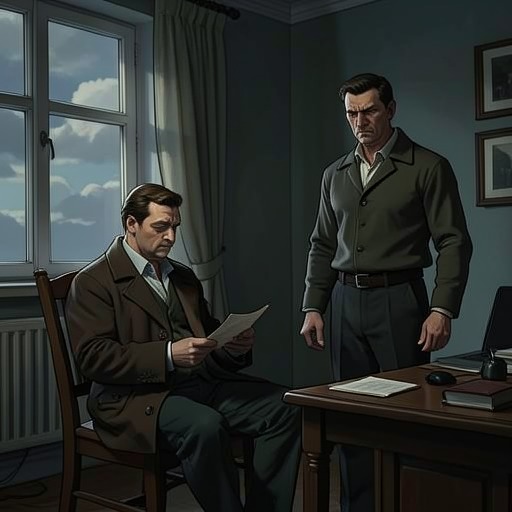
A later image makes the difference between a record and the money it is supposed to record sharply visible. Miss Harbottle sits with her head bowed over a new, shiny black box marked Petty Cash. Inside, a red book lists incomings and outgoings in neat columns, but the box is empty. A solitary sixpence rolls from the pages into it. The records have acquired order; the cash has not. Her shoulders sag, and she identifies the familiar cause: Siegfried has been at the box again.
Rules, Records, and Repeated Disputes
The conflict is not a single misunderstanding. After two months in the practice, Miss Harbottle tells Siegfried that they have gone over his repeated withdrawals about a dozen times. On the occasion James Herriot witnesses, Siegfried explains that he had rushed to Brawton the previous night and found himself short of money. Miss Harbottle requires an account of why he has emptied the cash box once more; his explanation does not resolve the problem she is responsible for recording.
The cash is only one part of her complaint. Siegfried has promised to enter his visits in the book each day and price them as he goes, but nearly a week has passed without an entry. Without that information, she asks, how can she prepare the bills for the first of the month? She also asks him to write legibly: medical terms are difficult enough to decipher without his scribbling. These are concrete obstacles to the work she has been hired to do, not a demand for tidiness in the abstract.
Siegfried’s answer is repeatedly that he must get to the calls waiting for him. He gathers a stomach tube and heads across the room, but her warning throat-clearing brings him back to the unfinished conversation. At another point, a long leather probang hangs over his shoulder as he tries to creep past the half-open office door. The brass end clatters against the wall; Miss Harbottle’s familiar rumble follows, and Siegfried turns, shoulders drooping, to go into the office. His clinical work may call him away, but the neglected administrative work follows him back.
Tactics and Narrative Role
The office itself becomes part of Miss Harbottle’s authority. She has arranged her desk in a corner diagonally opposite the door, with a view across the room, into the passage when the door is open, and out to the street through the window on her left. From there, little escapes her. James Herriot describes the struggle as a war of tactics: although Siegfried is the employer and seems at first to hold the advantage, Miss Harbottle proves resourceful in using the powers her post gives her.
Over the week described, the advantage shifts towards her. She repeatedly draws Siegfried back to the desk with questions, and her throat-clearing grows into an angry bark audible through the house. Most pointedly, she keeps slips of paper recording his clerical errors: misspellings, mistakes in addition, and incorrect entries. She does not produce them indiscriminately. When Siegfried is under pressure, she places a slip before him and asks, “How about this?” He cowers, offers a mumbled explanation and apology, and corrects the entry; she maintains an expressionless face and the bearing of someone whose demand is justified.
Miss Harbottle’s importance lies in how the practice’s daily disorder becomes legible through her work. Siegfried can rush between calls and treat records as secondary; she has to make those calls, their prices, and the cash they generate fit a system. The humor of their contest comes from the reversal: the employer who once appeared able to obstruct her finds himself summoned, checked, and made to correct his own paperwork. In the scenes that establish her role, she is not shown abandoning that effort or bringing the conflict to a final resolution. Instead, her growing command of the office makes the struggle over the practice’s order an ongoing part of its life.