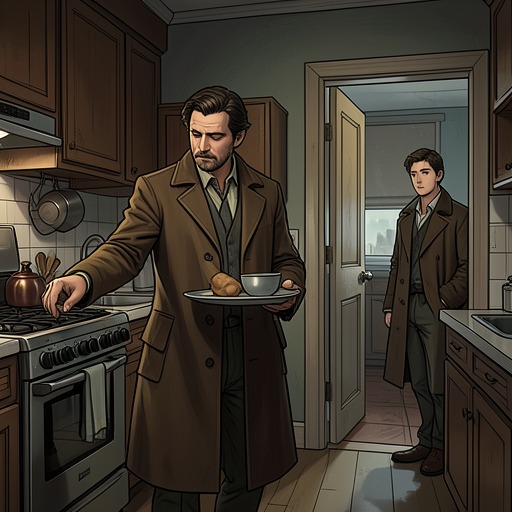
Mr. Alderson
All Creatures Great and SmallMr. Alderson, Helen’s father, is a skilled farmer whose grief for his dead wife and settled hopes for his daughter make him wary of James Herriot. His opposition is quiet rather than openly hostile: he watches James with alarm, then gives no formal answer to the proposal. Yet his affection for Candy, memories of his wife, and habitual humming disclose a man whose feelings emerge more readily in gestures and sounds than in declarations. His eventual ease with James signals acceptance without a ceremonial blessing.
Identity and Household
After his wife’s death, Mr. Alderson had withdrawn into himself. On the farm he remained an expert stockman, and Heston Grange was well run, but his attention often seemed elsewhere. When circumstances displeased him, he muttered to himself; when they pleased him, he broke into loud, tuneless humming. James could sometimes locate him among the farm buildings by following that unmistakable sound. The humming functions as a practical clue to his whereabouts, but also as an unguarded expression of a mood he otherwise keeps contained.
His household included Helen and two younger children, as well as Aunt Lucy, his recently widowed sister, who had come to live with them. She was a forceful and capable housekeeper, well able to manage the household and care for the children. Mr. Alderson’s resistance to James was therefore not simply a bid to keep Helen at home or to preserve his own domestic dependence on her. He had grown accustomed to imagining that she would marry Richard Edmundson, the son of an old family friend. The Edmundsons were wealthy and influential farmers, and Richard was keen on Helen; beside that prospect, an unknown young veterinarian with little money seemed an uncertain match.
A Guarded Courtship
As James’s evening visits to Heston Grange grew more frequent, Mr. Alderson gradually became conscious of him and increasingly alarmed by his presence. Their discomfort showed itself in small, reciprocal evasions: they watched one another from the corners of their eyes, then looked away whenever their glances met. James liked Mr. Alderson’s amiable, inoffensive nature, but understood that the older man resented the change James represented. The tension rested less on personal dislike than on a stubborn attachment to an expected future for Helen—one promising wealth and security, and one that James’s arrival threatened to displace.
Away from her father’s watchful presence, James and Helen found an easy life together. They attended dances in village institutes, walked for miles along old grassy mine tracks, and sometimes shared his evening veterinary calls. Their ordinary companionship felt self-contained and meaningful, but James remained conscious of the strain at Heston Grange and of Mr. Alderson’s unspoken judgment. The contrast between the relaxed intimacy of these outings and the sidelong scrutiny inside the house makes the father’s eventual change legible through conduct rather than explanation.
Candy and the Proposal
Mr. Alderson’s affection for Candy, the family’s Jersey cow, reveals a gentler side of his authority as a farmer. He usually paused opposite her on his way down the byre, humming to himself and briefly scratching her tall head. When she needed help calving, he had already examined her himself. James arrived to find a prepared loose box, with steaming buckets of water, a towel over the half door, and the experienced cowmen Stan and Bert beside their employer. Candy lay comfortably on deep straw, but her inward, preoccupied look suggested that the birth was not proceeding normally.
After the delivery, Mr. Alderson stayed close to both cow and calf. He had already rubbed the tiny heifer down several times; when the farmer lifted her to Candy’s head, Candy nosed her and began to lick her. Mr. Alderson stood with his hands clasped behind him, rocking on his heels, visibly absorbed in the scene. His familiar humming returned, louder and joyful. James chose that moment, after a nervous cough, to say plainly that he wanted to marry Helen. The announcement stopped the humming. Mr. Alderson turned to face him, searched his face unhappily, and said nothing; instead, he stiffly picked up the buckets, emptied them, and left the room. The abruptness of that practical gesture left James without an answer, but the setting had brought together Mr. Alderson’s love for his daughter’s home and his evident tenderness toward a new life.
Memory, Acceptance, and Change
The proposal led to a private late-night conversation over whisky. Mr. Alderson measured the drinks carefully, and as he drank, the strained lines in his face began to soften. He eventually spoke of his wife as an exceptional woman, his voice carrying a gentle yearning. The disclosure gives his guardedness a deeper context: he was not merely defending an advantageous arrangement for Helen, but was a widower whose own loss remained close. The scene does not provide a formal account of his decision about James; its significance lies in the unexpected intimacy of what he shares.
At four in the morning, Mr. Alderson rose, fell among the fire irons, and quickly got back to his feet. When James prepared to leave, the farmer’s drunken attempts to usher him out carried him across the kitchen into a dresser. James supported him upstairs; Mr. Alderson accepted the help, thanked him, and paused at his bedroom door without offering an explicit blessing. James waited outside, hearing the familiar tuneless humming from within, and took it as reassurance that all would be well. The ending turns the sound associated with Mr. Alderson’s private moods into an understated sign of reconciliation. His acceptance is never announced, but the later account of James and Helen’s honeymoon confirms that their marriage followed.