Mr. Soames
All Creatures Great and SmallMr. Soames is Lord Hulton’s farm manager and a recurring, sharply drawn figure in James Herriot’s early work. His encounters with Herriot move from professional confrontation to a request for assistance after his departure from the estate. Across those scenes, status and self-interest shape the way Soames approaches both veterinary judgment and the people whose support he later needs.
Identity and First Encounter
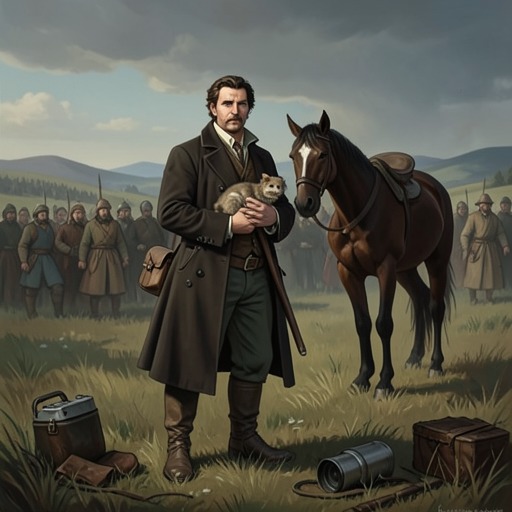
Soames first reaches the practice by telephone about a valuable hunting horse suffering from colic. He does not simply report the problem: he questions whether Herriot knows how to treat colic, names arecoline as the injection he believes the horse needs, and urges the young vet not to delay. He invokes Siegfried Farnon as the source of his knowledge, establishing himself as someone accustomed to giving instructions as well as making demands.
When Herriot arrives, Soames assesses him before engaging with him. He stresses his own title and claims to be a close friend of Siegfried Farnon; Herriot responds by giving his name. The exchange sets professional standing against social influence. Soames’s manner implies that Herriot’s youth and appearance count against him, while his own connection to the senior vet should count in his favor.
The Horse and the Limits of Authority
At the stable, the horse is in severe distress, and Soames is agitated with the horseman holding its head. Herriot considers the symptoms and concludes that the horse has an intestinal torsion. Soames accepts the diagnosis only as a reluctant concession, urging Herriot to act and complaining about the prospect of waiting through the night. The scene shows the limits of Soames’s earlier confidence: he had prescribed an injection by telephone, but the decision now depends on a veterinary assessment of a condition he cannot direct away.
Herriot tells him that the condition cannot be cured and that the horse is dying in continuous pain. He recommends immediate euthanasia with the humane killer in his car. Soames’s response turns on the horse’s worth: he objects to shooting an animal of such value. Herriot answers that its price cannot alter the need to relieve its suffering, and that Soames should have called earlier. The account establishes the recommendation and the conflict over it, but does not state Soames’s eventual decision. His importance in the episode lies in the pressure his resistance puts on Herriot to defend professional judgment and the animal’s welfare against an owner’s financial concern.
Return to the Surgery
Soames reappears at the practice after leaving his position with Lord Hulton. The contrast with his first meeting is pronounced. This time he is ingratiating, anxious to please, and deferential to Herriot; he asks whether Herriot and Siegfried Farnon might recommend him if they hear of another post. His changed manner makes the earlier insistence on title and authority newly legible: the status that had supported his commands is no longer available to him.
Soames explains that he has resigned, but Siegfried gives Herriot a less self-protective account. According to Siegfried, Soames had been conducting shady side dealings at the estate, selling quantities of corn and fertiliser, and was discovered after becoming careless. The difference between Soames’s presentation of his departure and Siegfried’s explanation leaves the character’s self-description visibly at odds with the account supplied by someone who knows the circumstances.
Relationships and Narrative Role
Soames’s claim to friendship with Siegfried Farnon is useful to him in both encounters, though in different ways. During the emergency, it supports his attempt to influence Herriot; after his departure, it underpins his appeal for help finding work. Herriot, meanwhile, is first the young practitioner Soames scrutinizes and then a professional contact whose recommendation he hopes to secure. That reversal gives their brief relationship its shape without suggesting that Soames has undergone a moral transformation.
The return also reveals an important connection between Soames and Tommy, the horseman present during the earlier visit. Herriot notices that Soames has a black eye, and Siegfried attributes it to Tommy. The account offers no further explanation of the incident, so its significance remains limited to the pointed detail: the former manager who had berated the horseman now appears at the practice marked by an encounter with him.
Soames serves as a counterpoint to the demands of veterinary responsibility. His insistence on the horse’s monetary value clashes with Herriot’s emphasis on ending its suffering, while his later request for assistance exposes how quickly a commanding employer can become a supplicant. The episodes do not resolve every question about his departure or the horse’s fate; instead, they leave the contrast between Soames’s claims and his circumstances to carry the characterization.