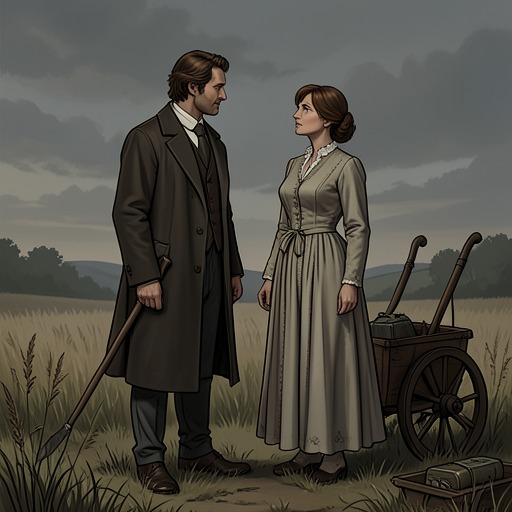
Poulton Institute Hall
All Creatures Great and SmallPoulton Institute Hall is the venue for a village dance whose communal cheer turns, for James Herriot, into an episode of drunken disarray and painful romantic self-consciousness. Perched on a steep mound above Poulton’s dead-end street, the hall is more than a backdrop: its height shapes the night’s mishap, while its crowded dance floor provides the setting for Herriot’s sudden encounter with Helen Alderson.
Setting and Approach
Poulton is described as a village on a road to nowhere, its single untidy street climbing the hillside to a circular green. An ancient stone cross stood on the green, and above it the institute hall perched on a steep mound. The dance thus occupied a conspicuous endpoint in the village landscape, reached by going uphill from the street. That physical arrangement later becomes consequential when Herriot and Connie, unsteady after drinking, circle the building and lose their footing on the slope.
The party’s approach began elsewhere. Tristan proposed stopping at a small pub for a drink before the group went to the dance, and the companions entered a low stone building. After their drinking there, they made their way through the darkness towards the mound, seeing faint light through the hall’s curtained windows and hearing music and rhythmic thudding. The sequence sets the hall’s bright, crowded sociability against the dim walk up from the inn, and makes its entrance a passage from private drinking to public festivity.
The Hall and Its Gathering
At the door, a cheerful young farmer collected the group’s money. Inside, the room was packed with young men in dark suits and girls in bright dresses, all dancing and sweating in the crush. Four musicians—playing piano, accordion, violin, and drums—performed from a low platform at one end. At the other, middle-aged women presided over a long trestle table laden with ham and brawn sandwiches, homemade pies, jugs of milk, and trifles generously topped with cream. The details establish the dance as a locally organized gathering, where music, food, and dancing share the room rather than separating into formal spaces.
Along the walls, young men watched for unattached girls. Herriot recognized a young client and learned that the dance was the Eva Three Step. He had not danced it before, but launched into it confidently with Connie. The hall’s packed floor, shaking boards, and loud music made dancing a bodily, collective experience: the movement was not elegant isolation but twirling and stamping among other couples, with shoulders bumping in the throng.
Exhilaration and Reversal
At first, Herriot felt almost weightless. He whirled Connie through the crowd and could scarcely feel his feet touch the floor; the sensation seemed so pleasurable that he judged himself happier than he had ever been. After half a dozen dances, the couple went to the food table and each ate two large wedges of ham and egg pie, followed by trifle, before returning to the floor. The exuberance had a plain physical basis in the dancing, food, and alcohol that preceded it, but its change came abruptly: halfway through a St. Bernard’s Waltz, Herriot felt his feet again, heavy and dragging, while Connie slumped in his arms.
Connie broke away, looking first pale and then green, and asked to go outside for fresh air. Herriot, also affected by the beer, tried to help her by walking around the building. The effort did not restore their balance. Because he forgot that the hall stood on a steep-sided hill, their erratic course took them over the edge of the path; they slid down a muddy bank and landed in a heap on the hard road below. The mound that had given the hall its elevated position turned the attempt to recover into a fall.
The Fall and the Return
Herriot initially lay still, then heard Connie whimpering nearby and feared she might have a serious fracture. When he helped her up, however, neither of them appeared injured. He attributed their escape from harm to their relaxed condition after drinking. Their return to the hall did not restore the earlier pleasure: Connie’s hair hung across her face, her eyes were vacant, and tears marked the mud on her cheeks; Herriot’s suit was plastered with clay, with more drying on one side of his face. They stood leaning against each other just inside the door, while the dancers blurred before Herriot and his stomach heaved.
The contrast with his earlier sensation of effortless dancing is sharp. The same room that had carried him through the Eva Three Step now held a disheveled, unsteady couple at its threshold. The dancers continued in a mass of movement, but Herriot could no longer participate in that shared gaiety. The hall’s doorway becomes a point of exposure: he and Connie are back inside, yet their muddy appearance and physical distress set them apart from the celebration around them.
Helen Alderson’s Arrival
At that moment, a woman greeted Herriot; Helen Alderson had entered with a man. Herriot struggled to focus on them. He noticed the man’s pink, scrubbed-looking face, fair hair plastered sideways, and spotless British warm overcoat, and registered that he was staring at Herriot with distaste. Helen explained that they had come in to see how the dance was going and asked whether Herriot was enjoying it. Her expression was kind, but her eyes moved between him and Connie with visible strain.
Herriot could not answer. In the noise and crush, he gazed at Helen and briefly felt an impulse to throw his arms around her, then rejected it and managed only a foolish nod. The hall therefore frames a private emotional reversal within a public gathering: Herriot’s night with Connie has ended in an undignified fall, and his reunion with Helen occurs when he is least able to present himself well. The evidence leaves the accompanying man unidentified, but his presence and disapproving look sharpen the awkwardness of the encounter. The dance’s final significance lies in this collision of communal celebration with Herriot’s compromised appearance and unspoken longing.