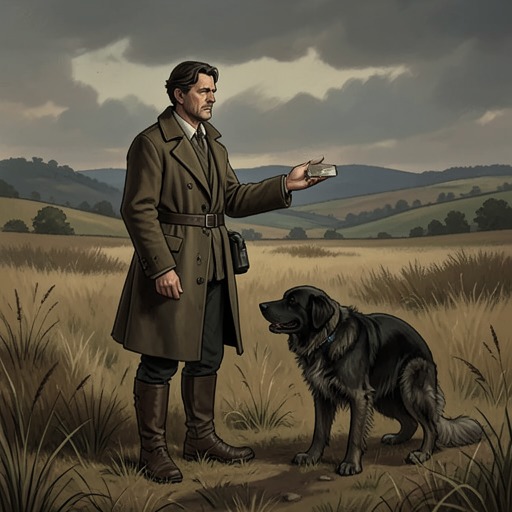
Siegfried misses out on the supervising veterinary surgeon post at Broughton races
All Creatures Great and SmallSiegfried Farnon’s unsuccessful bid for a supervisory veterinary post at Brawton races tests the prospect of a new professional life against the life he already has in Darrowby. The day does not end in appointment: the post goes to Herbert Jarvis. Yet its decisive turn comes not through an explicit verdict on Siegfried’s veterinary ability, but through his reunion with Stewart Brannon, whose unassuming friendship becomes more vivid than the career opportunity that brought Siegfried to the course.
The invitation and the opportunity
The possibility first arrives in a long blue envelope. At breakfast, Siegfried shows James Herriot an invitation from General Ransom to attend Brawton races on Saturday. What appears to be a social invitation is, Siegfried explains, an informal trial: Ransom and a colleague intend to assess him for a post supervising veterinary work across the North West Racing Circuit. The circuit is seeking a veterinarian for all its meetings, a role distinct from the local vet’s ordinary duty to attend races held in his own town and respond to injured horses.
The supervisory appointment would involve more than treating injuries. Its holder would also deal with suspected doping and other cases requiring specialist judgment. Siegfried has heard that the officials may consider him suitable, but he has not met the second man who will help assess him. The Saturday visit is therefore both an invitation and an examination, with the officials using time at the races to size him up.
The prospect carries a practical cost even before the assessment begins. When James asks whether the appointment would mean giving up general practice, Siegfried says it would not; instead, it would take him to racecourses for about three days each week. He wonders aloud whether that would be too much. His uncertainty matters: the choice is not simply between advancement and failure, but between a specialist role and the established practice he shares with James in Darrowby. The practice is described as rising, with a pleasant house and an assistant, and Siegfried’s eventual relief suggests that the possible promotion had never been an uncomplicated ambition.
The racecourse and an old friend
At the races, Siegfried and James are with Merryweather after a horse has been examined. Their professional business is interrupted by a stout, red-faced man gesturing from beyond the rails. Siegfried recognizes him as Stewart Brannon, an old college companion, and greets him with delight. The spontaneous reunion changes the emotional centre of the day: the formal assessment recedes as Siegfried takes his friend by the arm and goes to find a drink with him.
James already knows Stewart through stories told during late nights at Skeldale House. Siegfried had overtaken him partway through their course and qualified while Stewart was still struggling in his third year. In Siegfried’s account, Stewart had little appetite for study or personal grooming and seemed an unlikely candidate for success, yet he possessed a childlike openness, broad affection for other people, and an impregnable cheerfulness. The recollection gives the reunion a history beyond professional comparison: the two men had shared a formative world, but their careers had taken markedly different shapes.
Over drinks, Stewart shows no envy of Siegfried’s progress. Siegfried, in turn, hears about Stewart’s work at Hensfield and offers help if circumstances become difficult, including money if it would be useful. His offer is tentative and affectionate, made with visible discomfort rather than professional display. The exchange places mutual regard alongside the day’s career stakes: even as Siegfried is being considered for a prominent circuit appointment, his attention turns readily to an old friend whose circumstances may be harder.
The key, the car, and the failed departure
The gathering cannot last. General Ransom says that the party has been waiting and wants to leave, so Siegfried agrees to go. He searches his pockets for his ignition key, first repeatedly and then methodically, laying their contents out on the car bonnet. James recognizes the danger in the search: Siegfried has consumed considerably more whisky than he has, and the delayed effects are becoming apparent. Siegfried sways, his dented bowler slips over one eyebrow, and objects fall from his hands as he examines them.
The general’s patience gives way as the search continues and the ladies remain waiting. Stewart, who has stayed nearby, quietly offers transport. Siegfried thanks him and announces to the party that Stewart has gone to fetch his car. The rescue seems to restore order, but the vehicle only deepens the scene’s comic reversal. Stewart returns in a tiny Austin Seven, its rusted maroon body and cracked windows marking it as an extremely early model. The hood is gone, replaced by a home-made canvas cover tied to twisted struts with loops of string. There are no passenger seats: sacks occupy the front, and rough boxes labelled as American apples fill the back, alongside the medicine bottles, stethoscopes, powders, and syringe cases of Stewart’s veterinary work.
Siegfried tries to recover some authority by offering to clean the windscreen. The gesture is meant to be helpful, but the effort misfires: he is polishing the glass with a dead hen. The incident makes the day’s contrast especially sharp. Siegfried had arrived under assessment for a role demanding professional judgment and specialist responsibility; as the party waits, he cannot even produce his own ignition key, and his attempt to assist only compounds the embarrassment. The episode is not presented as the officials’ stated reason for choosing someone else, but it leaves the assessment day marked by a conspicuous loss of composure.
The appointment and its meaning
A couple of weeks later, Siegfried reads in the morning paper that Herbert Jarvis, a former captain in the Royal Army Veterinary Corps, has been appointed supervisory veterinary surgeon to the circuit. James looks for disappointment or regret, but sees neither. Siegfried reflects that he was never meant to get the position and would have been miserable if he had. He then urges James to set off into the hills, returning the narrative from racecourse ambition to the daily work of the practice.
The ending does not establish precisely why Siegfried was passed over; it records the appointment of Jarvis and Siegfried’s own settled response. That distinction preserves the event’s understated reversal. An opportunity that might have drawn Siegfried away from much of his general practice becomes, in retrospect, a role he is glad not to have taken. The sequence also makes Stewart’s presence more than a comic interruption: the friend whose improvised car and misplaced assortment of veterinary supplies disrupt the formal occasion offers a measure of affection and fellowship that the job itself cannot provide. By the time the failed appointment is confirmed, the day’s most durable outcome is Siegfried’s renewed connection with Stewart and his return, contentedly, to the hills around Darrowby.