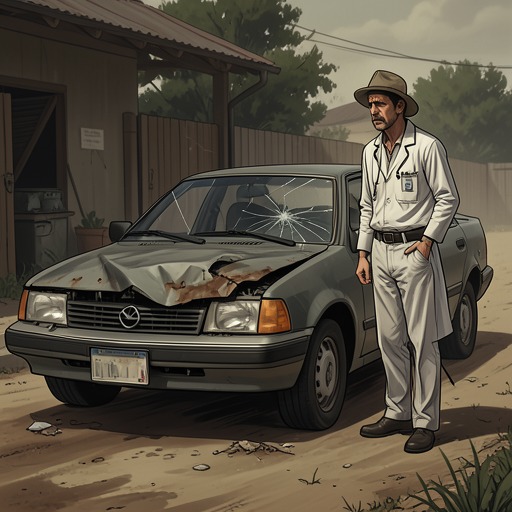
Siegfried’s new Rover
All Creatures Great and SmallSiegfried’s new Rover is both a prized possession and the focus of a test of trust between Siegfried Farnon and Tristan. Bought after Tristan’s earlier driving accident, it briefly signals that Siegfried has put the past aside. When an urgent call forces Tristan to take the wheel, however, the car’s value becomes a measure of the brothers’ unresolved conflict: it gets them to a sick cow, but returns with its left side badly damaged and Tristan once more facing dismissal.
Purchase and Place in the Household
The car enters the story in the shadow of Tristan’s recent crash. A fortnight earlier, while taking a girl home from a dance, he had overturned the Hillman. The car was written off, the insurers had reacted harshly, and Siegfried had dismissed Tristan in anger. Tristan’s familiarity with being sacked lets him expect that, if he keeps out of his brother’s way, the latest rupture may eventually pass.
Siegfried’s new Rover changes the household’s immediate balance. Siegfried has persuaded his bank manager to let him buy it, and the purchase has distracted him from the Hillman accident and its fallout. The Rover is therefore more than a replacement vehicle: its novelty has helped Siegfried move on before the consequences of Tristan’s mistake have been settled. That reprieve is precarious. The car’s importance is clear in Siegfried’s later insistence that Tristan must drive it without so much as scratching its paintwork.
The Emergency and the Loan
The Rover becomes necessary when Siegfried, ill in bed, receives an urgent call from Armitage of Sorton. A cow has milk fever, and Siegfried wants Tristan to take James Herriot out immediately; the animal may not survive the delay. James’s car is at Hammond’s garage for a light repair, and there is no spare available. Tristan quietly points to the Rover as the remaining option.
Siegfried’s consent comes reluctantly. He accepts that Tristan will have to drive, but warns him that damage to the car will have grave consequences. He even questions whether Tristan can manage the journey to Sorton and back without wrecking it. The exchange revives their established pattern: Siegfried’s fear for his possession comes out as an attack on Tristan’s competence, while Tristan withdraws without answering. Once outside the room, however, Tristan is delighted by the chance to drive the Rover, something he had never expected to do. The loan is at once a practical necessity and a rare privilege.
Collision and Physical Damage
For the first two miles on the Sorton road, the Rover gives Tristan room to enjoy its performance. The road ahead is straight, and he accelerates until the car is travelling at eighty miles an hour. An old, high-built car attempts to pass a milk lorry; the two vehicles remain abreast and leave the Rover with no clear path. Tristan brakes, but the approaching cars do not make room. A collision follows as the old car swerves towards the verge and strikes the Rover’s left side.
The quiet road after the impact makes the extent of the damage apparent. Both doors on the left are gone: one lies beside the road, and the other falls from its broken hinge. The side of the Rover is twisted where the other car has ploughed into it. Tristan, initially stunned, sits on the grass; the destruction is so extensive that his first concern about a mere scratch has given way to shock. The loss is not a minor blemish but damage to the conspicuous new possession Siegfried had entrusted to him.
Work Despite the Wreckage
The crash does not cancel the call. James and Tristan lift the shattered doors from the road, put them inside the Rover, and continue to Sorton. They treat the cow with milk fever, then return to Darrowby. The vehicle that had been the cause of the collision is thus also the means by which the urgent veterinary work is completed; the damage and the duty to the patient occupy the same journey.
Back at Skeldale House, Tristan reports the extent of the damage to Siegfried, who is still seriously ill. He says that the front and rear wings are badly damaged and both left-side doors have been torn off. Siegfried reacts by sitting bolt upright and sacking him. His outburst repeats the earlier dismissal, making the Rover a direct link between Tristan’s two recent driving disasters and the brothers’ recurring conflict. The account does not establish what later happens to the car or whether it is repaired.
Narrative Significance
The Rover’s importance lies in the reversal between its status and its use. Siegfried has acquired it as a carefully valued new possession; in the emergency, he must allow the very brother he distrusts to drive it. Its speed first gives Tristan pleasure, then helps carry the pair into danger, and after the collision the damaged vehicle still serves the call. It is neither simply a symbol of wealth nor merely a prop in a crash: its changing practical role binds family tension to the obligations of veterinary work.
The account also makes the car’s material vulnerability impossible to ignore. Before the accident, it is a coveted object whose smooth upholstery and performance invite enjoyment. Afterwards, missing doors and a twisted side make its damage visible and consequential. The contrast sharpens the irony of Siegfried’s warning: Tristan does not return with a scratch, but with wholesale damage, and yet the journey has included the treatment of the cow that prompted the loan. The Rover thus carries both the cost of Tristan’s risk and the work that had to be done despite it.