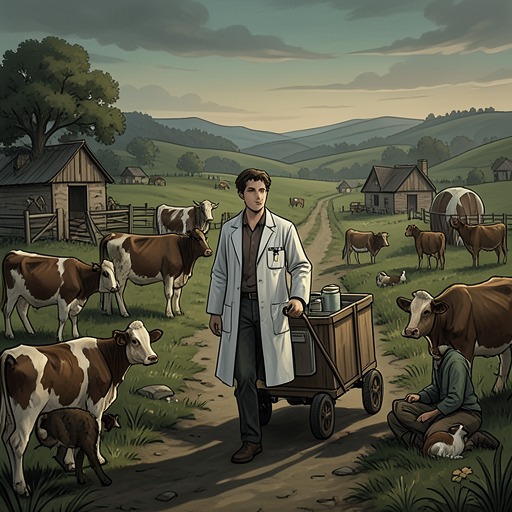
Spring
All Creatures Great and SmallSpring is the season of renewal and overload in the Yorkshire Dales: as the landscape begins to soften after winter, lambing arrives in a rush that tests the capacity of the veterinary practice. James Herriot’s account makes the season tangible through its changing light and weather, but also measures it by the concentrated cycle of animal illness and care that governs rural work.
The Season Arrives
The change first registers in late March, after James Herriot has examined sheep in a hillside fold. Resting against a tree in the lee of a small pine wood, he becomes newly aware of sunshine, larks, and wind moving through the high branches. Snow still lies in runnels behind the walls, and the grass remains winter-yellowed, but the sensation is already one of change and release from the months of cold.
April brings its own signs: sharp, dry winds move the snowdrops and bend the daffodils on village greens, while primroses brighten the roadside banks. Spring is not presented as an abrupt turn to warmth. It emerges unevenly, in small signs set against lingering winter, and becomes a lived transition rather than a date on the calendar.
Lambing and the Veterinary Year
The defining pressure of the season begins in April with lambing. Herriot describes it as the most vivid and interesting part of a veterinary surgeon’s year, its high point in the annual cycle, and a wave that arrives just when other work is already demanding attention. The season’s abundance therefore has a practical cost: the work does not pause to make room for lambs.
The pressure is sharpened by the condition of the livestock coming out of winter. Cows have spent months confined to the same few feet of byre and urgently need green grass and sunlight; their calves have little resistance to disease. Coughs, colds, pneumonias, and acetonaemias are already part of the workload when the sheep cases accumulate.
For much of the year sheep remain a minor part of the practice’s attention, but for about two months they nearly eclipse everything else. The sequence begins with pregnancy toxaemias and prolapses, then passes into the concentrated rush of lambing. Calcium deficiencies, gangrenous mastitis, and diseases affecting lambs—including swayback, pulpy kidney, and dysentery—extend the work beyond delivery itself. By the end of May the flood has slackened to a trickle, and sheep recede again into the hills.
A Landscape Becoming Gentler
In May and early June the season changes the texture of Herriot’s working days. The cold wind drops, the air carries the faint scent of wild flowers across the pastures, and early drives bring fields glittering in pale sunshine beneath lingering wisps of mist on the high tops. The landscape makes the work feel, at moments, like a privilege rather than merely an obligation.
At Skeldale House, the wistaria bursts into mauve bloom and pushes through open windows. Its fragrance accompanies Herriot as he shaves beside the mirror, bringing the season indoors as well as across the fields. The chapter’s pastoral calm is real, but it does not erase the veterinary workload: the beautiful mornings coexist with the lambing rush and the illnesses of spring.
Seasonal Work and Its Limits
Even as spring advances, the season does not bring unqualified ease. May and June are also the time for horse castrations. There are fewer horses on farms near the foot of the dale, where the stables are partly empty, but enough remain to make this period uncomfortable. The tractors already signal a change in farm life, while the surviving horses continue to impose a distinct seasonal demand on the veterinarians.
Spring’s significance lies in this double rhythm. Nature becomes more generous in light, scent, and growth, while the practice’s obligations intensify and then recede according to the animals’ needs. The return from winter is not simply a pastoral interlude: it is a cycle of recovery, illness, births, and labor, with the landscape’s beauty and the work of caring for it unfolding together.