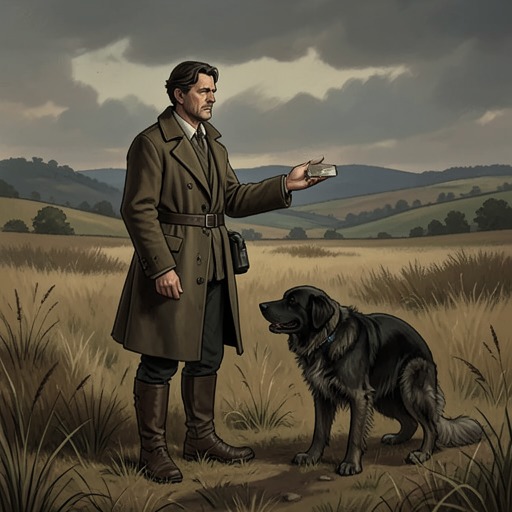
Stewart Brannon
All Creatures Great and SmallStewart Brannon reappears in Siegfried Farnon’s life as a former college companion whose unambitious student reputation has given way to a demanding, unsettled veterinary career and a crowded family life. At their reunion, Brannon’s cheerfulness and lack of envy matter as much as his hardships: he has struggled to find a living wage, yet offers help when Siegfried is in trouble. His return turns old college memories into a test of friendship in the present.
Identity and Background
Siegfried Farnon recognizes Brannon at the racecourse by his pudgy, grinning features and oily black hair. James Herriot already knows him indirectly: Siegfried had often recalled their college days during late-night conversations at Skeldale House. In those stories, Brannon was a conspicuously unlikely candidate for professional distinction. Siegfried had overtaken him partway through the course and qualified while Brannon was still struggling in his third year; he remembered him as averse to study and indifferent to washing or shaving.
That unpromising portrait was never the whole of Brannon. Siegfried’s recollections also emphasized his childlike ingenuousness, broad affection for other people, and durable good cheer. The reunion lets James see the contrast for himself: Brannon is now a large, shabby-looking man, but his warmth has survived the years and the difficulties that followed college. The impression is not of a sudden transformation into a grand success, but of someone whose essential kindness was more lasting than his academic shortcomings.
Career and Family Life
Brannon tells Siegfried that he passed his finals at the first attempt after Siegfried had left, though he encountered trouble with surgery. He had been working as a veterinarian for four years and had travelled widely in search of a position that could support him. His account ranges across the north and south of the country and includes six months in Ireland. The movement reflects not a settled professional ascent but the effort to find work that would provide a living wage.
The financial pressure is inseparable from his family circumstances. Brannon married Meg Hamilton while he was in his final year at college. By the time he meets Siegfried again, they have five children and are expecting another. He describes the family as having stayed just ahead of ruin, while remaining happy together. A few months earlier he had put up his veterinary plate in Hensfield, and he considers the practice a better footing: he can meet the housekeeping expenses. His measure of security is modest, but concrete. He does not claim prosperity; being able to provide for the household is enough to make him believe they will be all right.
Friendship with Siegfried Farnon
The reunion quickly restores the ease of their old connection. Siegfried leaves his companions at the racecourse to spend time with Brannon and takes him to the bar, where the two catch up over whisky. James listens as Brannon drinks with apparent unconcern and Siegfried recounts the progress of his own practice. Brannon responds without envy to the rising business, the house, and the assistant. The contrast between the two men’s circumstances is visible, but it does not become rivalry.
Siegfried’s concern takes the form of a direct offer: if Brannon’s affairs become difficult, he can turn to his old friend in Darrowby, and Siegfried has money he can spare. Brannon declines, explaining that the family is managing and that he appreciates the offer. His refusal is neither a rejection of Siegfried nor a denial of their past. He recognizes the kindness behind the proposal while maintaining that, for now, he can manage. The exchange gives their friendship a present-day substance: Siegfried offers practical assistance, and Brannon receives it with gratitude without pretending to need what he says he does not need.
The Car and the Limits of Goodwill
Brannon’s generosity becomes more conspicuous when Siegfried loses the key needed to arrange transport for the party. Brannon quietly offers to provide a car, then goes to fetch it. The gesture briefly appears to solve the problem, and Siegfried thanks him fervently for saving the situation. But the vehicle is a tiny Austin Seven, its rusted maroon paint and cracked windows marking its age. Its original hood has disappeared, replaced by homemade canvas tied to bent supports with loops of string.
The car is also loaded for Brannon’s work rather than for carrying a party. There is no passenger seat, only sacks laid over the bare boards; the back has no seats either, and rough wooden boxes labelled Finest American Apples hold veterinary bottles, stethoscopes, powders, and syringe cases. The image is both comic and revealing. Brannon has made do with what he has, carrying the tools of his trade in a vehicle that can scarcely serve as comfortable transport. His offer is sincere, but the condition of the Austin exposes the material limits behind his willingness to help. It is not wealth or convenience that he can give Siegfried, but what he has at hand.
Character and Narrative Significance
Brannon is defined by the tension between precarious means and emotional abundance. His student record and search for work establish a life without easy professional security; his family’s happiness, generosity toward Siegfried, and lack of envy show that hardship has not hardened his manner. The bulging old overcoat Siegfried remembers from their college years has become strained over Brannon’s heavier frame, a small visual marker of time passing, while the makeshift car makes his current working conditions unmistakable.
His role in the narrative is also relational: James first knows him through Siegfried’s stories, then watches those memories become a living encounter. Brannon’s presence gives Siegfried’s past a face and demonstrates that the affection in those recollections has endured. Their reunion does not erase the difference between a flourishing practice and a veterinarian still counting household costs. Instead, it shows friendship operating across that difference, in Siegfried’s offer of money and Brannon’s offer of transport. Brannon’s cheerfulness is not proof that his circumstances are effortless; it is the quality that persists through them.