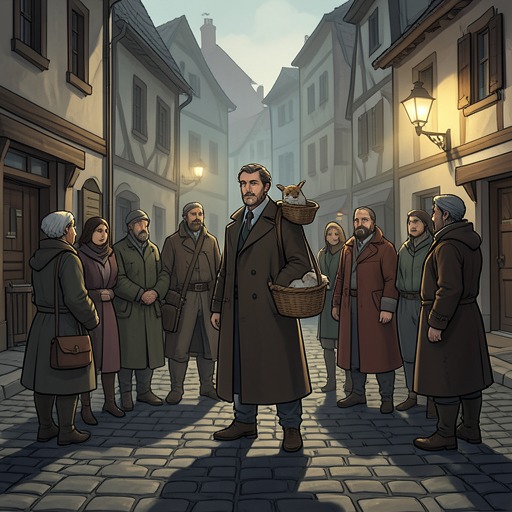
The Coopers’ Milk-Fever Cow Is Saved
All Creatures Great and SmallThe Coopers’ Milk-Fever Cow Is Saved is a recovery scene in which James Herriot treats a cow that has collapsed in a beck soon after calving. The cow’s apparent death gives way, step by step, to signs of life and then to recovery: calcium treatment revives her, Dan Cooper and his son help her onto her chest and to her feet, and she is brought to a warm shed with her calf. The scene also carries its resolution into the farmhouse, where Mrs. Cooper cares for the soaked veterinarian and sends him away with food.
The Emergency in the Beck
The illness had struck immediately after the cow calved. She had slipped down the muddy bank into the water and was unconscious when James Herriot arrived, with her hindquarters submerged and her head resting on a shelf of rock. Her calf stood beside her, wet and trembling. The setting makes the immediate problem more than a diagnosis: the cow is seriously ill, difficult to reach, and lying in water, while the newborn calf remains alongside her.
Dan Cooper feared that the cow was already dead because he could not see her breathing. Herriot judged that she was very far gone, but believed there might still be life in her. He explained that milk fever could respond to calcium given into a vein. Dan’s concern was personal as well as practical: the cow was one of his best milkers, and he knew that this illness often struck valuable animals. The scene holds those stakes together without making the farmer’s worry a substitute for the clinical problem.
Treatment and the Turn Toward Recovery
Herriot prepared a syringe and chose a wide-bore needle. Working in water that rose above his Wellington boots, he located the jugular vein at the base of the cow’s neck and connected the needle to a bottle of calcium through a flutter valve. His fingers were numb with cold, and the procedure required him to keep the bottle raised while the treatment flowed into the vein. The account stresses the practical difficulty of carrying out an intervention in the beck, rather than presenting the treatment as effortless expertise.
The first bottle produced no immediate response. Herriot used a second bottle, this time giving calcium under the skin, and noticed the cow’s eyelids quiver while he rubbed the injection site. That small movement changes the direction of the scene: what had looked like a futile effort becomes a reason to continue. Herriot told Dan that the cow was still alive, flicked her ear, and saw her open her eyes. The recovery then proceeded in stages rather than all at once.
Within fifteen minutes the cow was tossing her head. Herriot and Dan, joined by Dan’s tall son, pulled and pushed until she settled on her chest. Herriot thought she was likely to recover, but did not leave her lying in the water; he stayed because milk-fever cows could remain down for days and this one still needed to rise. She made repeated efforts to stand, but only after another half hour did she get to her feet. The sequence gives the recovery its force: a brief movement offers hope, while the cow’s eventual standing confirms that the treatment has worked.
Bringing Cow and Calf to Safety
Once the cow was up, the group guided her out of the beck and up the bank. Dan and his son carried the calf in a sack between them, while the unsteady mother followed, trying to reach it with her muzzle. The movement from water to farmhouse turns recovery into reunion and shelter: the calf is carried, the cow is able to follow, and both reach a shed where she stands knee-deep in straw and licks it vigorously.
Herriot’s decision to remain until the cow stood is central to the outcome. The injection had revived her, but it did not by itself complete the rescue; she still had to be brought out of the water and into safety. The farmer and his son supplied the physical assistance needed to move her, while Herriot watched her progress and judged when to try getting her onto her chest. The recovery is therefore presented as a sequence of clinical treatment, continued observation, and shared effort.
Hospitality After the Rescue
The cow’s recovery is followed by a quieter scene of care for Herriot. He had water inside his boots and was drenched after the work in the beck. In the farmhouse porch, Mrs. Cooper directed him to remove his socks and coat, roll up his trousers, dry his hair with a towel, and warm his feet in hot water with mustard. She then gave him tea. Her brisk instructions turn the farmer’s household into part of the episode’s aftermath: after the veterinarian has attended to the cow, the family attends to the person who treated her.
Dan and the children were already eating breakfast when Herriot joined them. He had learned not to force conversation at meals in the Dales, and this time he ate without trying to fill the silence. Mrs. Cooper noticed his appreciation of the homemade Yorkshire sausages and added more to his plate. She had killed a pig the previous week, and as Herriot was leaving she tucked a parcel under his arm, which he understood to contain food from the pantry.
By a quarter past nine, Herriot was back outside Skeldale House, warm and fed, carrying the memory of the cow’s quick recovery and the parcel from the Coopers. The episode closes not with a further medical procedure but with the consequences of the rescue: the cow is alive with her calf in a warm shed, and the veterinarian has been brought back from the cold by the household’s hospitality. The transition from emergency treatment to breakfast makes the scene’s reciprocal care concrete, linking the successful veterinary intervention with the farmers’ care for their visitor.