The emotional bond between humans and animals
All Creatures Great and SmallThe emotional bond between humans and animals is presented as a varied relationship rather than a single kind of affection: animals can be household companions, sources of grief, patients deserving careful attention, and the focus of hopes for the future. The book places these ties in ordinary settings, from a crowded cottage to a working farm, and shows how they can coexist with the practical demands of animal care and farm life.
Companionship in the household
The bond between Miss Stubbs and her animals is especially clear in the arrangement of her small, ground-floor room. Confined to bed and unable to get up again, she has little view beyond the room and a glimpse of hedge through worn curtains. The plain “God is Near” card hangs above her bed, but her attention is directed toward the animals who share her life: her three dogs and two cats. During James Herriot’s regular visits, the dogs bark until Mrs. Broadwith moves them to the back kitchen, while Miss Stubbs remains in bed, concerned above all with her pets. Her circumstances make their place in her life unmistakable: they are not incidental possessions, but the companions around whom her concern is organized.
That closeness becomes most visible when Miss Stubbs fears that death will separate her from them. After Ben dies, she tells James Herriot that she believes her own turn will come next. Her deepest worry is not only her approaching death, but the possibility that she will not see her animals again. She has heard that animals have no souls, and the thought troubles her enough that she says she lies awake thinking about it. James Herriot responds by grounding his reassurance in love, loyalty, and gratitude: if those qualities signify a soul, he argues, animals possess them. When she asks him to be honest rather than merely comforting, he admits uncertainty about the larger question but tells her that wherever she is going, the animals will go too. Her calm acceptance of his answer shows how directly her belief about an afterlife is bound to her attachment to the animals.
Care as attention and responsibility
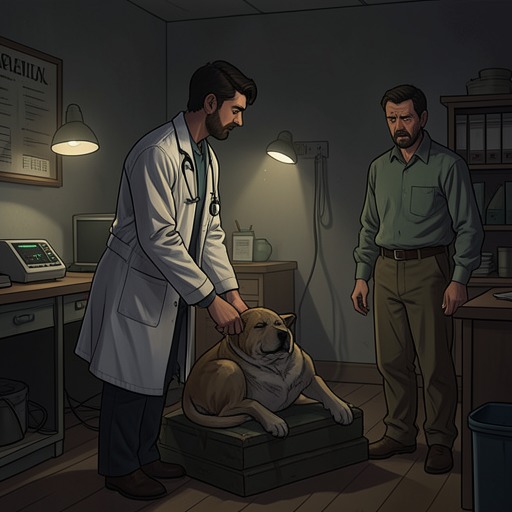
The human-animal bond also appears in acts of care that begin with close attention to an animal’s condition. When Harold Denham asks James Herriot to examine his Great Dane bitch after she has had puppies, he identifies a dark discharge as a reason for concern even though she is eating. The veterinary examination finds a slight fever and confirms that the discharge merits attention. The scene presents care as a shared responsibility: the owner notices a change and seeks advice, while the veterinarian examines the animal and considers what the signs may mean.
In a more urgent case, a horse with severe colic is visibly distressed, and its condition makes clear to James Herriot that ordinary treatment is inadequate. He explains that the pain could indicate a twisted bowel; examination confirms displacement and an abnormal mass. The episode places professional knowledge in the service of an individual animal’s suffering. A different examination reveals a dog with a markedly distended abdomen and signs of pain. When its master speaks, the dog briefly responds, thumping its tail before returning to its withdrawn state. That moment connects the animal’s physical condition with the companionship that has shaped its relationship with its owner: the response is brief, but the bond remains perceptible even during illness.
The same attentiveness informs James Herriot’s treatment of Strawberry, the Dairy Shorthorn cow that Dick Rudd regards as the beginning of a new herd. When she develops signs of a throat abscess, James Herriot explains the danger that a growing abscess could pose to her breathing and instructs Dick to apply hot water and salve. He returns over the following ten days as the abscess develops and Strawberry eats less, loses weight, and produces less milk. His concern is sharpened by the limits of what he can do: he believes the abscess must rupture to bring relief, while the injections he gives are of little use against the underlying problem. Here, care includes both sustained attention to an animal’s welfare and an honest recognition of the uncertain course of treatment.
Animals, livelihood, and the future
Dick Rudd’s attachment to cattle is bound up with ambition and economic reality. He wants to improve his stock until he has a dairy herd that meets his ideals, but knows that without money the process will be slow and might not be completed in his own lifetime. When he shows James Herriot a striking Dairy Shorthorn in his rough, cobbled byre, the cow stands apart from the older or less impressive animals gathered there. Dick values her as a productive animal: he estimates her capacity for milk and butter fat, and anticipates that her calf will be worth money. He has also given her the name Strawberry. James Herriot recognizes her as more than a promising purchase: she represents the foundation of the herd Dick hopes to build. The scene holds commercial value and personal hope together rather than treating them as opposites.
A related future-oriented bond appears in the care given to a sick pony by the Myatt children. After James Herriot treats the pony and leaves instructions for continuing care, three girls approach it. The eldest puts her arms around its neck and rests her cheek against its shoulder; the others stroke its flanks. Their expressions remain composed, but their gestures make their attachment evident to him. He looks back at them still tending the pony as he leaves. The moment makes the animal’s importance legible through the children’s physical closeness, without requiring them to explain what it means to them.
Grief, loyalty, and nonhuman value
The Bramleys’ experience of illness among their cats challenges the assumption that farm cats are valued only as pest controllers. Their home contains many cats, and when feline enteritis begins to kill them, Miss Bramley repeatedly brings sick cats and kittens to James Herriot in an egg basket. He tries treating them, including taking some into the surgery so they can be attended several times a day, but the mortality remains high. The family is stricken as the cats dwindle. Miss Bramley’s fear that the illness will pass through the whole group and her visible distress reveal a relationship whose significance cannot be reduced to the animals’ practical usefulness.
Even a brief encounter can register attachment as a particular relationship between an animal and its household. On a cold day, old Tip jumps onto the back of a cart carrying hay to the young cattle. James Herriot remembers the dog bracing himself against the cart’s movement, tail waving, and barking at the cold, then recalls that Tip slept at his master’s door as if it were the place of honour. The image links the dog’s independent liveliness with a settled place in his master’s life. Across these episodes, animals are not interchangeable examples of affection: a sick patient, a hoped-for foundation herd, a child’s pony, and a household companion call forth different forms of care. The book’s recurring attention to such particular ties gives animals a value that is emotional and relational as well as practical.