The fresh sheep skin
All Creatures Great and SmallThe fresh sheep skin is a traditional remedy whose use on a recumbent cow unsettles James Herriot’s confidence in his diagnosis. After the cow rises, Siegfried offers a possible physical explanation for the treatment while pointing out that the apparent success cannot securely be credited to the skin. Its lasting significance lies in that uncertainty: it becomes both a practical intervention and the object at the centre of a story that follows Herriot around the district.
The Remedy and Its Use
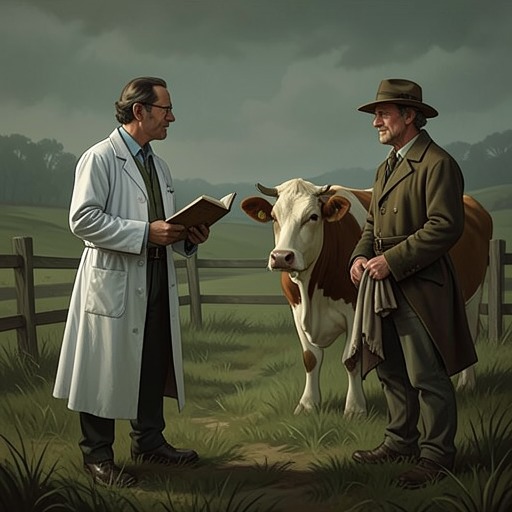
Mr. Handshaw recalls his father’s remedy after finding his cow walking in the byre that morning. He had obtained a fresh-killed sheep skin from the butcher and placed it on her back; the cow got up soon afterwards. The account presents the treatment as inherited farm knowledge, passed down from Mr. Handshaw’s father rather than introduced by a veterinary practitioner.
Siegfried gives the remedy a tentative rationale. Heat generated beneath the fresh skin could act like a hot poultice on the cow’s back, he suggests, and might encourage an animal that was lying down out of stubbornness to stand in order to get rid of it. His explanation makes the remedy intelligible without establishing that it caused this cow’s recovery.
The Disputed Diagnosis
The cow’s rise contradicts Herriot’s earlier assessment that she would not get up again. He remains troubled by what had seemed to him a broken pelvis, creaking and wobbling after the cow’s calving. Siegfried explains that the pelvic ligaments may take several days to tighten after calving, producing an effect that can be mistaken for a break. The sheep skin therefore appears alongside a second correction: the condition Herriot thought he had identified may not have been what it seemed.
Siegfried also resists treating the sequence of events as proof of the skin’s efficacy. The cow may already have been considering getting up when Mr. Handshaw laid the skin across her back; had she risen after one of Herriot’s injections, the veterinarian might have received the credit instead. The episode leaves the cause unresolved, balancing a plausible account of the remedy’s warmth against coincidence and the limits of diagnosis.
Reputation and Significance
Siegfried tells Herriot that this kind of reversal happens to veterinarians and urges him not to dwell on it. But the incident does not disappear from view. The cow becomes a district celebrity, and Mr. Handshaw proudly shows her to visitors ranging from the postman and policeman to corn merchants, lorry drivers, fertiliser salesmen, and Ministry of Agriculture officials. They repeatedly bring Herriot the same triumphant account: the cow that he had said would never rise again.
The sheep skin thus acquires a public meaning beyond its possible therapeutic effect. For Siegfried, it is an old remedy with a plausible basis, but not a certain explanation; for Mr. Handshaw, it is part of a story celebrating his father’s wisdom and the cow’s recovery. For Herriot, its association with the case makes professional uncertainty conspicuous. The episode does not simply oppose folk practice to veterinary knowledge: it shows how a mistaken impression, an uncertain outcome, and a memorable remedy can combine to shape a practitioner’s local reputation.