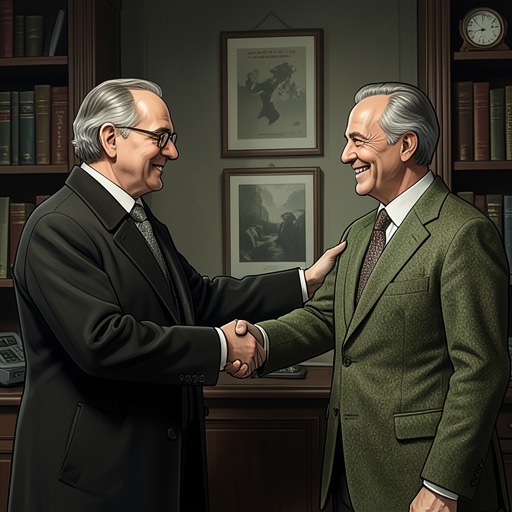
The mentor-and-friend relationship between James Herriot and Siegfried Farnon
All Creatures Great and SmallThe relationship between James Herriot and Siegfried Farnon is at once professional mentorship and personal friendship: Farnon gives a newly qualified veterinarian a foothold in rural practice, corrects his judgment when duty demands it, and stands beside him when an early decision is challenged. Their connection does not reduce Herriot to a pupil who merely follows orders. Its defining movement is toward trusted independence: Farnon’s instruction establishes the responsibilities of the work, while his approval allows Herriot to earn the confidence of clients in his own right.
The Offer That Begins the Partnership
In 1937, newly qualified veterinarians faced grim employment prospects. Agricultural depression had lasted a decade, the draught horse was disappearing from the profession, and the vacancies listed each week attracted scores of applicants. Herriot had begun to lose hope when a letter from Darrowby invited him to meet Siegfried Farnon and, if the two suited one another, stay on as an assistant. The prospect mattered not just as a job but as a way out of the unemployment facing many of his fellow graduates, some of whom were working in shops or shipyards.
Farnon made the offer with striking directness. After bringing Herriot to a seat and ordering beer, he told him, “Well, you can have this job if you want it. Four quid a week and full board. O.K.?” The terms sounded almost lavish against the humiliating notices in the veterinary press offering experienced practitioners for their keep alone. Herriot accepted, and the relationship began not in a formal lecture room but with an immediate act of trust: Farnon was willing to take on a young assistant, and Herriot was willing to build his future in an unfamiliar place under his guidance.
Teaching Through Responsibility
Farnon’s mentorship is clearest in the rule he insists must govern the work. When Herriot admits that he had postponed a visit to a cow with chronic mastitis because the case sounded mild and the owner had already been treating her, Farnon answers patiently but firmly. A veterinarian, he says, cannot rely on an owner’s account to decide whether an animal is seriously ill. The animal may have deteriorated, and it may die. His imperative is unmistakable: “YOU MUST ATTEND.” He repeats that the rule applies in any weather, at any hour, and that the visit must be made cheerfully.
The correction exposes a gap between book learning and professional responsibility. Herriot’s judgment had rested on a description from someone without veterinary training; Farnon insists that uncertainty itself is a reason to go and examine the animal. The lesson is not simply about diligence. It places the burden of assessment on the veterinarian, who must see the patient rather than allow convenience or a client’s confidence to settle the matter. Herriot recalls that Farnon had once made a contrary-sounding remark about a dead animal bringing owners to their senses. When Herriot brings it up, Farnon is astonished and dismisses it as nonsense before returning to the rule. Their exchange has the brisk, comic shape of a disagreement, but its practical consequence is serious: Herriot is being taught what the profession requires when the evidence is incomplete.
That teaching is reinforced by the practice itself. Herriot’s first examination of a cow in a difficult calving brings him into contact with confident lay advice: the farmer’s uncle recommends turning the calf completely around or pulling it out without first correcting its position. Herriot recognizes that the cramped space makes the first suggestion impossible and that the second could break the cow’s pelvis. He has to assert his own clinical judgment in the face of advice treated with deference. Farnon is not present in that episode, so it is not a lesson he gives directly; rather, it shows the independent decisions Herriot must learn to make within the professional responsibility Farnon later articulates so forcefully.
Support at Herriot’s First Crisis
The relationship’s personal loyalty becomes especially visible after Herriot’s first case at Lord Hulton’s estate. He finds a hunter staggering through its box in severe, continuous pain. Examination confirms a displaced intestine and a tense, abnormal mass; Herriot concludes that this is no ordinary colic but a likely intestinal torsion. The horse’s condition leaves no easy remedy, and Herriot decides that euthanasia is necessary to prevent further suffering. He returns to the surgery fearing that he has damaged his career before it has properly begun, although he knows he could not have acted differently.
Farnon comes back at one in the morning and listens while Herriot recounts what happened. Before he can respond, Mr. Soames telephones to complain. Farnon does not distance himself from his assistant or leave him to face the criticism alone. He tells Soames that Herriot did the only possible thing in the circumstances, rejects the claim that the horse should have been left to suffer, and affirms that preventing suffering is one of their duties. He also says that Herriot is a highly capable veterinary surgeon and that he would have made the same decision himself.
The defense changes Herriot’s immediate sense of failure into relief. After the call, Farnon pours whisky for them both and, smiling, tells him, “Well, you certainly got chucked in at the deep end tonight, my boy. Your first case! And it had to be Soames, too.” The affectionate address and the shared drink make the exchange more than a professional ruling. Farnon recognizes the ordeal of a first case, names the difficulty of having Mr. Soames as the client, and lets Herriot see that a painful decision can still be the right one. He further explains that Soames has a reputation for dishonesty at his employer’s expense, though he presents that as rumor rather than established fact. The episode therefore joins practical mentorship to emotional reassurance: Herriot receives both a defense of his judgment and the knowledge that his supervisor understands the pressure under which it was made.
Trust and Growing Independence
As Herriot’s work continues, the farmers’ attitude begins to change. A client telephones asking for him, and Farnon cups the receiver and calls him over: “Come on, James, here’s another one prefers you to me.” The teasing is accompanied by a smile; Herriot registers that Farnon is pleased. The moment matters because a less secure employer might resent a client’s preference, whereas Farnon treats it as evidence that his assistant is gaining standing.
Herriot has begun to notice that farmers no longer look past him in the hope that Farnon has come along too. Some now ask him in for a meal, and he understands these invitations as signs of carefully earned friendship, not merely hospitality. His account links professional recognition with a growing appreciation of the Dales people, whose independence, dignity, and hospitality become more evident to him in scattered hamlets and isolated farms. Farnon’s pleasure in being requested less often does not mean he withdraws from the relationship; it shows that his authority can accommodate Herriot’s success rather than compete with it.
The partnership thus combines instruction with room to act. Farnon sets a demanding standard, and Herriot has to develop the confidence to examine cases, make decisions, and accept their consequences. In the crisis over the hunter, Farnon’s backing makes clear that mentorship includes responsibility for an assistant’s reasonable action, not merely correction after error. In the phone exchange, his smile confirms that Herriot’s growing independence is welcome. Their friendship takes shape inside that professional exchange: stern when an animal’s welfare is at stake, encouraging when Herriot has endured a difficult case, and generous when clients begin to recognize Herriot as their own veterinarian.