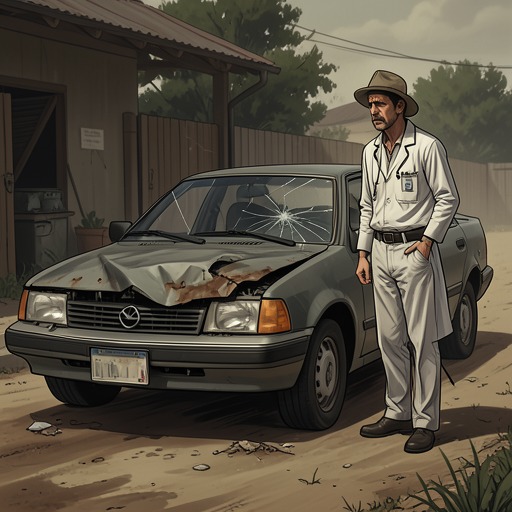
The veterinary practice’s Austin
All Creatures Great and SmallThe veterinary practice’s Austin is more than transport: on a steep farm hillside, its slipping gear and ineffective brakes transform an ordinary drive home into a serious accident, yet its battered body and stubborn engine allow the journey to continue. The episode makes the car’s precarious condition visible in a cascade of veterinary supplies, a flattened golf-club hut and, finally, a broken rear light that Tristan expects will bring another reprimand from Siegfried Farnon.
A working car in difficult country
The Austin appears on a remote farm in the Dales, where there is no road to the buildings and no track between them. The route runs across fields, from gate to gate, and the last gate marks the end of a steep, grassy descent. The farm lies far below, and from that final gate the drive home should take about ten minutes. The vehicle is thus part of the practical demands of rural veterinary work: it carries the people and equipment needed to reach farms that ordinary roads do not serve.
On this visit, Tristan is driving because James Herriot’s left hand has become infected after a difficult calving and his arm is in a sling. The day’s work has gone well. Tristan has removed warts from a heifer’s teats, and the farmer has praised his ability before offering him beer in the heat. After two bottles, Tristan pauses beside the gate, apparently in no hurry to leave. That relaxed interval matters to the accident’s shape: the car is left at the slope’s edge while the men enjoy a moment of hospitality, and the journey home is interrupted before it begins.
The descent
A grinding sound alerts Tristan that the Austin is moving backwards. It has slipped out of gear and has scarcely any brakes. Both men run after it, but Tristan can only touch the bonnet before its increasing speed carries it beyond reach. The hillside gives the car a long, uneven descent; it bounces over the ground and gathers speed until it seems to be travelling at about seventy miles an hour.
As the Austin hurtles downhill, its doors spring open one after another. Instruments, bottles, bandages and cotton wool spill across the turf, leaving a broken trail behind the car. Packets of nux vomica and bicarbonate stomach powder burst open on the grass. The supplies that make the car useful on a veterinary call become a measure of how completely control has been lost: the vehicle is still moving, but its contents are being scattered along its path.
There is only one obstacle on the otherwise open slope, a small building near the foot of the hill, where the land levels out. The Austin heads straight for it. Herriot turns away just before impact and notices the glowing end of Tristan’s cigarette; when he looks back, the building has been flattened and the car lies on its side atop the broken timbers, its wheels still turning. The collision demolishes the hut, later identified as the Darrowby Golf Club’s clubhouse, but the scene does not end with the vehicle destroyed.
Damage and recovery
The Austin is already so dented that the men struggle to tell which marks are new. Its rear end is badly caved in, but the only damage they can clearly identify is a smashed rear light. That assessment gives the incident its unlikely reversal: after a runaway descent and the destruction of a wooden building, the car may still be usable. The men return to the farm for help rather than immediately abandoning it.
The farmer explains that the hut belongs to the golf club, which rents that part of his land for a small nine-hole course. He is not greatly troubled by its destruction; he says that few people play there, mentioning the bank manager among them. With the farmer’s horse, the men pull the Austin upright. Tristan starts it, and the engine immediately runs strongly. He then drives carefully over the fallen wooden walls and onto the grass. The car has suffered damage, but it has not been put out of action.
The farmer and Tristan agree to keep quiet about the demolished clubhouse. The arrangement allows the men to leave without an immediate dispute over the building, while the damaged rear light remains a visible reminder that the incident has not been entirely erased. Tristan drives the Austin back up the hill, and the vehicle returns to service after a collision that initially appeared much more conclusive.
Blame and the car’s significance
On the road, Tristan turns from relief to the prospect of explaining the broken light to Siegfried Farnon. He feels that blame for the practice’s cars repeatedly falls on him, even when, in his view, he has been given old vehicles with tyres worn nearly to the canvas. His complaint is not a denial that he has caused damage before: he acknowledges that he was responsible for the Hillman he overturned a fortnight earlier, after taking a sharp turn at speed while driving a girl home from a dance. That car was written off, and Siegfried dismissed him before later being distracted by the purchase of a new Rover.
The Austin’s accident therefore joins mechanical failure to an existing pattern of tension between the brothers. The immediate cause is specific—the car slips out of gear on a steep slope and has inadequate brakes—but Tristan also understands the broken rear light through his broader grievance about being blamed for worn-out cars. His account does not make him wholly blameless; rather, it holds together his own earlier recklessness and his sense that responsibility is unevenly assigned. As an object, the Austin embodies that friction. It is battered, poorly equipped to stop on the hillside, and still capable of starting after being hauled from a wrecked clubhouse. Its survival gets Tristan and Herriot home, but its condition ensures that the journey ends with another anticipated reprimand rather than uncomplicated relief.