Tim Alton
All Creatures Great and SmallTim Alton is a smallholder on Marstang Fell whose life is shaped by poor land, severe weather, and a relentless cycle of farm work. In James Herriot’s visit to his farm, the alarm raised by a sick pig reveals how closely household survival and feeling are joined; the episode also gives Tim a quiet dignity that stands out against the contrasts of wealth and family affection in the surrounding countryside.
Identity and Setting
Tim’s farm sits at the top of a steep track, among a few harsh acres where wind flattens and yellows the grass. The farmhouse and its outbuildings crouch behind stunted, wind-bent trees; their massive stones have weathered for three centuries. The route up from the fertile valley passes through a striking change of country, from riverside trees and rich pastures to bare, rocky hillside and miles of limestone walls. Tim’s home belongs to this exposed upland landscape, not to the easier world of the valley below.
The farm’s physical austerity is also economic. Smallholders like Tim make a meagre living from a few cows, selling milk to large dairies or making butter. They raise pigs for home consumption and cure the meat themselves. On poorer farms, bacon is a staple, and the pig may be the one conspicuously fat creature among people, dogs, and cattle that are lean and spare. Tim’s livelihood thus depends on animals that are at once working stock, food, and part of the household’s daily life.
Work and the Farm’s Economy
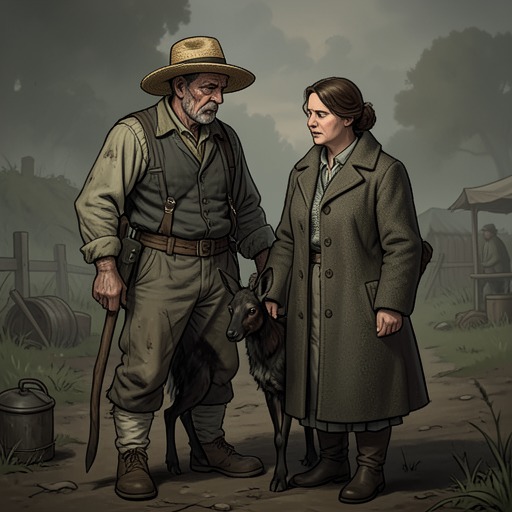
Tim’s body bears the cost of keeping such a farm going. Though only forty, he appears bent and worn by constant demands. His corded forearm and rough, work-swollen fingers make visible the labor that otherwise risks disappearing into the routine of smallholding. He once told James Herriot that the last time he missed a milking was twelve years earlier, when he attended his father’s funeral. The detail gives the work its measure: even mourning had not released him for long from the farm’s demands.
The kitchen provides another glimpse of the household economy. As James takes his leave, he bumps against a great side of bacon hanging from the beamed ceiling. It is about eight inches thick in places, almost all white fat, with only a narrow strip of lean visible on close inspection. The bacon is not simply a rustic detail: it makes tangible the practice of fattening and curing a pig for the family’s own use, and the importance attached to making that limited resource last.
The Sick Pig
James’s call to the farm is for a pig that has suddenly become seriously ill. Tim explains that the animal had seemed well the previous day but is lying flat that morning and did not even look up when its trough was filled. In Tim’s experience, a pig refusing food is a decisive warning that something is badly wrong. His concern is sharper than the habitual cheerfulness with which he meets other misfortunes, and James recognizes why: there is something personal about the family pig.
The change is especially stark because James has seen the animal in health. About a fortnight earlier, while treating a cow’s torn teat, Tim had proudly invited him to look into the sty. There, a twenty-five-stone pig emptied a huge trough of wet meal with effortless appetite. Tim had listened to the animal’s smacking and slobbering as though it were music. Now the pig lies with its eyes closed, filling the sty floor like a beached whale; the food remains untouched despite Tim’s splashing a stick in the trough and trying to encourage it. James takes its temperature and finds a fever of 107 degrees. The supplied account establishes the gravity of the crisis, but does not give its eventual outcome.
Family and Feeling
Tim’s concern for the pig belongs to a household in which animals are bound up with both survival and affection. Its fattening had been a point of pride, and its appetite a pleasure Tim had wanted to share with James. The contrast between that earlier scene and the animal’s stillness now makes the farmer’s worry legible without turning it into a speech: the familiar, productive creature has become an immediate threat to the household’s security and a source of personal distress.
James also sees Tim in relation to his eldest daughter, Jennie. As James leaves, she is pumping up the tyre of her bicycle outside the kitchen. Her father, still sprawled in his chair, turns to look at her and smiles; James reads serenity and nobility in his steady eyes and seamed face. Jennie, for her part, gives him a happy, private-looking glance before mounting her bicycle and pedalling quickly down the track. The scene offers a brief counterpoint to the farm’s hard routine: affection appears in a smile and a look, not in any explanation of what either character feels.
Narrative Role and Contrast
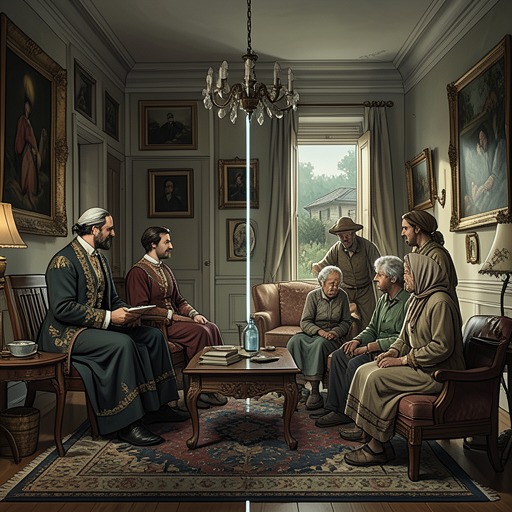
Tim’s story is set beside that of Henry Tavener, whose gracious mansion by the river is separated from the Altons’ crumbling farmhouse by more than a difference in comfort. James contrasts Tavener’s fine clothes, well-kept hands, books, pictures, and clocks with Tim’s worn clothes and the daily grind of staying alive on the exposed hillside. The comparison does not settle into a simple ranking of rich and poor. Its sharpest contrast is between the daughters: James remembers Julia Tavener’s contemptuous look toward her father and Jennie Alton’s shining tenderness toward hers.
That comparison changes the question from which household possesses more to which life offers more. James finds it increasingly difficult to decide who gets more from their different circumstances. As he drives from the Alton farm toward the smooth road, he reaches an unexpected preference: if he had the choice, he would settle for the Guinness. The closing note is a judgment shaped by the visit, not a claim that hardship is easy. Tim’s life remains a struggle against weather and labor, but the account sets beside that struggle the intimacy of a family, the pride of work, and the value of a life that cannot be measured by possessions alone.