Tricki Woo
All Creatures Great and SmallTricki Woo is a Pekingese and the cherished centre of Mrs. Pumphrey’s domestic life. His comic importance lies in the contrast between the extravagant affection lavished on him and the bodily consequences of that indulgence: he is repeatedly overfed, quickly exhausted, and prone to ailments that send his anxious owner reaching for James Herriot. Around him, the account builds a portrait of pet ownership as both intimate care and comic excess.
Identity and Household
Mrs. Pumphrey is an elderly widow whose late husband’s brewing fortune has left her with a beautiful house on the outskirts of Darrowby and a large staff, including servants, a gardener, and a chauffeur. In this comfortable household, Tricki Woo is not merely a pet but the declared apple of his mistress’s eye. His position is apparent in the welcome given to Herriot: the maid leads him into a room filled with expensive furniture, glossy magazines, and recent novels, while Mrs. Pumphrey greets him as an honoured visitor.
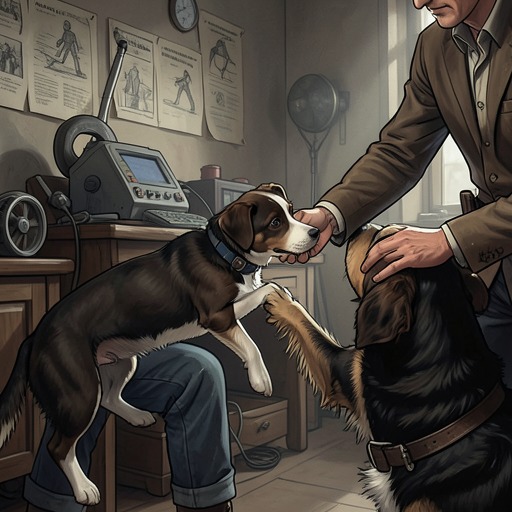
The intimacy is performed as family. Mrs. Pumphrey introduces Herriot to Tricki as his “Uncle Herriot,” and Herriot accepts the title, recognizing that the relationship has advantages. Tricki greets him with vigorous enthusiasm, bounding from his cushion, leaping onto the back of a sofa, and putting his paws on Herriot’s shoulders before licking his face. The display ends in exhaustion. Tricki receives roughly twice the food appropriate for a dog of his size, and the food is of the wrong kind; his affectionate welcome thus immediately reveals the indulgence that shapes his health and habits.
Food, Symptoms, and Veterinary Care
The recurring complaint Mrs. Pumphrey calls “flop-bott” is not a textbook diagnosis but her own name for Tricki’s discomfort from impacted anal glands. When the glands fill, he may suddenly sit down while walking, a small sign that alarms his owner enough to prompt an urgent telephone call to Herriot. The contrast is central to the scene: the symptom is specific and bodily, while Mrs. Pumphrey’s label turns it into one more familiar episode in the private vocabulary she shares with her pet and his veterinarian.
Her anxiety coexists with difficulty refusing him food. When Herriot warns that continued indulgence will make Tricki go “crackerdog” more often, Mrs. Pumphrey shrinks into her chair, says she tries to give him the right things, and admits that she cannot refuse when he begs for titbits. Her handkerchief and visible guilt show that the problem is not indifference but affection that repeatedly defeats restraint. Herriot is firm about the likely consequence, though he leaves the choice with her; the exchange makes their veterinary relationship a negotiation between medical advice and the owner’s attachment.
The Social World Around Tricki
Mrs. Pumphrey’s stories extend Tricki’s life beyond the house. She reports that he wrote to the editor of Doggy World, enclosed a donation, and presented himself as descended from Chinese emperors who had chosen to mingle with ordinary dogs. For the correspondence, he adopted the name Mr. Utterbunkum. The editor’s reply proposed Bonzo Fotheringham, a lonely Dalmatian, as a pen pal in Yorkshire. Mrs. Pumphrey recounts the exchange as exciting news; Herriot listens over sherry while Tricki snores on his lap. The dog’s imagined literary and aristocratic life is set against the ordinary physical fact of his sleepiness.
The same comic enlargement colours Mrs. Pumphrey’s account of a summerhouse bought specially for afternoons with Tricki. He refuses to enter it and, she reports, calls it “the bloody hut!” In these stories, she lends him elaborate intentions and a distinct social personality, even as the narrative repeatedly returns to his dependence on her care and his limited capacity for exertion. The humour arises from the gap between the grand little world she constructs around him and the small, pampered dog resting in her lap.
Herriot’s Relationship and Narrative Role
The relationship also has a material, reciprocal side. On leaving the house, Herriot looks back to see Mrs. Pumphrey waving and Tricki standing against the window, his wide-mouthed face appearing to laugh. On the drive home, Herriot reflects on the gifts sent in Tricki’s name: oak-smoked kippers when he goes to the seaside, tomatoes from the greenhouse as they ripen, and regular tins of tobacco, sometimes accompanied by a photograph with a loving inscription. The Christmas hamper from Fortnum and Mason’s prompts Herriot to conclude that this arrangement is worth encouraging. Mrs. Pumphrey has previously been cool when he thanks her, insisting that Tricki sent the gifts and should receive the thanks instead.
Tricki therefore connects the practical world of veterinary calls with the warmth and absurdity of Mrs. Pumphrey’s drawing-room hospitality. His recurring complaints bring Herriot into the household; his owner’s stories turn those visits into comic interludes; and his gifts make the professional relationship unexpectedly personal. The account does not make his indulgence harmless: Herriot explicitly links it to recurring discomfort. But neither does it reduce the bond to a medical problem. Tricki is at once an animal in need of sensible care, the object of Mrs. Pumphrey’s boundless affection, and the centre of a relationship in which professional advice, family-like familiarity, and material generosity continually overlap.