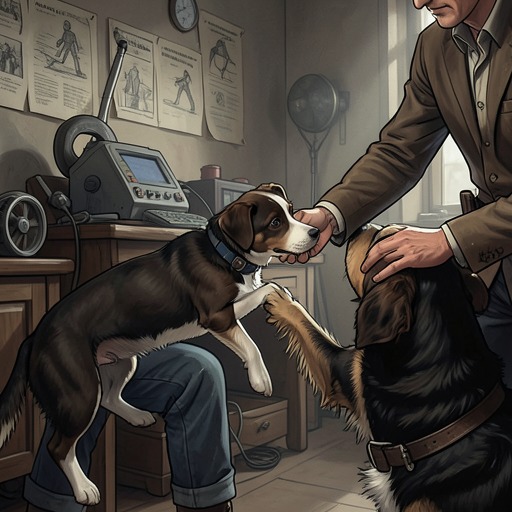
Tricki’s hospitalization, weight loss, and recovery
All Creatures Great and SmallTricki’s hospitalization turns an alarming case of obesity into a recovery achieved through restraint, movement, and company rather than medicine. When James Herriot sees him tottering along beside Mrs. Pumphrey, the little dog is so swollen that he resembles “a bloated sausage with a leg at each corner.” A fortnight away from his overindulgent home lets Tricki become an active member of the surgery dogs’ pack—and exposes the comic distance between the simple treatment and the elaborate gratitude it inspires.
The crisis at home
Mrs. Pumphrey explains Tricki’s listlessness as a sign of malnutrition. To build him up, she has added calf’s foot jelly, malt, cod-liver oil, and Horlick’s at night to his regular meals. Although Herriot had already advised her to reduce the sweet things, she admits that she could not keep refusing the cream cakes and chocolates Tricki loved. Exercise has dwindled too: he takes little walks, but his usual ring-throwing games have stopped while Hodgkin is laid up with lumbago.
Herriot sees the result in Tricki’s huge, sausage-like body, bloodshot eyes, and lolling tongue. He warns Mrs. Pumphrey that unless she sharply reduces the food and gives Tricki more exercise, he will become seriously ill. She promises to try, wringing her hands, and sets off along the road with Tricki in his little tweed coat. He has a whole wardrobe of warm tweeds, tartans, and waterproofs; the abundance of clothing and treats contrasts with the lack of the movement and limits he needs.
The strict new regime does not last long. Within days, Mrs. Pumphrey calls in distress: Tricki refuses even his favourite food, vomits, pants on a rug, and will neither walk nor do anything. Herriot has anticipated that keeping him in the house will not solve the problem. He proposes hospitalizing Tricki for about a fortnight under observation, and, despite Mrs. Pumphrey’s fear that separation will make her darling pine and die, insists that the dog is very ill and must leave without delay.
Separation and a simpler regimen
Herriot carries Tricki, wrapped in a blanket, out to the car while Mrs. Pumphrey wails. The household rushes to assemble an assortment of comforts: day and night beds, cushions, toys, rubber rings, separate bowls for each meal, and coats. The collection is too much for the car. As Herriot drives away, Mrs. Pumphrey throws an armful of little coats through the window; in the mirror, he sees the household in tears. Beside him, Tricki gasps on the seat but still makes a brave effort to wag his tail.
At the surgery, the other dogs crowd around their new arrival. Tricki looks down at the noisy pack with dull eyes, then lies motionless; after briefly sniffing him, the dogs lose interest. Herriot beds him in a warm loose box beside them. For two days Tricki receives no food, only plenty of water. By the end of the second day he is taking notice of his surroundings; on the third, he whimpers at the sound of the dogs outside.
When released, he trots into the garden and is engulfed by Joe the greyhound and the others. They roll him over and inspect him, then set off down the garden with Tricki following, still wobbling under his surplus weight but visibly intrigued. The change is not produced by a new drug or operation. Instead, the dogs’ ordinary activity and company draw him into a livelier routine.
Joining the pack
At feeding time, Tristan slops food into the dogs’ bowls. The pack rushes in, each dog eating at speed and guarding its chance at the last of the meal. Tricki initially walks around the shining bowls, casually licking inside one or two. The next day an extra bowl is put out, and Herriot is pleased to see him jostling his way toward it. His return to eating is shown not as a special indulgence but as participation in a shared, competitive routine.
From then on, his progress is rapid. He has no medicinal treatment: he runs about with the dogs, joins their friendly scrimmages, and is bowled over, trampled on, and squashed every few minutes. The formerly pampered little dog becomes an accepted member of the gang, an unlikely silky figure among shaggy companions. He fights for his share at meals and hunts rats in the old hen house at night. Herriot observes that Tricki has never had such a time in his life. The social world of the pack supplies both exercise and a kind of ordinary canine life absent from the carefully cushioned domestic routine.
Meanwhile, Mrs. Pumphrey rings a dozen times a day for bulletins, still concerned about details such as whether Tricki’s cushions are being turned and whether he is wearing the right coat for the weather. Herriot avoids those questions but can tell her that the dog is out of danger and “convalescing rapidly.” Her response gives recovery an unexpected second life at the surgery: she sends fresh eggs, two dozen at a time, supposedly to build up Tricki’s strength. For a time, the household has two eggs each for breakfast. Then bottles of sherry arrive, followed by two bottles of Cordon Bleu brandy to put a final edge on Tricki’s constitution. Siegfried Farnon produces his mother’s balloon glasses, and Herriot, Siegfried, and Tristan turn the gifts into ceremonial meals and repeated toasts to Tricki’s health. The dog’s rehabilitation is modest; the human celebration grows increasingly sumptuous.
Return and significance
After a fortnight, Herriot knows he cannot keep Tricki as a permanent guest: Mrs. Pumphrey is suffering, and the dog is ready to go home. When the chauffeur draws up in a car about thirty feet long, Mrs. Pumphrey remains inside, hands clasped and lips trembling, and asks whether Tricki is really better. Herriot goes to fetch him rather than making her leave the car.
In the garden, the little golden dog is running with the pack, ears flapping and tail waving. In two weeks he has become lithe and hard-muscled, keeping pace with the other dogs in long bounds. When Herriot carries him back, Tricki leaps into Mrs. Pumphrey’s lap and swarms over her, licking her face and barking. The beds, cushions, toys, coats, and bowls brought to the surgery have gone unused; Herriot helps the chauffeur load them back into the car.
With tears shining in her eyes, Mrs. Pumphrey declares, “This is a triumph of surgery!” The line gives the ending its gentle irony: the celebrated cure required no medicinal treatment, only a period away from excess, enough activity, and the company of other dogs. The event contrasts affectionate care with effective care without diminishing Mrs. Pumphrey’s attachment to Tricki. Her devotion is real, but her attempts to protect him from want have helped create the condition from which he must recover.