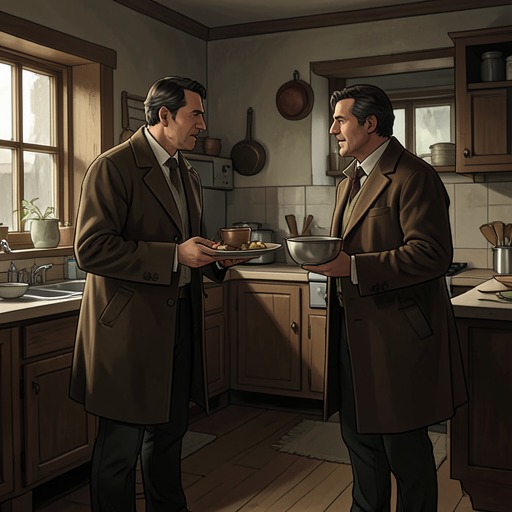
Tristan’s escaped hens
All Creatures Great and SmallTristan’s escaped hens are the disastrous result of Siegfried Farnon’s attempt to keep a productive flock under Tristan’s care. Their repeated escapes bring complaints from the neighbours and sharpen the brothers’ quarrel; their eventual success with Mrs. Dale turns the failed venture into an ironic test of how differently the same hens fare under different care.
A Flock Tristan Does Not Manage
Tristan shows little interest in the hens as egg producers. James Herriot observes him loitering outside the hen house, looking bored and sometimes tossing bread crusts over the wire; the regular feeding and balanced diet recommended by experts are conspicuously absent. He is more entertained by individual quirks, such as a hen’s unusual cluck or gait, than concerned with their upkeep. Meanwhile, no eggs appear, and Siegfried grows increasingly frustrated, anxiously checking the empty nesting boxes each morning.
Escape and Neighbourhood Complaints
The hens’ wandering becomes visible when Tristan calls James to look at unusually coloured birds perched in the elms and a neighbour’s apple trees. Only seven are in sight. Looking over the garden wall, the two find the other five pecking among cabbages. Getting all twelve back into the hen house takes a long time, and the chore has to be repeated several times a day. The hens have evidently tired of their confinement and Tristan’s management, ranging farther afield in search of food.
At first the neighbours treat the escapes as a joke, telephoning to say that their children are rounding up the hens and asking the household to collect them. Their amusement wears off as the nuisance continues. Siegfried is eventually subjected to painful conversations in which neighbours tell him plainly that the flock has become an intolerable disturbance. After one particularly unpleasant interview, he decides the hens must go.
Rebuke, Reversal, and Aftermath
Siegfried’s anger falls chiefly on Tristan. He blames him for the absence of even one egg after three weeks and for the hens flying about the countryside, which has left the household estranged from its neighbours. Tristan offers a halting defence, saying he had thought something was queer about the hens from the start. Siegfried explodes at the word, turns the accusation back on Tristan, and orders him out of sight. Tristan withdraws quietly and with dignity.
A fortnight later, Siegfried returns to the subject at the dining table. He has given the hens to Mrs. Dale, an elderly pensioner in Brown’s Yard, and has just heard that she is delighted with them. Her hot mash, given morning and night, is followed by a startling result: she is collecting ten eggs a day. The flock that produced none under Tristan has become highly productive under Mrs. Dale’s care. Siegfried’s voice rises as he repeats the figure, while James finishes his tea, makes a quick exit through the back door and garden, and passes the empty hen house on his way to the car. Its forlorn appearance provides a quiet counterpoint to the uproar still audible from the dining room.
Narrative Significance
The episode turns a small domestic failure into a comic reversal. The hens are first treated as egg-producing stock, but Tristan’s interest in their personalities and their own roaming behaviour disrupt that practical purpose. The final comparison does not blame the birds: Mrs. Dale’s care yields ten eggs a day where the Skeldale House venture yielded none. Siegfried’s repeated anger, followed by the unmistakable result of the gift, makes the empty hen house a remnant of both the failed enterprise and the quarrel it provoked.