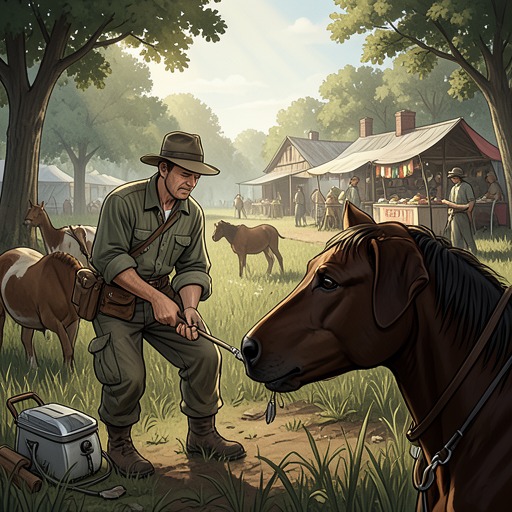
Uterine torsion
All Creatures Great and SmallUterine torsion is a twisting of the cow’s reproductive tract that can leave a live calf with no route out. In Candy’s case, the condition turns a difficult examination into a risky manual procedure: James Herriot must identify the obstruction by touch, enlist the farm men to roll the cow, and keep hold of the calf until the twist releases. The delivery succeeds, but only after the first movement worsens the constriction and the next attempt meets powerful resistance.
Presentation and Diagnosis
Candy’s condition is discovered during an examination after calving has become a concern. The passage is empty but narrows quickly to a small, ridged opening, barely wide enough for Herriot’s hand. Beyond it, he can feel the calf’s head and feet. The calf is alive, but the obstruction leaves it with no way out. These findings make the problem more than a difficult presentation of the calf: the passage itself has been twisted and constricted.
Herriot explains the condition to Mr. Alderson as a twisted calf bed. The diagnosis is formed through the physical examination rather than an external sign described in the scene. Once he recognizes the torsion, he has to explain both the immediate stakes and the proposed intervention: the calf is alive, but delivery cannot proceed unless the twist is corrected.
The Stakes of Correction
The available approach is to roll Candy while Herriot holds the calf. The procedure depends on coordinating several people around the cow: Bert takes the front legs, Stan the hind legs, and Mr. Alderson holds her head on the floor. Herriot stretches out on the concrete, reaches inside, and grasps the calf’s foot. In the period represented, caesarean sections on cows are not yet part of the practice described, so failure carries a stark consequence: Herriot may have to tell Mr. Alderson to send Candy to the butcher.
That prospect underlines the uncertainty behind Herriot’s assurance that rolling the cow will put matters right. He knows from experience that the method can work or fail; he is not certain of success. Nevertheless, he commits to the attempt and directs the men through each movement while maintaining his hold on the calf.
The Rolling Procedure
The first roll is clockwise. As Candy is moved onto her other side, Herriot feels no change inside. The men then roll her onto her brisket, but the direction proves wrong: a smooth band of tissue tightens around his wrist with numbing force. The danger is immediate enough that he calls for the cow to be returned to her original side. The men act quickly, relieving the pressure on his arm and restoring the starting position.
Herriot takes a fresh grip on the calf’s foot and asks the men to turn Candy the other way. The anti-clockwise movement carries her through 180 degrees without an apparent release; resistance remains tremendous. After a brief pause, he calls for one more turn. This time the obstruction gives way: the uterus opens around his arm, and the calf begins to slide towards him. The sequence shows why the intervention is not simply a matter of rolling the cow once. Direction and the response of the constricted tissue determine whether the movement worsens the danger or corrects it.
Delivery and Significance
With the twist released, Candy begins to strain. Her first effort is determined, and a second prolonged push brings the calf into Herriot’s arms, wet and wriggling. Mr. Alderson dries it with hay, then continues rubbing it down. The calf is a heifer, pale gold and notably small. The scene ends with the immediate obstruction overcome and the calf delivered; it does not describe Candy’s later recovery.
Uterine torsion matters here both as a physical barrier and as a test of practical judgment under pressure. Herriot must translate a tactile diagnosis into a coordinated procedure, revise the attempt when the first direction tightens the tissue, and persist despite resistance and the consequences of failure. The case’s successful ending depends not on certainty at the outset but on close examination, controlled teamwork, and recognizing when the cow’s body has finally released the twist.