the Dales
All Creatures Great and SmallThe Dales are more than a picturesque backdrop to rural veterinary practice: their distances, weather, roads, farms, and settlements repeatedly determine what the work demands, while their hills and valleys become inseparable from the narrator’s growing attachment to the place. The region first overturns his expectations of Yorkshire, then tests him with winter journeys and difficult access, and finally frames a sense of home that includes both partnership at Skeldale House and marriage to Helen Alderson.
Landscape and First Impressions
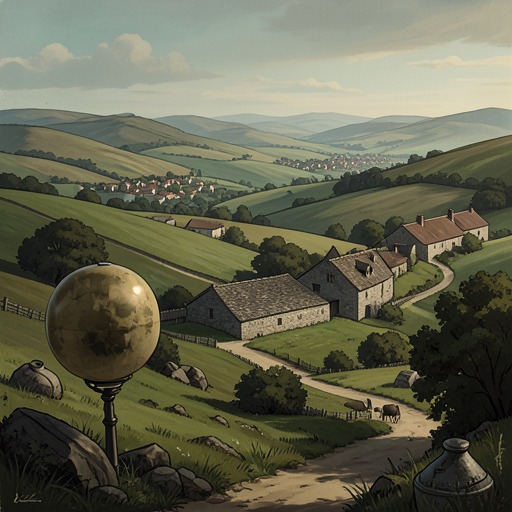
The narrator’s first approach to the Dales begins with uncertainty. In 1937, newly qualified and anxious about an interview with Siegfried Farnon, he travels by bus toward Darrowby in search of a position that might keep him from unemployment. Before reaching his destination, however, the country itself begins to revise his assumptions. The high ground resolves into grassy hills and broad valleys; rivers wind through wooded bottoms, and grey-stone farmhouses sit among cultivated fields that push green strips up into the heather-covered heights.
The region’s structure is visible in its boundaries as much as in its open views. Fences and hedges give way to dry-stone walls, which border roads, enclose fields, and continue across the fells. Their countless lines make human settlement legible across the uplands without diminishing the scale of the surrounding country. That combination—worked farmland set against broad, heather-dark summits—establishes a landscape shaped by both agricultural life and the larger forms of the hills.
Darrowby concentrates that contrast. The town is described in guidebooks as grey and modest, with a cobbled marketplace and two ancient bridges, but its position beside the pebbly River Darrow gives it a more compelling character. Its houses cluster along the lower slopes of Herne Fell, whose green mass rises more than two thousand feet above the roofs and remains visible from streets and windows. On arrival, the quiet square and its stillness make the town feel unlike the city the narrator has left behind; the clean, open air seems to release him from its confinement, grime, and smoke.
Farms, Roads, and the Work of Practice
For the veterinary practice, this landscape is not only something to look at. It is the route between cases, and its gradients and distances shape the physical effort of reaching animals. Worton, seen from a high moor, appears as a scatter of old stone houses beside the river, with small gardens softening the rising fellside. But the view is complicated by a road with a one-in-four gradient and two sharp bends. The narrator’s car has lost its braking power, turning the descent into a serious practical danger: in the Dales, even an attractive prospect may be bound up with the difficulty of getting safely from one place to another.
Winter makes that dependence on roads still more direct. The narrator is in his second winter in Darrowby when November brings heavy snow to the high country. While rain falls on the plain, snow fills roads and obscures familiar landmarks; around Darrowby, residents dig paths to their garden gates and clear drifts from their doors, knowing the task may have to be repeated the next day. The weather changes not just the appearance of the region but the conditions under which its people and practitioners can move.
A night of continuous snow precedes a call from Mr. Clayton of Pike House about a young animal with a slight cold. The ploughs have not attempted to clear the side road toward Pike Edge, and the car can go no farther. The narrator shoulders his rucksack, wearing a leather golf jacket and extra thick socks beneath his Wellingtons, and continues on foot. His description of the journey holds hardship and attraction together: the cold causes aching toes and painful fingers, while wind-sculpted drifts form smooth folds, deep hollows, and sharply edged hollows and cliffs. A bright farmhouse fire exerts its pull, but the vet proceeds across the bridge, past the frozen river, and upward through the snow. The region’s beauty does not suspend the obligation to reach a case; it makes that effort more vivid.
Weather, Animals, and Rural Life
The Dales’ weather can seem to close around the communities it affects. In the high country, snow fills the roads and makes travel slow; for the veterinary team, each fresh fall creates another obstacle. Sometimes the car can follow a council plough, but often it must be left behind and the remaining distance walked. The practical consequence is a working pattern of partial access and physical improvisation, rather than reliable travel from one farm to the next.
Cold also registers at the farm itself. After a morning’s veterinary work, the narrator steps outside into a grey sky and long, icy gusts crossing the open moor. He recalls the local names thin wind and lazy wind for air that seems to pass straight through a person rather than blow around them. The phrase gives local knowledge a place in the account: the weather is not an abstraction but a familiar force, named through its effect on bodies and daily routines.
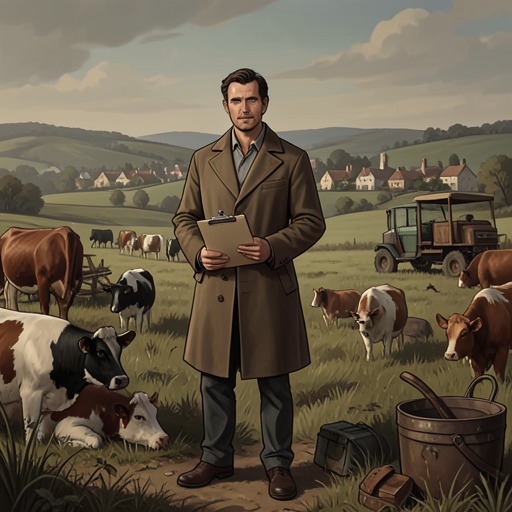
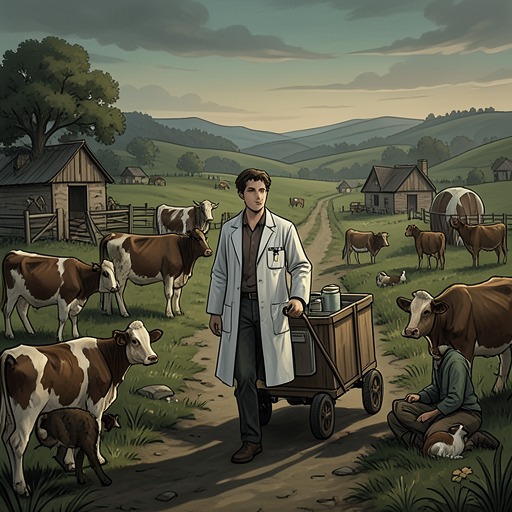
Against that exposure, the farmhouse kitchen offers shelter, and the farmyard shows another kind of adaptation. While Peter loads a cart with hay for young cattle, the old dog Tip leaps aboard and rides across the fields, undeterred by the cold. The narrator remembers him braced against the cart’s uneven movement, barking at the weather. The scene makes rural life more than a struggle against conditions: people, working animals, and companion animals share the same farms and routines, though each meets the cold in its own way.
Settlements and the Meaning of Home
The Dales’ settlements offer a quieter counterpoint to the effort of reaching scattered farms. Darrowby’s river, bridges, market square, and houses beneath Herne Fell give the narrator a first sense of a place that is both compact and open to the surrounding landscape. Skeldale House, in Trengate, marks the immediate possibility of work: the ivy-covered house and its brass veterinary plate identify the destination of the journey that brought him into the region. What begins as an employment interview thus connects the landscape to a change in his prospects.
Ellerthorpe later becomes part of the story of his marriage. On their honeymoon, the narrator and Helen arrive at the Wheat Sheaf after driving ten miles across a desolate moor and descending a steep, narrow road in darkness. The inn is a low grey-stone building on the village’s single long street, plain and unfashionable rather than stylish. Its appeal lies in its welcome, its meals, and the peaceful, sleepy character that the couple later remember with happiness. The old stone frontage remains unchanged when the narrator passes it decades afterward, preserving a setting to which memory can return.
The honeymoon does not remove the couple from veterinary work. The next morning, the narrator takes Helen to assist with testing at Allen’s farm, beginning a second day of the test. When the farmer calls Helen his missus, the ordinary courtesy strikes the narrator as a milestone. He sees her seated on a rough stone wall with her notebook, then becomes aware of the surrounding hills and the scent of clover and warm grass. The moment joins the region’s physical details to the completion of a personal transition: the narrator understands his first two years in Darrowby as having led toward this life with Helen, while his new nameplate at Skeldale House marks his professional place.
Narrative Significance
Across these episodes, the Dales are presented through repeated contrasts: the open valley and the constricted road, beautiful snow and blocked access, the cold moor and the warm farmhouse, a modest village inn and the lasting richness of its hospitality. The landscape is not static scenery, because its weather and terrain alter the course of work and the effort required to perform it. Nor is it simply hostile: its rivers, hills, stone buildings, and cultivated fields furnish the experiences through which the narrator’s initial uncertainty gives way to attachment.
The region also gives the narrative a shared setting for professional and personal change. Darrowby is where the narrator arrives hoping for his first assistant’s position; the farms and roads become the daily geography of veterinary practice; and the hills around Ellerthorpe frame a honeymoon that continues to include work. By the time he notices Helen as his wife on the hillside, the Dales signify not merely the place where he has found employment but a life in which landscape, vocation, and marriage have become closely joined.