“Don’t let her go.”
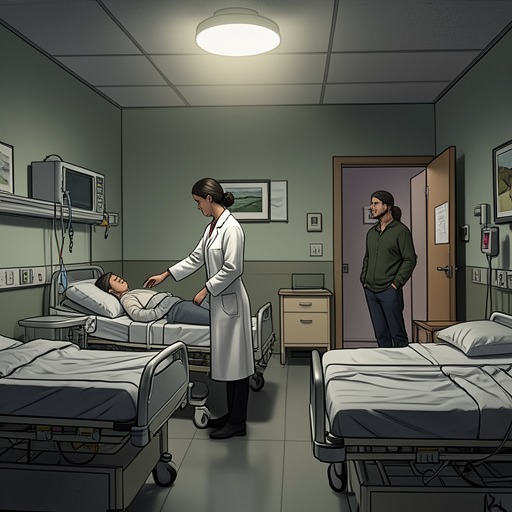
All My Puny Sorrows“Don’t let her go” names a plea that recurs as the Von Riesen family confronts psychiatric discharge and the danger of leaving Elfrieda Von Riesen without support. For Yolandi Von Riesen, the words carry the weight of an earlier loss: the family begged a hospital not to release Yolandi and Elfrieda’s father, but he was allowed to leave and was gone for good. Now, as Elfrieda is hospitalized, the same fear becomes immediate again. The phrase is not a demand to confine her indefinitely; it is a request that the hospital not mistake apparent composure for safety, and not send her home without a plan for care.
The family history inside the plea
The expression’s force comes from repetition across generations of crisis. Yolandi describes the family as a chorus that keeps asking hospitals not to let its loved ones go. The earlier request concerned Yolandi and Elfrieda’s father at a hospital in East Village. The family pleaded, the hospital released him, and he died by suicide. That remembered failure gives the present plea a specific consequence: release is not an abstract administrative outcome for Yolandi, but something associated with a loss that cannot be reversed.
The echo also marks the limits of family authority. Yolandi and Elfrieda had asked the hospital to keep their father, yet their status as family had not been enough to prevent his release. During Elfrieda’s hospitalization, Yolandi again has to ask clinical staff to recognize what relatives know about the person in their care. Her fear is sharpened by the possibility that Elfrieda could convincingly say she feels well, even while remaining at risk. The phrase therefore joins past grief to present vigilance: the family remembers what happened when its warning was not heeded and tries to make that warning legible this time.
A plea against premature discharge
Yolandi’s concern is concrete well before she reaches the nurses’ desk. She reasons that Elfrieda knows how to follow rules and could tell doctors and nurses that she feels positive and is not suicidal. If the hospital accepts that account at face value, Yolandi fears, Elfrieda may be home that same day. From a secluded alcove overlooking the parking lot and fields, she weighs trusting Elfrieda’s presentation against assembling a support team immediately. Her certainty that Elfrieda will be released soon turns a general anxiety into a practical emergency.
That fear shapes the final appeal. At the nurses’ desk, Yolandi places her palms on the counter and begs the staff not to let her sister go. Asked whom she means, she identifies Elfrieda Von Riesen. When a nurse asks whether Elfrieda is due to be discharged, Yolandi clarifies that she is not making a routine inquiry: she wants the staff not to believe Elfrieda if she says she is fine, because she may be convincing while still being unsafe. The nurse does not recognize Yolandi as Elfrieda’s sister, and directs the decision about discharge to the doctor. The encounter makes the gap between a family’s sustained knowledge and the institution’s immediate recognition visible in a few exchanges.
Yolandi then finds Janice, who has come around the corner carrying a guitar. Struggling to speak, Yolandi asks that Elfrieda not be sent home while she is away and explains that she plans to return to take her to Toronto for a few weeks or months. Janice reassures her that the hospital will not discharge Elfrieda without follow-up care in place. The options remain undecided: a long-term facility or continuing outpatient psychiatric visits. That qualification matters. Janice cannot promise a particular destination or outcome, but she does promise that discharge will depend on arranging care rather than simply freeing a bed. She also tells Yolandi that Toronto is a good idea.
Being heard, and being treated as a person
The plea arises in a story where communication itself is contested. Elfrieda sometimes refuses to speak, and Yolandi has seen a psychiatrist dismiss the possibility of communicating with her through writing. He says he has no time to exchange a notebook and insists that Elfrieda must attempt to communicate normally if she wants to get better. The refusal makes the hospital’s demand for cooperation more consequential: the patient’s means of expression are treated as an inconvenience rather than a possible route into her experience.
Other scenes offer a contrast. Janice explains that art therapy can help patients express themselves more easily through paint and paper than through language. Yolandi, too, experiences difficulty speaking: when Janice asks how she is doing, Yolandi sits shaking her head, pressing a finger to her lips as if holding words in. These moments place the plea within a wider struggle over which forms of distress can be heard and how much time others will give them. Yolandi is not asking staff simply to accept her interpretation without question; she is asking them not to treat fluent reassurance as the only reliable evidence of Elfrieda’s condition.
Lottie voices the related question of dignity when she challenges hospital staff about Elfrieda’s treatment. She objects to the assumption that cooperation is itself a sign of mental health, and argues that Elfrieda should be allowed to eat when she feels ready and to remain silent if she does not want to talk. Her intervention and Yolandi’s plea differ in emphasis, but both resist reducing care to compliance. The family’s concern is not that Elfrieda must behave in a prescribed way; it is that her needs and personhood must remain central while decisions about her safety are made.
Reassurance without certainty
The promise Yolandi receives is deliberately limited but important. Earlier, a nurse had reassured her that Elfrieda was not going anywhere soon, noting that Nic had already explained he was in Spain. At the later nurses’ desk, Janice makes the safeguard more explicit: there will be no return home until follow-up care is arranged. The plan is not yet settled, and Yolandi’s role in bringing Elfrieda to Toronto remains prospective. Still, the response changes the immediate meaning of the plea. For once, a hospital worker acknowledges both the danger Yolandi fears and the need for care after discharge.
The expression’s emotional power lies in holding two times together: the earlier release of Yolandi and Elfrieda’s father, and the unresolved decision about Elfrieda. Its repetition makes family memory an argument for attention, while the hospital scenes test whether that argument can alter care. Janice’s assurance does not erase the past or guarantee what will happen next. It does, however, replace a feared, unplanned departure with a promise to establish follow-up care first. In this sense, “Don’t let her go” is both a cry against repeating a devastating failure and a request that responsibility continue beyond the moment of discharge.