Christmas
All My Puny SorrowsChristmas is a recurring calendar point through which the novel measures family closeness, strain, and loss. Its scenes range from a childhood holiday disrupted by Elfrieda Von Riesen’s distress to an adult celebration after her discharge, and then to a later gathering at which her absence is felt in the gifts, music, and rituals around the tree. The season promises a shared script of reunion and celebration, but the family’s memories repeatedly expose the effort required to perform it.
A season revisited through memory
Christmas appears not as one continuous episode but as a point of return in Yolandi’s narration. Later gatherings prompt her to remember earlier ones, so that present-day efforts at celebration coexist with scenes from childhood. The movement between those times preserves their differences: the family can arrange food, gifts, music, and a tree, but those familiar practices do not erase what has happened to its members.
The recollections also make Christmas a test of ordinary happiness. A meal, a song, or a decorated room may offer a moment of company, yet the season’s expectation that everyone should take part can weigh heavily on Elfrieda. Later, when the family makes a deliberate effort to avoid demanding cheerfulness, the change is not a rejection of gathering. It is an acknowledgment that celebration cannot simply be required of people in pain.
Childhood rituals and the family’s earlier world
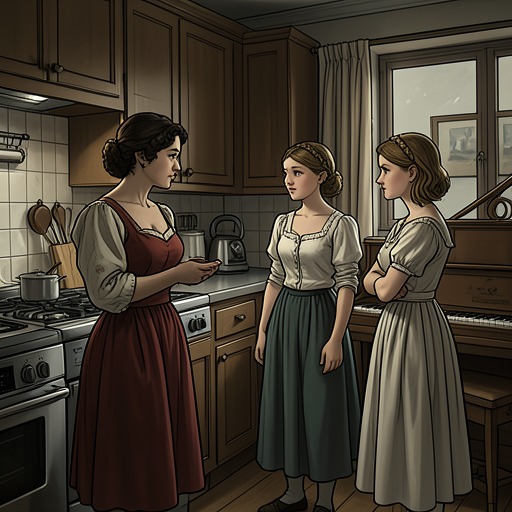
One childhood Christmas memory centers on Elfrieda returning home at fourteen after a special scholarship at the Juilliard School had opened a promising musical career. Relatives were already gathered around a table prepared for the holiday meal. Yolandi remembers the contrast between the public picture of a successful young musician and her sister’s inability to join in the family’s celebration. Elfrieda objected to the appearance of happiness and the sense that the occasion required a performance. She proposed that she and Yolandi leave for a pool hall instead; Yolandi urged her to come to the table.
Their mother’s gentle knock at the bathroom door makes the family gathering audible just beyond the sisters’ private crisis. Yolandi wanted her older sister beside her at the meal, telling stories and drawing the younger relatives’ admiration. The memory therefore holds two wishes in tension: for Elfrieda to be safe and present, and for her to become again the confident, vivid sister Yolandi had admired. The holiday table is not merely a setting; it represents the family’s hope that a familiar ritual can restore a familiar version of Elfrieda.
A separate recollection places Christmas in the background of Yolandi’s childhood memories of her father. Between Christmas and New Year’s, when he was thirty-seven, he travelled by train to Ottawa to research Canadian history and attend Lester B. Pearson’s funeral. A stranger invited him to his first New Year’s Eve party, in the Glebe. Years later, Yolandi remembers the hush that followed her father’s account and her sense that he had lost a leader and needed a friend. The story gives the turn of the year a quieter significance: a holiday interval becomes attached to a moment when her father’s vulnerability came close to the surface.
Elfrieda’s return and the fragile reunion
After Elfrieda is discharged from hospital, the family celebrates her homecoming at Christmas with spicy Indian food, wine, and the Armagnac her mother had given Nic. Elfrieda appears serene, with a pale pink scarf at her throat and a small amount of makeup covering a scar above her eye. Her hands still shake slightly; her trousers are too large, and Nic has made her a rope belt. The details place signs of recent difficulty alongside the family’s relief at having her home.
Nic calls Elfrieda affectionate names, her mother welcomes her warmly, and Nic gives her a library novel. Yet Yolandi cannot easily meet her sister’s eyes. She sees Elfrieda’s loving home and musical success as reasons she ought to stay, while recognizing that such outward signs do not settle the question of whether she wants to live. The celebration thus carries both reunion and apprehension. The absence of discussion about Paris or tennis does not resolve the underlying danger; it marks what the family is not addressing in that moment.
Later Christmas: making a home amid absence
In a later Christmas scene, Yolandi and Nora buy an especially large tree from the No Frills parking lot across from Runnymede Library on Bloor Street West. The seller calls it the Everest of trees. Once its plastic straps come off, it expands to fill the living room. Lottie knits a black sweater while Nora plays music, and the three work together to steady the tree. Their effort becomes a small, shared undertaking: the family tries to do something ordinary and succeeds, at least briefly, in getting the tree to stand on its own.
After they have stepped away to celebrate, the tree falls and brings down a painting, the television, books resting on the piano, a sculpture, a coffee cup, and a large plant. The mishap turns a modest domestic triumph into a comic wreckage of the room. Christmas here is neither a perfect refuge nor a solemn memorial; it is an occasion on which affection, frustration, and household disorder occupy the same space.
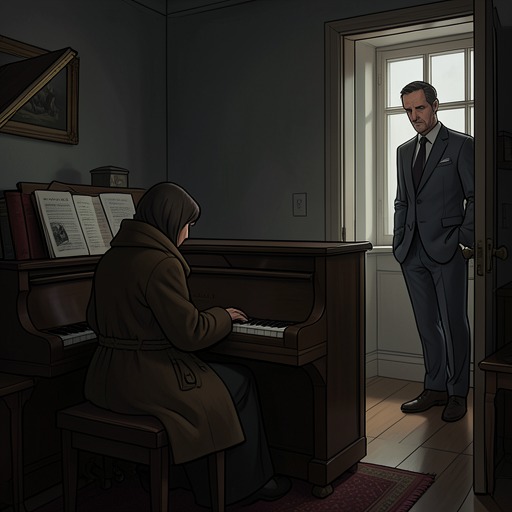
Claudio later visits with carefully wrapped gifts and letters of condolence from Elfrieda’s colleagues and fans. Elfrieda’s old piano books remain piled on the family piano, while the gifts go beneath the precarious tree. At the table, Claudio admits that he had believed music would save her life. Lottie answers that it probably did for as long as Elfrieda was alive. The exchange brings the season’s two strands together: music remains part of the family’s Christmas surroundings, and the gathering must make room for grief rather than pretend it has passed.
The holiday after expectation
As another Christmas approaches, Nora resists forced gaiety, and Yolandi recalls the earlier holiday when Elfrieda could not join the family meal. The memory changes the terms of the present gathering: a small amount of cheerfulness may be possible, but demanding a performance would repeat the pressure that made the old scene painful. Christmas becomes less a promise of uncomplicated happiness than an occasion for adjusting the family ritual to the people who are actually there.
The novel’s Christmas scenes do not settle into a single meaning. They preserve the warmth of meals and shared work, the strain of expectations, the return of painful memories, and the later presence of condolence letters and piano books. By letting these moments recur across childhood and adulthood, Yolandi’s narration shows how a holiday can carry both continuity and change: the family keeps gathering, but the people and the terms of gathering are never quite the same.