Elfrieda Von Riesen
All My Puny SorrowsElfrieda Von Riesen is a concert pianist whose musical brilliance helps her break from the restrictive community of her childhood, but it does not free her from recurrent suicidal despair. Her story is held in the tension between exceptional artistic achievement and private crisis: the sister who once demanded perfect page turns becomes the person Yolandi Von Riesen cannot save by devotion, argument, or care. Through Elfrieda, the novel considers both the force of a life shaped by music and the limits of what family love can accomplish.
Identity and Background
Raised in East Village in a Mennonite family, Elfrieda grows up within a community where conformity carries moral weight and women’s ambitions are constrained. Her parents initially keep a piano in the house in secret, covering it when church elders visit. A city doctor had recommended a creative outlet for Elfrieda, but the suggestion itself was framed as a way to prevent her from becoming wild, a quality the community regarded with suspicion. Her parents come to value her playing and sometimes request songs; the piano is not simply tolerated as treatment but becomes a central expression of who she is.
The family’s silence also has a history behind it. Elfrieda’s grandparents came from a Mennonite village in Siberia, where the family endured violence during the upheavals surrounding the Bolshevik Revolution. Her grandfather survived after hiding, was transported to Moscow, and was sent to Canada. He warned the next generation not to teach the children Plautdietsch if they wanted them to survive. Yolandi describes suffering as something that can pass between generations, while the family’s difficulty speaking about its origins gives Elfrieda’s wish to explore her Russian roots particular force. Her interest in Russia is expressed as a possibility during her departure for Europe, not as a journey she is shown making.
Music, Defiance, and Departure
As a child, Elfrieda makes Yolandi her page-turner for fast pieces she has not memorized. She trains her younger sister to move at exactly the right moment and without making a sound. If Yolandi turns too early or too late, Elfrieda stops playing; the precision she demands makes the task a small but telling rehearsal of her own musical discipline. Yolandi takes pride in being just ahead of her sister in this one role, and in helping create an uninterrupted passage through the music.
The piano also becomes the instrument through which Elfrieda asserts an adult self. When church elders gather in the family home to address the forbidden instrument, she plays with such intensity that the room’s ordinary social order seems to fall away. Her mother begins to hum and sway; the men remain silent. After the performance, Elfrieda joins her mother and Yolandi in the kitchen, drinks apple juice, and celebrates having finally mastered the piece. The elders leave without taking the piano, but the encounter has exposed the conflict between communal control and her artistic independence. Yolandi understands the performance as the moment Elfrieda became free and dangerous to the authority that had kept her at home.
At seventeen, Elfrieda leaves for Norway to perform and study with a teacher she calls the Wizard of Oslo. She has completed high school early, earned top marks, received six piano scholarships, and won a Governor General of Canada prize for the highest marks. Her achievements provoke anger and fear among the elders, whose assumptions about women’s education and ambition she has already exceeded. The departure is not her first time leaving home, but Yolandi remembers it as the one that is meant to last. Elfrieda’s rise as a pianist thus begins in both accomplishment and separation: the talent celebrated beyond the community is the same talent that makes a settled return difficult to imagine.
Crisis and the Sisters’ Conflict
As adults, Elfrieda’s periods of psychiatric care recur. Janice, a psychiatric nurse who knows the family from earlier admissions, welcomes her warmly while regretting that she is in the hospital again. Elfrieda apologizes and seems weary of the repetition. In another exchange, she accuses Yolandi of lying about what life is. The sisters’ argument lays bare the limits of reassurance: Yolandi cannot honestly promise that life will become bearable, while Elfrieda rejects consolations that do not acknowledge her experience.
Elfrieda describes a glass piano inside her body, an old upright Heintzman whose entire structure, including its keys, has become glass in her account. She fears it will break and associates certain sounds with that possibility. The image joins her musical identity to her fragility without reducing either to a diagnosis: the piano is at once a familiar instrument and a frightening, intensely personal explanation for what she feels. Her account gives Yolandi a language for her sister’s terror, but it does not resolve the sisters’ disagreement about how to respond to her wish to die.
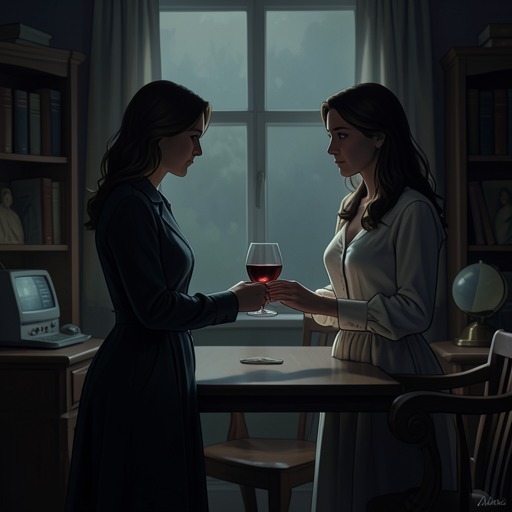
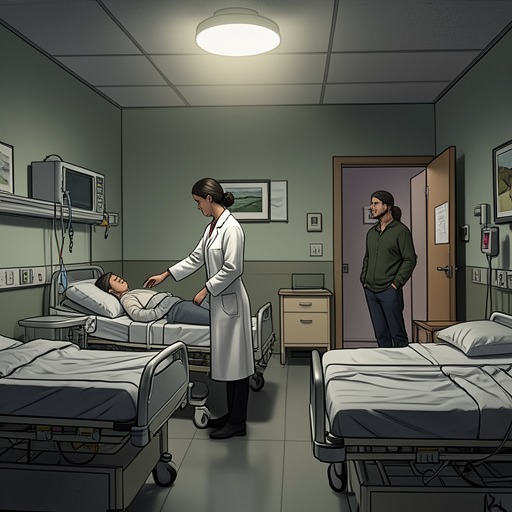
When Elfrieda asks Yolandi to take her to Switzerland, Yolandi refuses. Elfrieda pleads for what she calls one last act, while Yolandi rejects the finality of that framing. Their conflict is not a lack of love but a collision between Elfrieda’s insistence on control over her death and Yolandi’s refusal to assist her. Later, after Elfrieda attempts suicide shortly before a concert, Lottie and her sister Tina find her and call for emergency help. Elfrieda survives and receives intensive medical care, including respiratory support. The crisis brings Yolandi back to Winnipeg, where she and Julie sit beside Elfrieda and hold her hands. Unable to speak, Elfrieda communicates with gestures; when she indicates that she wants her glasses, the request offers a small sign of attention still directed toward the world around her.
Care, Separation, and Legacy
Yolandi’s fear persists beyond the immediate emergency. Leaving the psychiatric ward, she asks the nurses not to discharge Elfrieda simply because she might convincingly say that she is fine. She identifies her sister by her full name and explains that apparent reassurance would not remove the danger she sees. The plea makes visible the strain of trying to protect someone within a system whose staff and family do not share Yolandi’s constant vigilance.
At home with Lottie, Yolandi proposes that Elfrieda stay with her in Toronto after leaving the hospital. She imagines a different environment, with herself available, Nora often present, and a piano that could be rented if Elfrieda wanted to play. She even suggests getting a boat, despite knowing that Elfrieda may not care for boating. The plan gathers practical details around a hope that is deliberately modest: a change of scene, company, and music might make living together possible. Nic agrees that Elfrieda should be able to go if she wants, and Yolandi continues arranging the visit while working and calling Winnipeg for updates.
During those calls, hospital staff tell Yolandi they will not let Elfrieda go, and Nic sometimes puts the phone to Elfrieda’s ear. For a time she does not answer. Then her voice returns clearly with a direct question about when Yolandi is coming to get her. The exchange gives the proposed move a reciprocal shape: it is no longer only Yolandi’s idea of rescue, but a plan Elfrieda asks her to carry out. The evidence does not present that plan as a cure or a lasting resolution.
By a later Christmas, Elfrieda has died. Claudio visits Lottie with condolence letters from the pianist’s colleagues and fans, and the family raises a toast to Elfrieda. He admits that he had believed music would save her; Lottie answers that it probably did for as long as Elfrieda lived. That exchange neither makes music a remedy nor denies its importance. Elfrieda’s playing gave her a means of expression, a route away from the constraints of East Village, and a bond with her family. Her life and death leave those gifts intact while refusing the comforting idea that talent, achievement, or love could guarantee her survival.