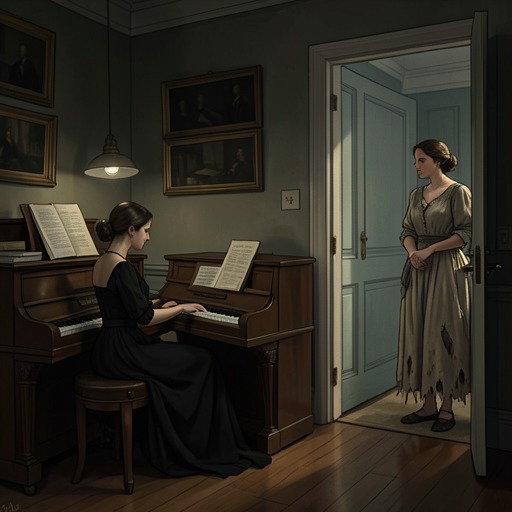
Elfrieda and Claudio’s agent-pianist relationship
All My Puny SorrowsElfrieda Von Riesen and Claudio’s agent-pianist relationship joins a long professional association to a form of personal attention that extends beyond arranging concerts. Claudio represents Elfrieda from her early career onward, supports her in many unspecified ways, and remains concerned about her wellbeing when performance obligations press in. The novel sets this durable working bond against a recurring difficulty: the pianist’s distress can make the demands of a carefully planned career impossible to meet, even as she worries about disappointing those who depend on her.
A partnership formed early
Claudio enters Elfrieda’s life when she is seventeen and studying in Oslo. Their first meeting, however, takes place after one of her concerts in Rome, when she is outside the concert hall, smoking, crying, and trembling. She has taken off her shoes and is sitting on the ground in her military jacket and black concert dress. Claudio approaches calmly, says he is honored to meet her, and tells her that he has heard a great deal about her. He offers to represent her, explaining the arrangement when Elfrieda jokingly interprets representation as pretending to be her.
His attention in this encounter is not limited to her musical reputation. He asks whether she is all right, whether she needs a cab, and whether she needs to eat. That combination of professional interest and immediate concern establishes the particular tone of the partnership as Elfrieda recounts it: her performance has drawn Claudio to her, but he also notices the vulnerable person recovering behind the concert hall. The scene does not suggest that he can resolve her distress; it shows that he approaches her with care rather than treating the distress as irrelevant to the career opportunity.
Claudio does not simply begin representing her without further steps. He insists on flying to Manitoba to meet Elfrieda’s parents and ask their permission. Elfrieda remembers this as a mark of class and recalls the astonishment his visit caused in her town. Her recollection gives the start of their association a family dimension: the proposed professional relationship is introduced not as a private transaction alone, but through a meeting with the household from which she is beginning her independent life.
Support beyond representation
The narrative describes Claudio as someone who has bailed Elfrieda out in many different ways, though it does not itemize those occasions. This broad statement establishes that his role has accumulated over time beyond the initial offer to manage her career. Elfrieda has been with him since her studies in Oslo, and her sister, Yolandi Von Riesen, hears his story of their first encounter as part of the shared history surrounding Elfrieda’s work and private life.
The account also gives small details about Claudio himself, while making clear that Elfrieda knows relatively little about his personal life. He visits his sick father in Malfi once a month and enjoys swimming long distances across straits, narrows, and channels. Sometimes he returns with his face swollen from jellyfish stings. These particulars make him more than an unseen name attached to contracts: he has obligations and pursuits of his own, even though the novel presents the partnership primarily through what he does for Elfrieda and how Elfrieda remembers him.
Career obligations and care
When Elfrieda is hospitalized and her immediate family is trying to understand her condition, the professional commitments surrounding her work continue to gather. Nic shows Yolandi messages for Elfrieda from several people, and mentions interest from the Free Press and BBC Music Magazine. Claudio has been leaving messages, but Nic has not yet told him what is happening. The unanswered communications make the distance between the public machinery of a concert career and Elfrieda’s private crisis concrete: colleagues and media still seek access to the pianist, while the people closest to her are struggling to manage the present emergency.
The tour is months in the making, and a run-through is scheduled for three weeks later, two days before the opening. Yolandi believes Elfrieda will not be ready because she keeps talking about being unable to do the tour; Nic agrees that the concerned parties should hear the news as soon as possible. Yolandi suggests that Claudio can be called and will deal with it, drawing on the history of his involvement. Nic hesitates, however, and the conversation stops short of showing that the call is made. The scene therefore presents Claudio as the person expected to handle a professional crisis, but does not claim that he has already been informed or that he can remove the underlying conflict.
When Claudio reaches Yolandi, he asks her to tell him whether Elfrieda is all right. He knows that she becomes unsteady as a performance approaches and wants to know whether she is well and managing. He also points to the tour’s imminent schedule: Elfrieda needs to be ready in less than three weeks. His questions register concern, but they also reveal the practical pressure imposed by commitments made months in advance. Yolandi cannot reassure him; she admits she is not sure, and the exchange leaves the uncertainty unresolved.
The partnership’s limits
Claudio’s long support matters precisely because it does not make him a substitute for family care or a cure for Elfrieda’s suffering. The account associates him with career representation, attentive conduct, and repeated assistance, while the acute disagreements over whether Elfrieda can continue living are shown between Elfrieda and her family. Yolandi refuses Elfrieda’s request to take her to Switzerland, and later speaks to her before leaving for a family funeral, promising that she will return and that Elfrieda can stay with her for a while. These episodes do not establish Claudio’s position on those decisions; they show the intimate burdens that the professional partnership cannot settle.
The resulting portrait is neither of a manager who simply demands performance nor of a rescuer capable of preventing crisis. Claudio’s first response to Elfrieda is humane, and his later questions show that he understands performance approaches as a period of particular instability. Yet the scheduled run-through and opening remain real obligations, while Elfrieda’s readiness is unknown. The relationship’s significance lies in that tension: a durable professional bond can offer attention and practical help, but it cannot make an artist’s life conform to a tour calendar or decide, on her behalf, what she can endure.