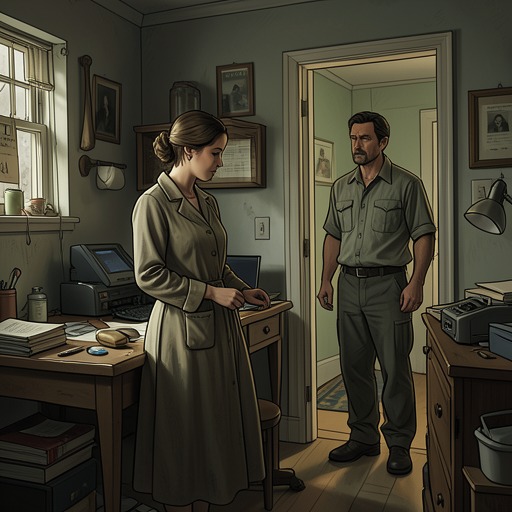
Jake Von Riesen
All My Puny SorrowsJake Von Riesen is a quiet, studious Mennonite husband and father whose wish to be a good Christian leaves him vulnerable to the authority of East Village. He builds a home for his young family, then loses it under commercial and communal pressure; later, his death by suicide reveals how much grief and inherited history have accumulated behind his reserved manner. Through Jake, the family’s private losses meet the public demands of property, religious conformity, and silence.
Identity and Background
Jake built the family’s first house himself when he and Lottie were barely twenty. Their early married life had been energetic and unconventional: on hot evenings, after his teaching and her baking, they ran through the sprinkler in their front yard, to the dismay of more conservative neighbours. The memory, later described by Elfrieda as their La Dolce Vita moment, suggests a young couple capable of delight even within a community attentive to propriety. Jake’s care for the house likewise had a personal dimension: it was built with loving attention to its details, including a long covered porch where the family could watch electrical storms while staying dry.
In East Village, however, Jake is regarded as an oddball: quiet, depressive, studious, and given to ten-mile walks in the countryside. He believes reading, writing, and reason can lead toward paradise. Those commitments set him apart in a community where religious devotion and commercial success have become closely associated, and where dissent can be interpreted as a failure of faith. His reserve does not mean that he lacks convictions; rather, his intellectual and personal values coexist uneasily with a strong desire to remain a good Christian.
The House and the Pressure to Yield
In the summer of 1979, Jake’s first house is taken away on the back of a truck. The family watches it travel down First Street and out toward the highway. When Yolandi asks where it is going, Jake shades his eyes and says that he does not know. He remains looking at the empty place for so long that Lottie eventually honks the car horn softly to bring his attention back to the family waiting for him. The pause makes the loss more than a property transaction: the house he built has disappeared, and he cannot yet turn away from its absence.
The car dealer next door wants the property to expand a parking lot. After persistent pressure and threats, Jake gives in and sells it for very little. The dealer later presents the sale as merely business, but the circumstances make clear why Jake feels no simple freedom to refuse. In East Village, commerce and piety have become intertwined; the implication is that resisting a prosperous neighbour may also mean failing to act as a good Christian. Jake fears that holding on to what is already his could itself be sinful. His parents move into a similar new house, but it is not the home he constructed with such attention, and Jake can see the vacant site across the highway from his lawn chair.
Lottie urges him to fight the sale, while Elfrieda tries to organize a petition against businesses expanding into people’s homes. Neither effort relieves his persistent guilt. Lottie’s support also has limits: she is a loyal Mennonite wife who does not want to overturn domestic hierarchy, and her objections are easily overlooked. The family’s attempts to defend Jake expose how communal pressure works not only through the car dealer, but through religious expectations and the gendered limits on who is heard.
Religious Authority and Elfrieda’s Music
The conflict over Jake’s home belongs to a wider pattern of scrutiny. After Elfrieda begins making her mark around town, the bishop arrives with a convoy of elders for what he calls a visit. Jake ushers the men into the living room and stands among them, visibly panicked, while Lottie remains in the kitchen rather than serving them. She has urged Jake to tell the elders that their visit is inconvenient; he has said he cannot do so. Their disagreement shows his difficulty in setting a boundary even within his own home.
This visit concerns Elfrieda’s plan to study music at university. She is fifteen, and the elders are suspicious of higher education, particularly for girls. One warns Jake that she will get ideas; he can only nod. The scene places him between a daughter’s ambitions and a religious authority he has not learned to challenge directly. The family has already hidden a piano from the community because instruments are prohibited in town. Jake and Lottie let Elfrieda study with a teacher from Winnipeg after a doctor recommends a creative outlet, and the parents eventually come to love her playing. When the elders discover the piano, Jake offers to accept excommunication, but the elders relent on condition that the instrument be used only for the Lord.
During the visit, Elfrieda plays Rachmaninoff’s Prelude in G Minor, Op. 23. The elders fall silent; Lottie begins to hum and sway, and the music fills the house. For Jake, the performance is inseparable from a turning point in his daughter’s life: she takes control through her playing, while the family’s concealed attachment to music becomes impossible to reduce to the elders’ conditions. The scene also sharpens Jake’s position. He has allowed his daughter room to pursue her gift, yet he remains unable to answer the men who question that choice.
Inherited History and Ending
Jake’s hesitation has a history older than the local disputes. His parents came from a Mennonite village in Siberia, amid the violence of the Bolshevik Revolution. His father survived the murder of his own parents by hiding in a manure pile, then was transported with thousands of other Mennonites to Moscow and sent to Canada. He warned Jake and Lottie not to teach their children Plautdietsch if they wanted them to survive. The language carries shame and silence across generations; the family’s pain is not confined to the people who first endured it. Lottie later learns, in her university training as a therapist, that suffering can pass from one generation to another.
That history helps frame Jake’s alarm when Elfrieda mentions that she might travel to Russia while in Europe. Even the slightest mention of Russia makes her parents react with distress. The family’s silence is protective in intention, but it also leaves the past active in the present, shaping what can be said and where a daughter may go. Jake’s wish to conform and his fear of inherited danger thus belong to the same family history: both press him toward silence, even when his children’s lives are opening beyond the community.
The novel later recalls that, in the days before Jake knelt in the path of a fast-moving train and died by suicide, Yolandi repeatedly hummed a reassuring refrain to herself as she fell asleep. The recollection connects his death to the family’s continuing effort to find words and comfort in the face of distress, without making that effort sufficient to prevent the loss. Jake’s trajectory—from building a home to watching it disappear, from sheltering a piano to standing before the elders, and finally to his death—makes him a quiet center of the family’s grief. His life shows how private despair can remain largely unspoken even while its pressures are visible in the choices a family is allowed, or unable, to make.