Mennonite religious morality and mental illness
All My Puny SorrowsMennonite religious morality and mental illness is a recurring conflict in the Von Riesen family’s history: a local religious order demands conformity, while family members try to understand and respond to psychological suffering. The novel traces how that conflict shapes Elfrieda’s artistic independence and suicidal despair, Lottie’s later work as a therapist, and Yolandi’s painful efforts to protect her sister without dismissing her wishes. Its account is rooted in the specific East Village Mennonite community and family, rather than presenting their experience as a description of all Mennonites.
Communal Authority and Gender
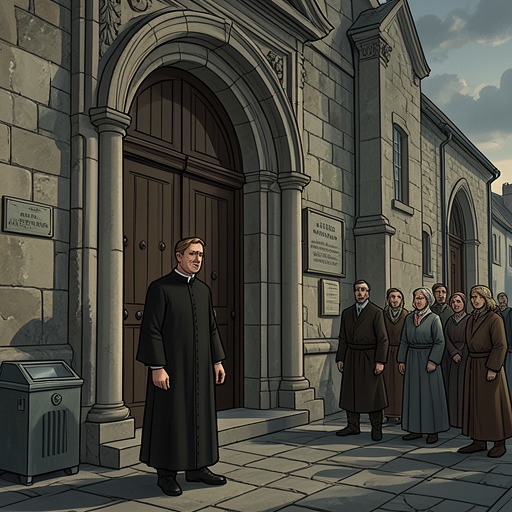
In East Village, church authority reaches into education, music, dress, and family life. When Elfrieda is fifteen, the bishop arrives at the Von Riesen home with a group of elders after hearing that she hopes to study music at university. The visit is presented as an intimidating exercise of authority, not a casual pastoral call. The elders are especially suspicious of higher education for girls, and the prospect that Elfrieda might leave the community makes her plans a matter of communal concern. Their objection makes education more than a personal ambition: it threatens the expectation that young women will remain within established boundaries.
That pressure operates alongside specific rules and judgments. Pianos are technically forbidden in the town because they are associated with worldly pleasure. The family has nevertheless kept one for Elfrieda, initially following a city doctor’s recommendation that she have a creative outlet. When the elders discover the instrument, they consider disciplining Jake but ultimately allow it to remain on condition that Elfrieda use it only for religious purposes. The compromise permits music while placing the terms of its legitimacy in the elders’ hands.
The restrictions are gendered but do not eliminate resistance. At the gathering in the family home, Elfrieda plays Rachmaninoff while the elders are present. The performance turns an instrument tolerated under conditions into a means of self-expression before the very people who have come to question her future. Her success in school and her plans to continue her education intensify the community’s unease. Later, she completes high school early, wins six scholarships, and receives a Governor General of Canada prize for her marks before leaving to study and perform in Europe.
Historical Memory and Silence
The novel connects the family’s present religious culture to a history of persecution and displacement. The Von Riesen grandparents came from a Mennonite village in Siberia in 1917, amid the upheaval of the Bolshevik Revolution. The family’s inherited account includes the murder of the grandfather’s parents, his survival by hiding, and his subsequent removal with other Mennonites to Moscow before being sent to Canada. References to Russia provoke alarm in Elfrieda’s parents, suggesting that the past remains emotionally active even when the family avoids discussing it.
Plautdietsch, the language associated with the older generation and the community, is also described as a language of shame. The grandfather warns the parents not to teach it to their children if they want them to survive. Lottie later studies to become a social worker and therapist, and understands suffering as something that can pass between generations. This account complicates any simple division between religion and mental illness: silence may be a way of carrying inherited pain, while the religious practices meant to preserve communal identity can also reinforce the conditions in which pain goes unspoken.
From Communal Discipline to Care
After Elfrieda leaves for Europe, Lottie pursues university study and trains as a therapist. By the time she graduates, the church elders have withdrawn from the Von Riesen women. She converts the spare bedroom into an office, where Mennonites come, often secretly, for help. Therapy carries stigma in the community, yet people seek Lottie’s support in whatever ways they can manage: some pay with food or labor rather than money. Her practice therefore marks a change in the family’s relationship to distress. Where the elders’ response centers on religious discipline and conformity, Lottie makes room for private conversation and practical care.
The need for that care is not abstract. One of Lottie’s clients asks her to keep two bullets so the client will not be tempted to use them against herself or her daughter. The incident presents a form of psychological crisis that reaches beyond the immediate family, while also showing Lottie’s role as a trusted confidante. Her work does not erase the community’s judgment; the secrecy around her clients indicates that seeking help still carries social risk.
That tension resurfaces when a pastor from the family’s former church visits Elfrieda in hospital. He tells her that giving her life to God will remove her pain and that refusing this promise is sinful. Lottie wants Elfrieda to be able to express her anger at the visit, but Elfrieda instead responds by reciting a poem. The contrast is significant: the pastor interprets suffering through religious certainty, while the family’s response recognizes Elfrieda’s distress and her right to answer in her own way. The scene does not suggest that religious belief itself is identical with harm; it shows how a claim of spiritual authority can become dismissive when it promises a cure and treats continued suffering as a moral failure.
Autonomy, Protection, and the Family’s Conflict
The family’s most difficult moral conflict emerges in Elfrieda’s repeated attempts to die and her requests for help ending her life. During one attempt, she stops eating and asks that no doctor be called. Yolandi comes from Toronto and calls an ambulance despite Elfrieda’s pleas. The sisters understand the choice differently: Elfrieda wants control over an unbearable life, while Yolandi believes that keeping her alive remains a responsibility. Their love does not resolve that disagreement; it makes the consequences of each choice harder to bear.
Later, Elfrieda asks Yolandi to take her to Zurich, without telling Lottie or Nic, because she expects them to prevent the trip. Yolandi refuses to promise this, and elsewhere plainly tells Elfrieda she will not take her to Switzerland. The refusal is neither presented as indifference nor as an easy victory for one moral position. Yolandi remains committed to helping her sister, but she cannot accept the requested action as the only remaining form of care. When she later leaves Winnipeg with Lottie for Tina’s funeral, she tells Elfrieda she loves her and will return, while acknowledging that they do not agree about what saving her means. Her intention is to keep searching for other possibilities without denying the seriousness of Elfrieda’s pain.
Narrative Significance
Yolandi’s retrospective anger identifies another dimension of the conflict: inherited trauma may help explain a community’s fear and rigidity, but it does not excuse conduct that makes others feel small or condemned. She recalls religious men threatening and judging her family and insists that the family’s history of persecution cannot justify terrorizing people in the present. The novel thus distinguishes between acknowledging historical suffering and allowing it to become a license for further harm.
Across these episodes, religious morality and mental illness are not treated as separate topics. Communal rules shape which ambitions appear dangerous, which forms of expression are allowed, and whether psychological suffering can be spoken about without shame. At the same time, the family’s choices resist a simple opposition between faith and care: Lottie’s therapeutic work, Elfrieda’s music and poetry, and Yolandi’s conflicted protection all create responses that cannot be reduced to obedience or rejection. The enduring question is how to honor a suffering person’s dignity when the people who love her cannot agree on what help requires.