Rachmaninoff’s Prelude in G Minor, Op. 23
All My Puny SorrowsRachmaninoff’s Prelude in G Minor, Op. 23 is the piece Elfrieda Von Riesen plays while church authorities confront her family about her ambition to study music at university. Performed from another room as the men pressure her father, it transforms the household’s private piano into a forceful answer to the community’s restrictions. The episode marks a turning point: the narrator remembers the music as Elfrieda’s debut as an adult woman and, unknowingly at the time, as a world-class pianist.
A piece prepared in secret
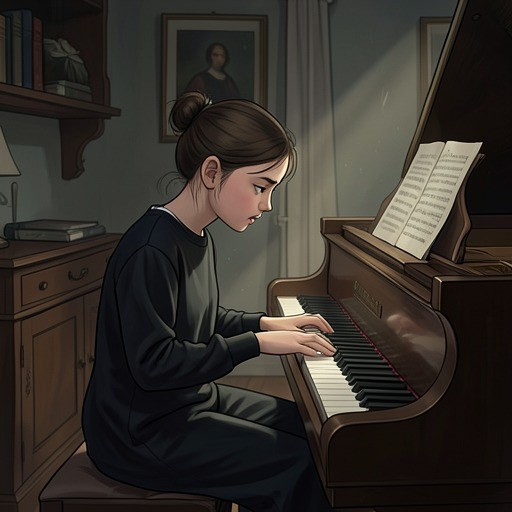
Elfrieda Von Riesen had worked on the prelude for two years with a conservatory teacher who drove from Winnipeg, where Elf and Nic live, to give her lessons twice a week. The family knew its nuances intimately. In the narrator’s account, the music held both agony and ecstasy, and gave form to the unruly movement of an interior life. This extended study makes the performance more than an impulsive display: the piece is the result of sustained discipline, one that Elfrieda could bring to bear at the moment others were trying to determine what her future should be.
The piano itself had entered a household negotiating the rules of the East Village Mennonite community. Pianos were forbidden in town because they were associated with saloons, speakeasies, and unrestrained pleasure. The parents nevertheless brought one into the house after a doctor recommended a creative outlet for Elfrieda’s energy, hoping to prevent her from becoming what the family understood as wild. When the elders visited, the instrument was covered with sheets and gunny sacks. Over time, however, the parents came to love her playing and sometimes requested familiar songs. The piano thus moved from concealed exception to cherished family presence, even as its existence remained a point of contention with the authorities.
The performance during the elders’ visit
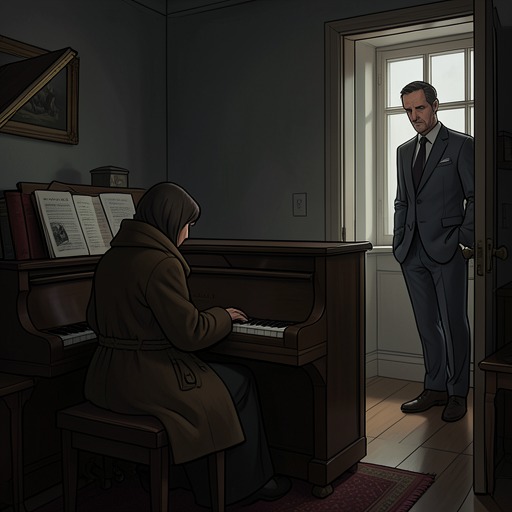
The immediate occasion was a visit from the bishop and church elders. They objected to Elfrieda’s plan to attend university, especially because she was a girl, and warned her father that she would get ideas. While the men spoke in the living room, Elfrieda began playing in the spare bedroom beside the front door, where the piano stood and where much of her life had taken place. Her mother and Yolandi Von Riesen were in the kitchen. The authorities’ conversation stopped as the music grew louder.
The narration makes the performance’s physical and social effects accumulate. Elfrieda plays louder, then quieter, then louder again; her mother hums and sways. The men remain silent, seeming, in the narrator’s description, to have become the ones receiving a reprimand. Even the birds and flies fall quiet in the remembered scene. The stillness does not prove that the elders accepted Elfrieda’s ambitions, but it gives the music an authority the spoken discussion had denied her. The piece occupies the space where her plans were being judged and changes the terms of the encounter without requiring her to enter the living room or argue with the men directly.
A turning point for the family
The narrator later reads the performance as the moment Elfrieda took control of her life. She imagines that the elders must have understood that a young woman capable of expressing such passion and tumult could not remain contained by their community’s expectations. This is explicitly retrospective interpretation, not a certainty about what the men thought. The account also preserves a crucial uncertainty: the narrator is not sure whether Elfrieda knew the bishop and elders were in the living room, or whether she happened to choose that exact moment to play the piece to fierce perfection.
When the prelude ends, the piano top slams shut and the bench scrapes across the linoleum. Elfrieda enters the kitchen, takes the apple-juice jug, drinks the remainder, throws it away, and says she has finally nailed the piece. The elders leave in the order they arrived; their cars start and disappear from the curb. Their departure coincides with the performance, though the narration does not establish that the music alone caused it. The father does not join his family in the kitchen but goes to his study. For the narrator, the scene also marks his loss of the elders’ approval, his authority as head of the household, and, in the larger sense of her interpretation, his daughter, whose freedom makes her dangerous to the community’s order.
The performance in later memory
Yolandi Von Riesen recounts the incident again in conversation with Radek, describing her mother and herself hiding in the kitchen while Elfrieda played in the other room. In this version, the stronger the pressure on her father, the more forcefully Elfrieda seemed to scream through the piano. Yolandi describes the playing as driving the men away through brilliance and rage, and Radek answers with an image of sunlight confronting vampires. When he asks which piece it was, she identifies the prelude by its G-minor key and opus number. The exchange turns a childhood scene into a compact family story: the title remains its precise, recoverable detail, while its emotional meaning is carried by the contrast between the elders’ pressure and Elfrieda’s musical answer.
That later account also places the performance within a larger recollection of resistance and its consequences. Yolandi recalls that Elfrieda burned the church’s revival tent that night, after the church men had visited. The prelude is not the same act, nor does the remembered sequence establish that the music caused what followed. Instead, the retelling links the performance with a wider pattern of defiance, while the original scene remains more ambiguous about Elfrieda’s immediate intention. Across both tellings, the piece matters as something the family had learned to recognize from years of practice and as an event that briefly made the room, the household, and the authority of its music feel larger than the rules imposed upon them.