Yolandi Von Riesen
All My Puny SorrowsYolandi Von Riesen narrates her family’s history from the position of a sister who loves Elfrieda Von Riesen, watches her suffer, and cannot always understand her in the moment. As a child, Yolandi stands between her sister’s private world of music and the public demands of their Mennonite community; as an adult, she acts on her concern even when Elfrieda resists help. Her defining tension is between looking for clues and living with what cannot be resolved: she wants to know what her sister needs, but care repeatedly requires her to remain present without possessing an answer.
Identity and Early Family Life
In a childhood memory, Yolandi sits beside Jake Von Riesen while community authorities question him at home about Elfrieda’s plan to study music at university. At fifteen, Elfrieda is already suspected of wanting to leave the community, and the men regard higher education for girls with hostility. Yolandi absorbs the encounter from the itchy living-room davenport, aware of Jake’s isolation and of Lottie’s deliberate refusal to serve the visitors. When Lottie calls her into the kitchen, Yolandi joins her on the counter and shares apple juice from the plastic jug. The small domestic refuge sits close to the pressure in the living room: Yolandi can hear the mixture of English and Plautdietsch, but she is still a child watching the adults’ conflict rather than directing it.
The piano gives that household tension a sound. While the men are still in the living room, Elfrieda begins Rachmaninoff’s Prelude in G Minor, Op. 23 in the spare bedroom. Yolandi hears the conversation stop and the music grow louder. Her parents had concealed the piano from the elders, despite their growing pleasure in Elfrieda’s playing; for Yolandi, the piece becomes the soundtrack to her sister’s concealed resistance. This scene establishes her as a witness to both the danger Elfrieda faces and the force with which she answers it. Yolandi does not need to explain the authorities’ silence: the interruption of their speech by the music makes the contrast legible.
A Sister’s Names and Ways of Seeing
The sisters’ private language records an intimacy that is also playful and sometimes difficult for Yolandi to understand. Elfrieda calls her Swivelhead because she is often looking around for solid clues about what is happening and not finding them; another nickname, Mayhem, belongs to the same affectionate vocabulary. Yolandi later recalls that Elfrieda learned French very young, sometimes spoke only French, and at other times stopped speaking for long periods, as Jake did. These details present Yolandi’s knowledge of her sister as accumulated observation rather than complete explanation: she remembers habits and silences, but the meanings of those silences remain uncertain.
As a child, Yolandi could be embarrassed by Elfrieda’s attempts to remake their town as an Italian village. Elfrieda renamed streets and people, addressed older Mennonite relatives as signor and signora, and offered them espresso and grappa. Others made fun of her, and Yolandi felt the embarrassment too. In conversation with Radek, she can recognize the performance differently: Elfrieda was creating excitement and trying to be funny and sophisticated. The retrospective change does not erase Yolandi’s earlier discomfort. It shows her revising her childhood judgment as she comes to see the comedy not merely as eccentricity but as an imaginative refusal of the town’s narrow limits.
Departure and the Promise to Write
Before Elfrieda leaves through airport security, the sisters play one last game of Concentration. During the game, Elfrieda asks Yolandi to write letters and insists that ordinary life is worth writing about even when nothing seems to happen. Yolandi calls her own life boring and agrees only tentatively; Elfrieda grips her arms and makes clear that she is counting on her. The request gives writing a practical place in their relationship: it is not a claim that Yolandi’s life must be extraordinary, but an appeal to keep communicating across distance.
The departure is painful for the family. Jake and Lottie smile bravely and dab their eyes with tissues; Elfrieda turns away at the last moment so Yolandi will not see her crying. Yolandi notices the concealment and thinks of recording it under observations of things meant to be hidden. On the drive home, snow obscures almost everything except the road immediately ahead. She sees the flakes as notes and signatures swirling over a short measure of road, an image that carries music into the family’s uncertain journey home. Before she can stop Lottie from testing the ice with the brake, the car spins out and lands upside down in a ditch. The sequence binds the sisterly farewell to Yolandi’s habit of noticing: she makes a record of what is hidden, even as events outrun her ability to intervene.
Care During Elfrieda’s Crises
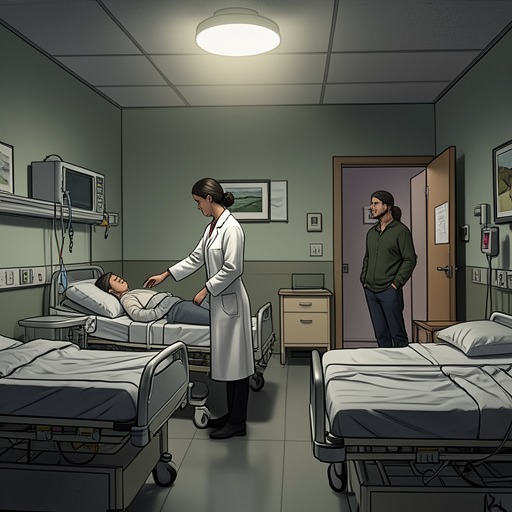
As an adult, Yolandi is a mother of Nora and Will, and her family responsibilities extend across Toronto and Winnipeg. During a hospital visit, Janice asks how she is; Yolandi answers that she is fine but worried. Janice acknowledges the worry while looking toward Elfrieda, who turns away. Yolandi clears her throat until Elfrieda slowly makes eye contact with the nurse. The brief exchange shows Yolandi mediating between her sister and the people caring for her, without pretending that her presence can make the encounter easy. At home, the demands of that separation continue in messages: Nora asks urgently how Elfrieda is, Will sends practical news from Toronto, and Julie asks what wine to bring and sends her love. Yolandi’s care for her sister takes place alongside her ongoing ties to her children and oldest friend.
One earlier crisis brings the limits of family promises into sharper focus. When Lottie tells Yolandi that Elfrieda has stopped eating and is begging her and Nic not to call a doctor, Yolandi travels from the airport directly to her sister’s bedroom. She kneels beside Elfrieda and says she will call a doctor. Elfrieda begs her not to and promises to eat, but Yolandi acts on her own decision rather than treating a promise made under pressure as sufficient. Lottie stays in the dining room with her back to them, unable to support one daughter’s position over the other’s. The scene leaves Yolandi with the difficult role of acting when no family member can make the choice painless: her intervention is an expression of concern, but it also means defying the person she is trying to protect.
Witness, Memory, and the Unanswerable
Yolandi’s questions about Elfrieda’s wish to die are sharpened by the memory of Jake’s suicide. She wonders whether Elfrieda’s despair is an illness, a family inheritance, or something that has coexisted with apparently happy moments; these remain questions, not conclusions. Recalling a book she read after Jake’s death, she turns toward a language of compassion for artists who suffered, but she does not use that language to explain Elfrieda away. Instead, she asks her sister whether she is considering reasons to stay alive or only trying to find an exit. Elfrieda does not answer directly. When Yolandi asks whether opposing forces are at work in her mind, Elfrieda describes the contest as profoundly unequal.
Yolandi then asks whether Elfrieda knows how much she would be missed. Elfrieda looks at her, her eyes filling with tears, but says nothing. Yolandi leaves the room; when Elfrieda calls her back, she turns and asks what is wanted. Elfrieda’s reply shifts attention from her own crisis to Yolandi’s life, insisting that Yolandi is not a slut and that no such category exists. The exchange does not settle the question of how to keep Elfrieda alive. It does reveal the sisterly bond in a form that survives the failure of a direct answer: concern moves both ways, even in a conversation organized around one sister’s danger.
Yolandi’s narration makes that imperfect witnessing central to her character. She records gestures, nicknames, silences, practical messages, and acts of concealment, then returns to them with changed understanding. Her earlier search for clues never becomes mastery over Elfrieda’s inner life; instead, it becomes a discipline of attention. The promise to write, the decision to call for help, and the question about how much she will be missed are distinct acts of connection. Together they show Yolandi trying to remain answerable to her sister without claiming that love can explain or cure her suffering.